
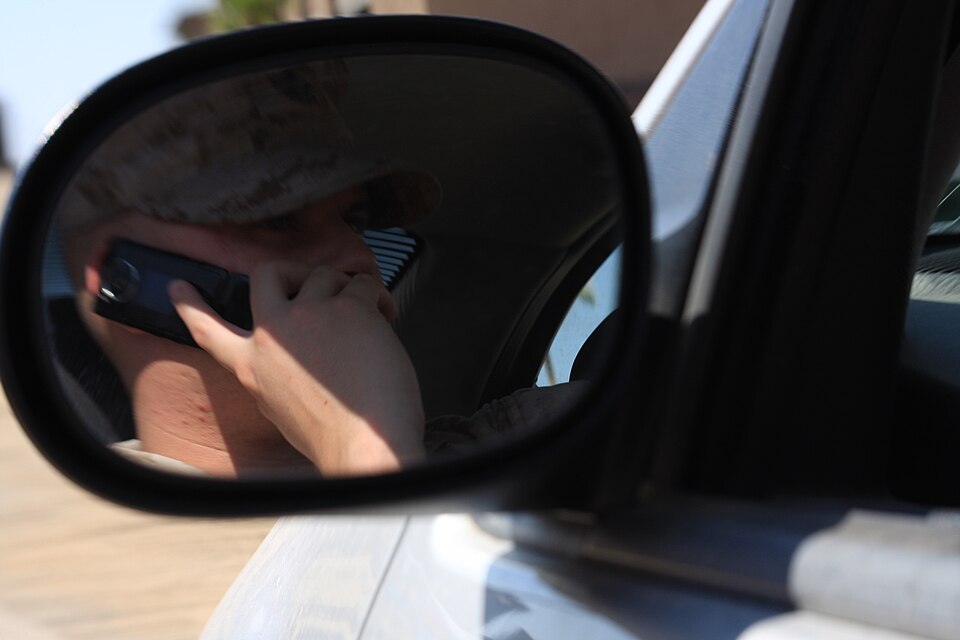
Photo: U.S. Marine Corps, public domain, via Wikimedia Commons
Texting while driving is banned for all drivers in 49 states and DC. Holding your phone at all while driving is banned in 33 states and DC. Many states go further for teens: drivers under 18, or on a permit or intermediate license, often cannot use a phone at all, even hands-free. This page gives the rule in each state and how the teen bans work.
Key facts (GHSA state law summary, updated October 2025)
- Hand-held phone-ban coverage and enforcement vary by state. Colorado has an additional officer-observation condition: a citation under its device ban requires observed use that caused careless and imprudent driving. Check the dated state source rather than assuming “primary” describes every condition.
- Texting ban for all drivers: 49 states plus DC. Montana is the only state without one.
- All-phone ban for novice drivers (hands-free included): many states have one, but the rules differ on who counts as a novice. Check your state’s row in the table below.
- “Primary” means police can stop you for the phone offense alone. “Secondary” means they need another reason to stop you first.
- Laws change often. Several states added hand-held bans in 2025, including Pennsylvania (June 5, 2025), Iowa (July 1, 2025) and South Carolina (September 1, 2025).
Phone and texting laws by state
“Novice ban” means no phone use at all, hands-free included, for the drivers listed. Where a state has no novice ban, teens still follow the all-driver rules.
| State | Hand-held ban (all drivers) | Novice all-phone ban | Texting ban (all drivers) |
|---|---|---|---|
| Alabama | Yes (secondary) | Age 16, or 17 with an intermediate license held under 6 months | Yes |
| Alaska | No | No | Yes |
| Arizona | Yes | Permit and intermediate holders under 18 (secondary) | Yes |
| Arkansas | School and work zones only | Under 18: no phone use at all; 18 to 20: hands-free only | Yes |
| California | Yes | Under 18 (secondary) | Yes |
| Colorado | Yes (from January 1, 2025); citation requires observed device use causing careless and imprudent driving | Not in the re-enacted statute; DMV guidance still says under 18 | Yes |
| Connecticut | Yes | Under 18 | Yes |
| Delaware | Yes | Learner and intermediate holders | Yes |
| District of Columbia | Yes | Learner’s permit holders | Yes |
| Florida | School and work zones only | No | Yes |
| Georgia | Yes | No | Yes |
| Hawaii | Yes | Under 18 | Yes |
| Idaho | Yes | No | Yes |
| Illinois | Yes | Under 19 | Yes |
| Indiana | Yes | Under 21 | Yes |
| Iowa | Yes (from July 1, 2025) | No separate teen ban since July 1, 2025 (the state manual has not yet been updated) | Yes |
| Kansas | No | Learner and intermediate holders | Yes |
| Kentucky | No | Under 18 | Yes |
| Louisiana | School and highway construction zones (primary); secondary elsewhere | Yes (secondary outside school and construction zones) | Yes |
| Maine | Yes | Under 18 and permit holders | Yes |
| Maryland | Yes | Under 18 | Yes |
| Massachusetts | Yes | Under 18 | Yes |
| Michigan | Yes | Level 1 and 2: no non-emergency calls, including hands-free (Kelsey’s Law) | Yes |
| Minnesota | Yes | Permit holders under 18 and provisional license holders | Yes |
| Mississippi | No | No | Yes |
| Missouri | Yes (secondary) | No | Yes (secondary) |
| Montana | No | No | No |
| Nebraska | No | Under 18 with a learner or intermediate license (secondary) | Yes (secondary) |
| Nevada | Yes | No | Yes |
| New Hampshire | Yes | Under 18 | Yes |
| New Jersey | Yes | Permit and provisional holders | Yes |
| New Mexico | No | Check with the New Mexico MVD | Yes |
| New York | Yes | No (but see junior license penalties below) | Yes |
| North Carolina | No | Under 18 | Yes |
| North Dakota | No | Under 18, and permit holders of any age | Yes |
| Ohio | Yes | Under 18 | Yes |
| Oklahoma | Learner and intermediate holders only | No | Yes (check with Service Oklahoma whether enforcement is primary or secondary) |
| Oregon | Yes | Under 18 | Yes |
| Pennsylvania | Yes (from June 5, 2025) | No | Yes |
| Rhode Island | Yes | Under 18 | Yes |
| South Carolina | Yes (from September 1, 2025; citations from February 28, 2026) | No | Yes |
| South Dakota | No | Learner and intermediate holders (secondary) | Yes (secondary) |
| Tennessee | Yes | Learner and intermediate holders | Yes |
| Texas | School crossing zones and public school property only | Under 18 | Yes |
| Utah | No | Under 18 | Yes |
| Vermont | Yes | Under 18 | Yes |
| Virginia | Yes | No | Yes |
| Washington | Yes | Learner and intermediate holders | Yes |
| West Virginia | Yes | All drivers under 18 (any license level, including Level 3) | Yes |
| Wisconsin | Work zones only | Learner and intermediate holders | Yes |
| Wyoming | No | No | Yes |
Enforcement labels are a summary: Colorado has the specific officer-observation condition in C.R.S. 42-4-239(6), as noted in its row. Do not infer an unrestricted phone-only citation rule from a “primary” label. This table follows the GHSA summary, which state highway safety offices last reviewed in mid-2025. Check your state’s DMV or highway safety office before relying on it, especially in a state that has passed a new law since then.
What “hands-free” usually allows
Exact wording differs, so read your state’s law. Using California and New York as examples:
- Allowed for adults: calls in hands-free mode. New York defines hands-free as communicating without using either hand.
- Mounting: California says to mount the phone on the windshield, dashboard or center console where it does not block your view, and to use only a single swipe or tap.
- Not allowed: holding the phone to talk, and reading or sending texts or emails. In New York you may hold the phone only to start or end a call.
- Emergencies: calling for emergency help is allowed, including for minors in California.
Teen phone rules: why they are stricter
If your state has a novice ban, hands-free calling, voice texting and Bluetooth do not get you out of it. The only common exception is an emergency call. Two state examples:
- California: a minor may not use a phone or wireless device to answer calls or send or reply to texts while driving, even hands-free. Emergency calls are the exception.
- New York: there is no blanket novice ban, but junior permit, junior license and probationary drivers who use a hand-held phone or text get a 120-day suspension for a first conviction. A later conviction within 6 months of getting the license back means revocation for at least 1 year. Adults face a fine of up to $200 and 5 license points for a first hand-held offense.
State-specific guides: Florida, Georgia, Illinois, Michigan, New York, Pennsylvania, Texas.
Phones and your road test
Some states treat phone use during the road test as an automatic fail. Nevada says so outright. Delaware does not allow phone or music use during the test. Put the phone away and silence it before the examiner gets in. See common reasons people fail the US driving test.
Common questions
Can I use GPS on my phone while driving?
Usually yes, if the phone is mounted and you only tap once to start or stop. Set the route before you move. In a state with a novice all-phone ban, check whether navigation is allowed for teens.
Is it legal to text at a red light?
Treat it as no. Being stopped in traffic is not the same as being parked, and many state laws are written to cover it. Pull over and park first, and check your state’s exact wording.
Can a 16-year-old talk on a hands-free phone?
Not in states with a novice all-phone ban (check your state’s row in the table). Elsewhere, teens follow the adult rules. Exceptions are narrow: in Utah, for example, drivers under 18 may use a device only for a medical emergency, to report a hazard or crime, or to talk to a parent or legal guardian.
Do phone tickets add points?
Often. New York adds 5 points for a hand-held or texting offense. See points systems and license suspensions.
Whose law applies on a road trip?
The law of the state you are driving in. Montana, for example, has no all-driver texting ban, but cities and other states do.
Is a smartwatch covered?
Possibly. Many laws are written for portable electronic devices in general, not only phones. New York’s texting law, for example, covers portable electronic devices such as cell phones and smartphones. Check your state’s wording.
All national guides: learning to drive in the USA. Curfews and passenger limits: US graduated driver licensing compared.
Sources
- Governors Highway Safety Association, “Distracted Driving” state law summary (ghsa.org)
- California DMV, “California Driver’s Handbook, Section 8: Safe Driving” (dmv.ca.gov)
- New York DMV, “Driver’s Manual”, chapters on traffic control, alcohol and other drugs, and keeping your license (dmv.ny.gov)
- Nevada DMV, “Drive Test” information (dmv.nv.gov)
- Delaware DMV, “Delaware Driver Manual” (dmv.de.gov)
- Michigan Secretary of State, “What Every Driver Must Know” (SOS-133)
- Arkansas State Police, “Arkansas Driver License Study Guide” (October 2026)
- Iowa Code section 321.276 and 2025 Iowa Acts chapter 14 (legis.iowa.gov)
- North Dakota DOT, “Class D Operator’s Manual” 2025-2027 (dot.nd.gov)
- West Virginia DMV, “Driver’s Licensing Handbook” (rev. 07/2026)
- Maine BMV, “Maine Driver’s License Manual” (Rev 11/23)
- South Carolina Department of Public Safety, “Hands Free SC” (scdps.sc.gov)
- Utah Driver License Division, “Utah Driver Handbook” 2026