
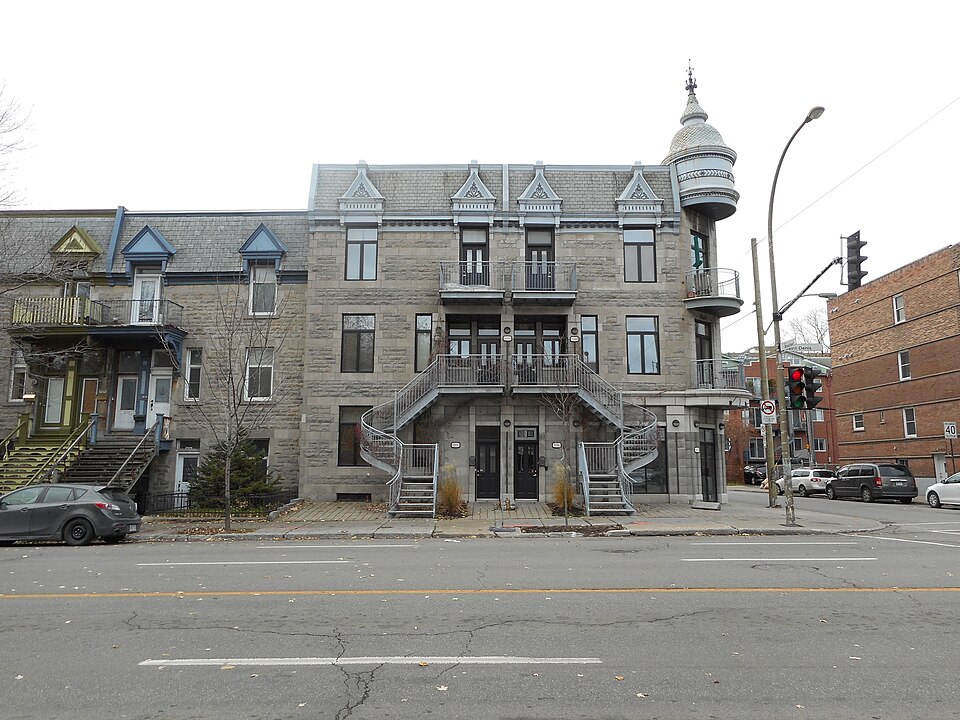
Photo: Jeangagnon, CC BY-SA 3.0, via Wikimedia Commons
Montreal is where many Quebec learners first meet heavy cycling traffic, one-way grids, shared streets and photo radar, and it has its own right-on-red ban. This page sets out the Quebec rules that matter most when you drive in Montreal on a learner’s or probationary licence. Start with the Quebec learner driver guide if you are new to the licensing steps.
The five Montreal rules to know first
- No right turn on red anywhere on the island of Montreal.
- Pass cyclists with at least 1 metre of space at 50 km/h or less, 1.5 metres above 50 km/h.
- Check for cyclists before opening your door.
- On a bicycle route the limit is 30 km/h; on a shared street, 20 km/h with pedestrians having priority.
- Photo radar tickets go to the vehicle owner, with no demerit points.
Right on red: not on the island
Elsewhere in Quebec you may turn right on red after a full stop unless a sign prohibits it. On the island of Montreal it is prohibited everywhere, with signs only at entry points such as bridges and tunnels. Wait for green. Full details: right turn on red in Quebec.
Driving next to bike lanes in Montreal
Quebec recognizes several types of bikeway. Knowing which one you are next to tells you where cyclists will be.
| Bikeway | What it looks like | What it means for you |
|---|---|---|
| Bike lane | Lane along the road with no physical barrier, usually on the right; sometimes bollards | One-way. Cyclists are right beside you, so check your mirror and blind spot before turning right. |
| Contraflow bike lane | On a one-way street, a bike lane running the opposite way, marked by a diamond sign on a red background | Expect cyclists coming toward you on a one-way street. |
| Bike path | Separated from traffic, reserved for cyclists | Where it crosses a road, cyclists do not have the right of way and must obey the signs. |
| Bicycle route | A street signed as a bicycle route | Maximum 30 km/h for vehicles. Cyclists may ride anywhere in the lane, two abreast. |
| Designated roadway | Shared lane, no dedicated space | Normal traffic rules apply. |
Passing a cyclist in Montreal
- Slow down, and stay behind if a vehicle is coming toward you or is in the next lane.
- Keep at least 1 metre in zones of 50 km/h or less, and 1.5 metres in zones over 50 km/h.
- The minimum gap does not apply if the cyclist is behind a raised barrier, such as a curb-protected bikeway.
- You may cross a solid line to give a cyclist room, only when it is safe. Crossing a solid line in other cases can mean 3 demerit points and a fine of $200 to $300.
- On a bicycle route, you may pass within 1 metre if you slow down and have enough space to do it safely.
Opening your door
After parking on a Montreal street, check your mirror and look over your shoulder for oncoming cyclists before opening your door. The SAAQ notes that the Highway Safety Code requires this check.
Shared streets (rues partagées)
A shared street is signed with a pedestrian-priority sign, sometimes with a “Rue partagée” tab under it. On it:
- Maximum 20 km/h.
- Pedestrians may use the whole roadway, walk in any direction and cross anywhere at any time.
- You must give way to pedestrians and cyclists on or crossing the street.
- The 1 metre passing gap does not apply if there is enough room to pass safely.
One-way streets in Montreal
- A prohibited direction sign stops you entering a one-way street the wrong way. Signs are in French: see Quebec road signs in French.
- With several lanes, use the leftmost lane to turn left and the right lane to turn right.
- Watch for contraflow bike lanes: cyclists may legally ride against one-way traffic where a sign allows it.
- Even on a green light, stop before the intersection if you do not have room to cross it completely.
Photo radar and red-light cameras in Montreal
Quebec uses three kinds of device: stationary photo radar at the roadside, mobile units on vans, trailers or tripods, and red-light cameras at signalled intersections (which can also catch speeding). The Government of Quebec publishes device locations by region, including Montreal, and signals devices in advance.
- The device photographs the vehicle and plate; a peace officer reviews every image before a ticket is issued.
- The statement of offence comes by mail, never by email. Ignore any email asking you to pay a photo radar fine.
- No demerit points are added, because the driver is not identified. The vehicle owner is responsible.
- You have 30 days from receiving the statement to plead guilty or not guilty.
A ticket from a police officer is different. Running a red light carries 3 demerit points, and a learner or probationary driver loses the licence at 4 points. See Quebec probationary licence rules.
Winter in the city
From 1 December to 15 March, Quebec-registered vehicles need winter tires. See Quebec winter tire law and, for snow and ice technique, winter driving in Canada for new drivers.
Common questions
Is it hard to learn to drive in Montreal?
It is busier than most of Quebec: more cyclists, pedestrians and one-way streets. Practise first on quieter streets with your accompanying rider, then build up to downtown. See Quebec learner’s licence rules.
Can I turn right on red in Montreal?
No, not anywhere on the island.
Can I stop in a bike lane in Montreal?
Follow the posted signs, and always check the lane for cyclists before turning right across it or pulling in to the curb.
Do photo radar tickets in Quebec give demerit points?
No. They are sent to the vehicle owner with a fine only.
Where are the photo radars in Montreal?
The Government of Quebec lists photo radar locations by region on quebec.ca, and devices are signalled in advance.
What is the speed limit on a Montreal bicycle route?
30 km/h for vehicles. On a shared street it is 20 km/h.
Sources
- Government of Quebec, “Turning right at a red light” (quebec.ca)
- Government of Quebec, “Rules for passing on roads” (quebec.ca)
- Government of Quebec, “Rules for using a bikeway” (quebec.ca)
- Government of Quebec, “Bicycle route rules” (quebec.ca)
- Government of Quebec, “Driving on a shared street” (quebec.ca)
- Government of Quebec, “Manoeuvre at intersections” (quebec.ca)
- Government of Quebec, “Traffic rules for cyclists” (quebec.ca)
- Government of Quebec, “Regulatory signs” (quebec.ca)
- Government of Quebec, “About photo radars” (quebec.ca)
- Government of Quebec, “Offences detected by photo radar devices” (quebec.ca)
- SAAQ, “Let’s all share the road… safely” (saaq.gouv.qc.ca)
- SAAQ, “Demerit Points: Driver’s Licence” (saaq.gouv.qc.ca)