
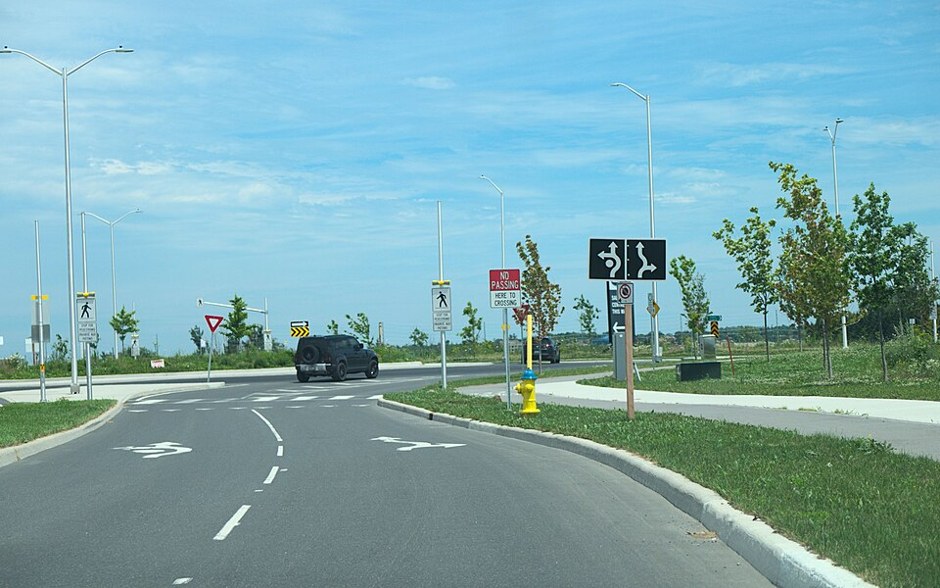
Photo: Lynxano, CC BY 4.0, via Wikimedia Commons
Ontario’s roundabout rule is simple: traffic already in the roundabout has the right-of-way, so you yield at the entrance and go when there is a gap. This guide covers that and the other intersection rules on the G1 test and both road tests: four-way stops, uncontrolled intersections, turns on red, where to stop, and the pedestrian crossover rule that catches many new drivers.
Who goes first? Ontario right-of-way at a glance
| Situation | Rule |
|---|---|
| Four-way stop | The first vehicle to come to a complete stop goes first. If two stop at the same time, the vehicle on the left yields to the one on the right. |
| Uncontrolled intersection (no signs or lights) | If two vehicles arrive at the same time from different roads, the driver on the left yields to the driver on the right. |
| Traffic lights not working | Treat it as an all-way stop. Yield to vehicles already in the intersection and to those entering from your right. |
| Turning left or right | You yield. Left: to oncoming traffic and pedestrians. Right: to pedestrians, and check your blind spot for cyclists. |
| Leaving a driveway or private road | Yield to vehicles on the road and pedestrians on the sidewalk. |
| Roundabout | Yield to traffic already in it. |
| Pedestrian crossover or school crossing with a guard | Stop and wait until people have crossed the whole road. |
Signalling never gives you the right-of-way. Make sure the way is clear first.
Where exactly do you stop?
At a stop sign or red light, come to a complete stop:
- at the stop line, if there is one
- if not, at the crosswalk, marked or unmarked
- if there is no crosswalk, at the edge of the sidewalk
- if there is no sidewalk, at the edge of the intersection
If traffic is backed up through an intersection on a main road, stop before entering and wait until there is room on the other side. This does not apply when you are turning left or right.
How to drive a roundabout in Ontario
Approaching
- Read the signs and choose your exit before you arrive.
- Two-lane roundabout: left lane to turn left or go straight; right lane to turn right or go straight. Never enter from the right lane if you want to turn left.
- Slow down and watch for pedestrians before the yield line.
Entering
- Check vehicles already in the roundabout and those waiting, including cyclists.
- Enter when there is an adequate gap. Do not enter directly beside a vehicle already circulating, because it may leave at the next exit.
- Travel counter-clockwise and keep to the right of the central island.
Inside
- Do not stop except to avoid a collision. You have the right-of-way over entering traffic.
- Do not change lanes.
- Missed your exit from the inside lane? Go around again.
Exiting
- Once you pass the exit before yours, signal right.
- Leave in the same lane position you entered: left lane stays left, right lane stays right.
- From the left lane, watch for vehicles on your right that are still circulating. Watch for pedestrians at the exit.
Trucks, cyclists and emergency vehicles
- Large vehicles may swing wide, use the apron, or take both lanes before entering. Do not ride alongside them.
- Cyclists usually ride in the centre of the lane, or dismount and use the crosswalks.
- Emergency vehicle coming? Do not stop inside. Leave at your intended exit, drive past the traffic island, then pull over to the right.
Pedestrian crossovers: the full-road yield rule
A pedestrian crossover is a marked crossing without traffic lights, usually with signs, ladder-style markings, a “shark teeth” yield line and sometimes overhead flashing lights that pedestrians activate with a button.
At a crossover, a school crossing, or anywhere a crossing guard is working, drivers and cyclists must stop and yield the entire width of the road. You may go only when pedestrians and the guard have crossed and are safely on the sidewalk. It does not matter that the person is on the far side of the road from you.
- Do not pass any vehicle within 30 metres of a pedestrian crossover.
- Penalty for failing to yield at a crossover, crosswalk or school crossing: a fine of up to $1,000 and 4 demerit points (ontario.ca, page dated December 2021). Fines double in Community Safety Zones.
Crosswalks at lights and stop signs
Ordinary crosswalks at signals or stop signs are different. There, you yield to pedestrians in your path, but you only have to wait for the entire road to clear when a school crossing guard is present.
School crossing guards
When a guard shows a red and white stop sign, stop before the crossing and stay stopped until everyone, including the guard, has left the road.
Turning at lights: green arrows and turns on red
- Flashing green or left green arrow with a green light: you may turn left, go straight or turn right from the proper lane. Oncoming traffic faces a red.
- Left green arrow with a red light: turn left from the left-turn lane. A yellow arrow means do not start the turn.
- Right on red: allowed unless a sign forbids it. Stop completely, wait until clear, yield to pedestrians.
- Left on red: only from a one-way road onto a one-way road, after a complete stop.
- Flashing red: treat as a stop sign. Flashing yellow: go through with caution.
- Transit signal (white vertical bar): for buses and streetcars only. Everyone else yields.
If your turn signals or brake lights stop working, use hand and arm signals until they are fixed.
Waiting to turn left? Keep your wheels straight until you can complete the turn. Lane choice for each kind of turn is in the handbook’s “Changing directions” section.
Scenario: the crossover test trap
You are in the right lane of a four-lane road. A pedestrian steps into a crossover from the far curb. You must stop at the yield line and wait until they reach the sidewalk on your side. Driving through once they have passed your lane is a failure to yield.
Common questions
Who goes first at a four-way stop in Ontario?
The first vehicle to stop completely. If two stop at the same time, the one on the left yields to the one on the right.
Do I signal when entering a roundabout?
The handbook asks you to signal your exit. Signal right once you pass the exit before yours.
Can I turn left on a red light in Ontario?
Only from a one-way road onto another one-way road, after a full stop.
What is the difference between a crosswalk and a crossover?
A crosswalk is usually at lights or stop signs. A crossover has no traffic lights and is marked with signs, markings and sometimes flashing lights. At a crossover you wait for the whole road to clear.
Can I stop inside a roundabout to let someone in?
No. Stop only to avoid a collision. Circulating traffic has the right-of-way.
I stopped past the stop line. Should I back up?
No. Ontario’s road-test guidance says not to reverse; wait until it is safe to go.
Related Ontario guides: signs and pavement markings, sharing the road, the G2 road test, school bus rules. Back to learning to drive in Ontario.
Sources
- Government of Ontario, “The Official MTO Driver’s Handbook: Driving through intersections” (ontario.ca)
- Government of Ontario, “The Official MTO Driver’s Handbook: Changing directions” (ontario.ca)
- Government of Ontario, “The Official MTO Driver’s Handbook: Stopping” (ontario.ca)
- Government of Ontario, “The Official MTO Driver’s Handbook: Traffic lights” (ontario.ca)
- Government of Ontario, “The Official MTO Driver’s Handbook: The Level Two road test” (ontario.ca)
- Government of Ontario, “Driving near pedestrian crossovers and school crossings” (ontario.ca)