
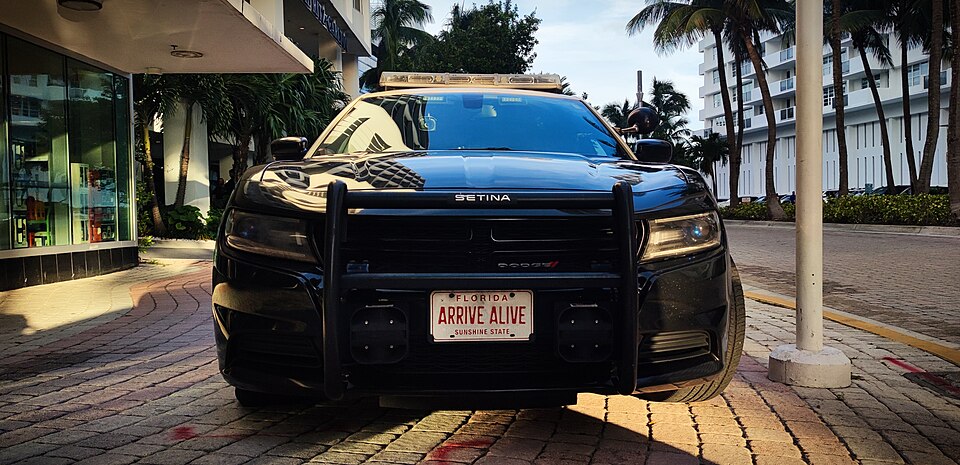
Photo: Elbert Hampton, CC0, via Wikimedia Commons
Every Florida-registered car must carry at least $10,000 of personal injury protection (PIP) and $10,000 of property damage liability (PDL). Florida is a no-fault state: after a crash, your own PIP pays most of your injury costs first, whoever caused it. This guide covers the insurance minimums, what PIP actually pays, the 14 day rule, and exactly what Florida law says you must do at the scene of a crash.
Key facts
- Minimum cover: $10,000 PIP plus $10,000 PDL (ss. 627.733, 627.736 and 324.022).
- PIP pays 80% of medical bills and 60% of lost income, up to $10,000 in total, plus a $5,000 death benefit.
- Get initial medical care within 14 days of the crash or PIP medical benefits do not apply.
- Call police straight away if anyone is hurt or damage looks like $2,000 or more.
- Leaving the scene of an injury crash is a felony, with license revocation of at least 3 years.
What car insurance is required in Florida?
| Coverage | Minimum | Law |
|---|---|---|
| Personal injury protection (PIP) | $10,000 medical and disability, plus $5,000 death benefit | ss. 627.733, 627.736 |
| Property damage liability (PDL) | $10,000 per crash (or a $30,000 combined bodily injury and property damage policy) | s. 324.022 |
Who needs it:
- Every owner or registrant of a motor vehicle that must be registered in Florida, for the whole registration period. For PDL, s. 324.022 defines this as self-propelled vehicles with four or more wheels.
- Nonresidents whose vehicle has been in Florida for more than 90 days in the last 365.
You must show proof of PIP and PDL to register a vehicle (s. 320.02). If you move to Florida and take a job or enroll your children in public school, register your vehicles within 10 days (s. 320.38). For your license, see moving to Florida.
Bodily injury liability is not part of the basic requirement for most drivers. It becomes mandatory at $100,000/$300,000/$50,000 after a DUI conviction (s. 324.023). Read the financial responsibility section below before choosing PIP and PDL only.
What does Florida PIP pay for?
PIP covers you, relatives living in your household, anyone driving your car, your passengers, and pedestrians your car hits (s. 627.736(1)).
| Benefit | What it pays |
|---|---|
| Medical | 80% of reasonable, medically necessary costs |
| Disability | 60% of lost gross income and earning capacity |
| Combined limit | $10,000 for medical and disability together |
| Death | $5,000 per person, on top of the $10,000 |
The 14 day rule
PIP medical benefits only apply if you receive initial services and care within 14 days of the crash. Initial care must come from a hospital, a physician, dentist, chiropractic physician or APRN, or emergency medical transport. Massage therapy and acupuncture are never covered.
The $2,500 limit
The full $10,000 is available for medical care only if a physician, dentist, physician assistant or APRN decides you had an emergency medical condition. Otherwise medical reimbursement is capped at $2,500.
Can you sue the other driver?
Only for pain and suffering if the injury meets the threshold in s. 627.737. That means significant and permanent loss of an important bodily function, permanent injury, significant and permanent scarring or disfigurement, or death.
Florida’s Financial Responsibility Law
This is separate from the PIP and PDL requirement. After a crash that police must report:
- FLHSMV can suspend the license of each driver, and all the owner’s vehicle registrations, 30 days after notice of the crash.
- This does not apply if the driver or owner had an automobile liability policy in force at the time.
- Other exemptions include a legally parked vehicle, a written release from all injured parties, or a security deposit (s. 324.051).
Proof of financial responsibility means $10,000 bodily injury per person, $20,000 per crash and $10,000 property damage (s. 324.021(7)). Drivers with only PIP and PDL can be caught by this, so ask an insurer about bodily injury cover. See car insurance for new drivers.
Proof of insurance and lapses
- Carry proof whenever you drive: a paper or electronic card, the policy or a binder. Show it when an officer asks (s. 316.646).
- Showing an officer your phone does not give them consent to look at anything else on it.
- Insurers report cancellations to FLHSMV. If your PIP or PDL lapses, FLHSMV can suspend your license and registration (s. 324.0221).
- Stopping cover on a car? Turn in its license plate at a driver license or tax collector office before you cancel the insurance, so your license and registration are not suspended.
- Reinstatement fee as of November 2026: $150 the first time, $250 the second and $500 for each later reinstatement within 3 years of the first.
What to do after a crash in Florida
- Stop at the scene or as close as possible, and stay until you have done steps 3 and 4 (ss. 316.027, 316.061).
- Move the car if it blocks traffic and the crash caused only property damage, as long as it is safe. Failing to make a reasonable effort is a nonmoving violation.
- Help anyone injured. Arrange transport to a doctor or hospital if treatment is clearly needed or the person asks (s. 316.062).
- Exchange information. Give your name, address and vehicle registration number to the other driver, the injured person, or whoever is attending damaged property. Show your license if asked.
- Call police immediately if anyone is injured or killed, or damage appears to be $2,000 or more (s. 316.065). Call the city police inside a city, otherwise the county sheriff or the Florida Highway Patrol.
- Give the officer proof of insurance. If you cannot at the scene, providing valid proof within 24 hours may get the citation voided (s. 316.066(1)(d)).
- File your own report within 10 days if the crash damaged a vehicle or property and police did not need to make a report (s. 316.066(1)(e)).
- Get checked by a doctor within 14 days to keep PIP medical benefits.
If you hit a parked car or other unattended property
Stop. Then either find the owner or leave a secure note in a visible place with your name, address and registration number. Notify the police without unnecessary delay (s. 316.063). Driving off is a second degree misdemeanor.
If nobody can take your details
If everyone else is unable to receive the information and no officer is present, report the crash to the nearest police authority yourself.
A general checklist that works in any state is at what to do after a car crash.
Florida hit and run penalties
| Leaving the scene of a crash with | Offense | Maximum penalty |
|---|---|---|
| Property damage only | Second degree misdemeanor | 60 days in jail, $500 fine, 6 points (damage over $50) |
| Injury (not serious) | Third degree felony | 5 years in prison, $5,000 fine |
| Serious bodily injury | Second degree felony | 15 years in prison, $10,000 fine |
| A death | First degree felony | Mandatory minimum 4 years in prison |
Any conviction for leaving an injury or fatal crash means license revocation for at least 3 years. You also need a victim’s impact panel or a vulnerable road user course before reinstatement, and courts must normally order restitution (s. 316.027). Penalty maximums are from ss. 775.082 and 775.083.
Common questions
Is Florida a no-fault state?
Yes. Your own PIP pays your first $10,000 of covered injury costs no matter who caused the crash. You can only sue for pain and suffering if the injury meets the s. 627.737 threshold.
Does Florida require bodily injury liability insurance?
Not for most drivers registering a car. It is required after a DUI conviction. Without it, you risk a financial responsibility suspension after a crash that police must report.
Does a teen with a learner’s license need their own policy?
The legal requirement is on the vehicle’s owner or registrant. Ask your insurer how a learner or new driver in the household must be listed.
Do I have to call the police for a minor crash in Florida?
Only if someone is hurt or killed, or damage appears to be $2,000 or more. Otherwise exchange details, and file your own written report within 10 days if no police report is made.
What if I didn’t go to the doctor within 14 days?
PIP medical benefits do not apply if initial care was not received within 14 days of the crash.
Can I show my insurance card on my phone?
Yes. Florida accepts proof in an electronic format.
Back to the Florida learning to drive guide. Points from a crash are explained in the Florida points system.
Sources
- Florida Legislature, “Florida Statutes s. 627.733, Required security” (leg.state.fl.us)
- Florida Legislature, “Florida Statutes s. 627.736, Required personal injury protection benefits; exclusions; priority; claims” (leg.state.fl.us)
- Florida Legislature, “Florida Statutes s. 627.737, Tort exemption; limitation on right to damages” (leg.state.fl.us)
- Florida Legislature, “Florida Statutes s. 324.022, Financial responsibility for property damage” (leg.state.fl.us)
- Florida Legislature, “Florida Statutes s. 324.021, Definitions; minimum insurance required” (leg.state.fl.us)
- Florida Legislature, “Florida Statutes s. 324.023, Financial responsibility for bodily injury or death” (leg.state.fl.us)
- Florida Legislature, “Florida Statutes s. 324.051, Reports of crashes; suspensions of licenses and registrations” (leg.state.fl.us)
- Florida Legislature, “Florida Statutes s. 324.0221, Reports by insurers to the department; suspension; reinstatement” (leg.state.fl.us)
- Florida Legislature, “Florida Statutes s. 316.646, Security required; proof of security and display thereof” (leg.state.fl.us)
- Florida Legislature, “Florida Statutes ss. 316.027, 316.061, 316.062, 316.063, 316.065 and 316.066, Crashes” (leg.state.fl.us)
- Florida Legislature, “Florida Statutes ss. 320.02 and 320.38, Registration” (leg.state.fl.us)
- Florida Legislature, “Florida Statutes ss. 775.082 and 775.083, Penalties and fines” (leg.state.fl.us)