
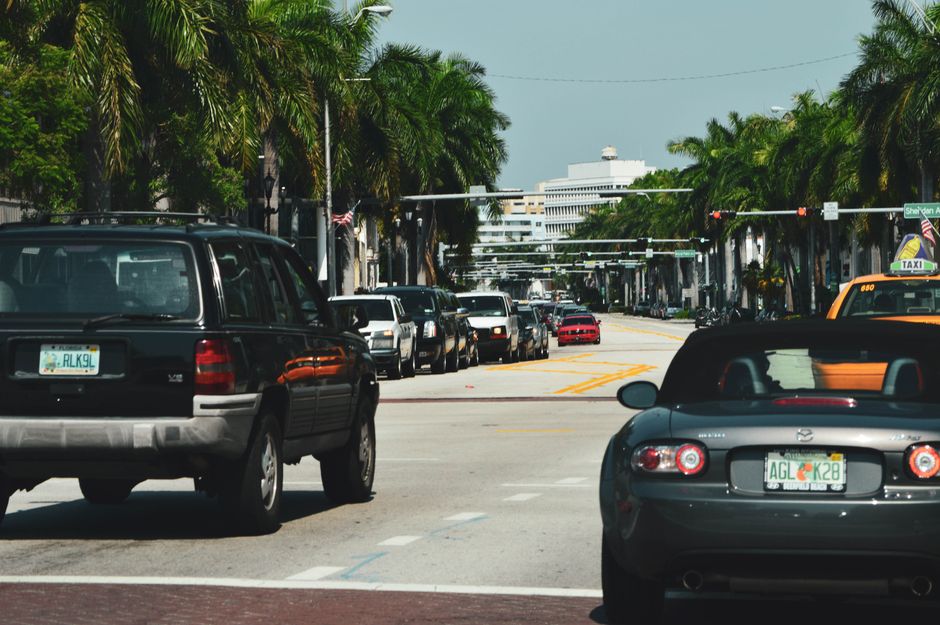
Photo: Caio Cezar, Pexels
This is a free, full-length practice test for the Florida Class E knowledge exam, the test most people call the Florida permit test. The real exam has 50 multiple-choice questions and you need 40 correct (80%) to pass, so this practice set also has 50. Every question is original and unofficial: it tests the same knowledge as the FLHSMV exam, but it is not the real question bank.
Florida permit test format at a glance
| Item | Florida rule |
|---|---|
| Questions | 50 multiple choice |
| Pass mark | 40 correct (80%), so you can miss 10 |
| What it covers | Road signs and Florida traffic laws, including the laws on alcohol and drugs |
| Under 18 | Can take it online through an approved third party administrator |
| 18 and over | Takes it in person |
| Study source | Florida Class E Driver License Handbook |
For what to bring and what a retest costs, see the Florida Class E knowledge test guide.
How to use this practice test
- Cover the answers and work through all 50 questions in one sitting.
- Score yourself. 40 or more is a pass on the real exam’s standard.
- For every miss, read the handbook topic named in the explanation, not just the answer.
- Retake the whole set a few days later. If you can explain why each wrong option is wrong, you are ready.
Part 1: Road signs, signals and markings (questions 1 to 15)
1. A red, eight-sided sign always means:
- A. No entry for trucks
- B. Come to a complete stop
- C. Stop only if other traffic is present
- D. Slow down and yield
Answer: B. The octagon is used only for STOP signs. You stop fully at the stop line, or before the crosswalk if there is no line. Handbook topic: traffic controls, regulatory signs.
2. You see a yellow, diamond-shaped sign. What kind of sign is it?
- A. A warning of a hazard or change ahead
- B. A regulatory sign you must obey
- C. A sign marking a recreation area
- D. A guide sign with directions
Answer: A. Yellow diamonds warn of conditions ahead, such as curves, merges or intersections. Handbook topic: traffic controls, warning signs.
3. A five-sided sign shaped like a house warns you of:
- A. A no passing zone
- B. A school zone or school crossing
- C. A railroad crossing
- D. A hospital zone
Answer: B. The pentagon shape is reserved for school zone and school crossing signs. Handbook topic: traffic controls, sign shapes.
4. A round yellow sign with a black X and two letter Rs means:
- A. Reduced speed ahead
- B. Railroad crossing ahead
- C. Roundabout ahead
- D. Road closed ahead
Answer: B. The round yellow sign is the advance warning for a railroad crossing. Slow down, look and listen. Handbook topic: traffic controls, railroad signs.
5. Orange signs with black letters or symbols are used for:
- A. Work zones and road construction
- B. Toll plazas
- C. Hurricane evacuation routes only
- D. Tourist attractions
Answer: A. Orange marks temporary traffic control in work zones. Expect workers, lane shifts and lower speeds. Handbook topic: traffic controls, work zones.
6. You approach a traffic signal that is flashing red. You must:
- A. Stop completely, then go when it is safe, as at a stop sign
- B. Speed up to clear the intersection
- C. Wait until the light turns green
- D. Slow down and continue if the road looks clear
Answer: A. A flashing red light has the same meaning as a STOP sign. Handbook topic: traffic controls, signals.
7. A steady yellow traffic light means:
- A. The light is about to turn red; stop if you can do so safely
- B. Turn left without yielding
- C. Pedestrians have the right of way only
- D. Speed up before it turns red
Answer: A. Steady yellow warns that red is coming. Stop if you can do so safely; if you are already too close to stop, continue through with care. Handbook topic: traffic controls, signals.
8. A flashing yellow left-turn arrow means you may:
- A. Turn left only after coming to a full stop and waiting for green
- B. Turn left without stopping because you have a protected turn
- C. Not turn left at all
- D. Turn left only after yielding to oncoming traffic and pedestrians
Answer: D. A flashing yellow arrow allows a turn, but oncoming traffic has a green light. Find a safe gap. Handbook topic: traffic controls, turn signals and arrows.
9. A solid yellow line on your side of the center line means:
- A. Passing is not allowed from your side
- B. The road is one way
- C. You may pass if the road ahead is clear
- D. The lane is for buses only
Answer: A. A solid yellow line on your side of the center marks a no passing zone for traffic in your direction. Handbook topic: traffic controls, pavement markings.
10. White lines painted on the road separate:
- A. Parking spaces from bicycle lanes only
- B. Lanes of traffic moving in the same direction
- C. Toll lanes from free lanes only
- D. Traffic moving in opposite directions
Answer: B. Yellow lines separate opposite directions; white lines separate lanes going the same way and mark the right edge of the road. Handbook topic: traffic controls, pavement markings.
11. A red circle with a diagonal slash over a symbol means:
- A. The action shown is not allowed
- B. The action shown is recommended
- C. The action shown is allowed only at night
- D. The road ahead is closed
Answer: A. The slashed red circle means the action pictured, such as a U-turn or a right turn, is prohibited. Handbook topic: traffic controls, regulatory signs.
12. A blue sign along a highway usually shows:
- A. Speed limits
- B. Hazardous cargo routes
- C. Motorist services such as gas, food or lodging
- D. Construction zones
Answer: C. Blue guide signs point to services. Green signs give directions and distances; brown signs mark recreation and cultural sites. Handbook topic: traffic controls, guide signs.
13. A downward-pointing red and white triangle tells you to:
- A. Slow down and give the right of way to traffic and pedestrians, stopping if needed
- B. Stop and wait for a green light
- C. Pass slower vehicles on the right
- D. Merge without looking
Answer: A. The triangle is the YIELD sign. Slow down, stop if necessary, and go only when it is safe. Handbook topic: traffic controls, regulatory signs.
14. The white X-shaped sign at a railroad crossing (a crossbuck) means:
- A. Railroad tracks cross the road here; yield to trains
- B. The crossing is for trains only, not cars
- C. You must stop only if a train is in sight and moving fast
- D. The crossing has been closed permanently
Answer: A. The crossbuck marks the crossing itself. Treat it like a yield sign: trains always have the right of way. Handbook topic: traffic controls, railroad crossings.
15. A traffic officer is directing traffic at an intersection where the signal shows green. You should:
- A. Follow the officer’s directions
- B. Stop and wait for the officer to leave
- C. Follow the signal
- D. Follow whichever you saw first
Answer: A. Directions from a law enforcement officer override signs and signals. Handbook topic: traffic controls, officer directions.
Part 2: Right of way, turns and intersections (questions 16 to 25)
16. Two cars reach a four-way stop at the same time. You are on the left. Who goes first?
- A. Whoever honks first
- B. Whoever is driving faster
- C. You, because you are on the left
- D. The car on your right
Answer: D. When two drivers arrive together, the driver on the left yields to the driver on the right. Otherwise the first to arrive goes first. Handbook topic: right of way.
17. You are turning left at a green light (no arrow). An oncoming car is going straight. You must:
- A. Flash your headlights and turn
- B. Yield to the oncoming car, then turn when there is a safe gap
- C. Wait for the light to turn red, then turn
- D. Turn first because you were waiting
Answer: B. Drivers turning left yield to oncoming traffic going straight or turning right. Handbook topic: right of way, turns.
18. A pedestrian is crossing in a marked crosswalk in front of you as your light turns green. You should:
- A. Drive around them
- B. Go, because you have the green light
- C. Wait until the pedestrian has crossed safely
- D. Honk so they hurry
Answer: C. Pedestrians lawfully in a crosswalk must be given the right of way, even when your light is green. Handbook topic: sharing the road, pedestrians.
19. A pedestrian using a white cane or a guide dog is about to cross. You must:
- A. Continue if your light is green
- B. Always stop and give them the right of way
- C. Yield only if they are in a crosswalk
- D. Sound your horn to warn them
Answer: B. A white cane or guide dog signals a blind or visually impaired pedestrian. Always yield. Handbook topic: sharing the road, pedestrians.
20. You are pulling out of a driveway onto a public road. Who has the right of way?
- A. You do, if you are turning right
- B. Traffic on the road and pedestrians on the sidewalk
- C. Whoever is larger
- D. You do, if you signal
Answer: B. When entering a road from a driveway, alley or parking lot, yield to pedestrians and to all traffic already on the road. Handbook topic: right of way.
21. You hear a siren and see flashing lights coming up behind you on a two-way street. What should you do?
- A. Pull to the left and keep driving
- B. Stop where you are in the lane
- C. Pull to the right edge of the road, clear of any intersection, and stop
- D. Speed up to stay ahead
Answer: C. Florida law requires you to move to the right edge, clear of intersections, and stop until the emergency vehicle has passed. See Florida move over and school bus rules. Handbook topic: sharing the road, emergency vehicles.
22. At a roundabout, which vehicles have the right of way?
- A. Vehicles already in the roundabout
- B. The largest vehicles
- C. Vehicles entering the roundabout
- D. Vehicles turning right
Answer: A. Slow down, yield to traffic already circulating, then enter to the right and travel counterclockwise. Handbook topic: intersections, roundabouts.
23. You want to turn right on a red light. Unless a sign forbids it, you must first:
- A. Signal for 10 seconds
- B. Come to a complete stop and yield to pedestrians and other traffic
- C. Slow down and turn if no one is coming
- D. Wait for a green arrow
Answer: B. Right on red is allowed after a full stop unless a sign prohibits it. You still yield to pedestrians and cross traffic. Handbook topic: turns.
24. To make a right turn, you should start from:
- A. Any lane, as long as you signal
- B. The lane closest to the center line
- C. As close to the right curb or edge as practical
- D. The left lane, swinging wide
Answer: C. Right turns are made from the right lane, close to the curb or edge, into the nearest lane of the new road. Handbook topic: turns.
25. A funeral procession led by an escort vehicle is passing through an intersection while your light is green. In Florida you should:
- A. Honk to signal them to stop
- B. Proceed because you have a green light
- C. Yield and let the procession pass
- D. Drive through gaps between the vehicles
Answer: C. Florida law says you must yield to every vehicle in a funeral procession led by a funeral escort or lead vehicle, whatever the signals say. Do not cut into or through it. Handbook topic: right of way, funeral processions.
Part 3: Speed, space and passing (questions 26 to 30)
26. The posted speed limit is 45 mph, but heavy rain is cutting your visibility. You should drive:
- A. Slower than 45 mph, at a speed that is safe for the conditions
- B. At 45 mph, because that is the limit
- C. Faster, to get out of the rain sooner
- D. With your hazard lights on at 45 mph
Answer: A. A speed limit is the maximum in good conditions. You must always drive at a speed that is safe for the road, weather and traffic. Handbook topic: driving safely, speed.
27. When roads are wet, slippery or busy, your following distance should:
- A. Depend only on the speed limit
- B. Get shorter so others cannot cut in
- C. Get longer
- D. Stay the same
Answer: C. You need more time and distance to stop on wet or slippery roads, so leave a bigger gap. Handbook topic: driving safely, following distance.
28. When another vehicle is passing you, you should:
- A. Move toward the center line
- B. Flash your high beams
- C. Stay in your lane and keep your speed steady or slow slightly
- D. Speed up so they cannot get in front
Answer: C. Help the passing driver by keeping right and not speeding up. Handbook topic: driving safely, passing.
29. Before changing lanes, you should check your mirrors and:
- A. Turn your head to check your blind spot
- B. Nothing else, mirrors are enough
- C. Honk your horn
- D. Brake firmly
Answer: A. Mirrors leave blind spots. A quick look over your shoulder shows whether a vehicle is beside you. Handbook topic: driving safely, lane changes.
30. You may not pass another vehicle when:
- A. You are on a highway with two lanes in your direction
- B. The road ahead is clear and straight
- C. You are approaching the top of a hill or a curve where you cannot see oncoming traffic
- D. The other driver signals you to pass
Answer: C. Never pass where you cannot see far enough ahead to complete the pass safely, such as near hills, curves, intersections or railroad crossings. Handbook topic: driving safely, passing.
Part 4: Sharing the road (questions 31 to 35)
31. You are driving on a two-lane road with no median. A school bus coming toward you stops and shows its stop signal. Under Florida law you must:
- A. Stop only if children are visible
- B. Slow to 20 mph and pass
- C. Keep going, because the bus is on the other side of the road
- D. Stop, and not pass until the stop signal is withdrawn
Answer: D. Under s. 316.172, drivers in both directions stop for a school bus showing its stop signal. Oncoming traffic is exempt only where an unpaved median of at least 5 feet, a raised median or a physical barrier divides the highway. Handbook topic: sharing the road, school buses.
32. On a divided highway with a raised median, a school bus on the other side stops with its stop signal out. In Florida you:
- A. Must pull onto the shoulder
- B. Are not required to stop, but should watch for children
- C. Must stop
- D. Must stop and honk
Answer: B. A raised median, a physical barrier or an unpaved median of at least 5 feet means oncoming traffic does not have to stop (s. 316.172). Traffic behind the bus always stops. Handbook topic: sharing the road, school buses.
33. On a highway with two lanes in your direction, a tow truck with amber lights flashing is working on the right shoulder. Florida’s move over law requires you to:
- A. Move out of the lane closest to the tow truck if you can do so safely
- B. Stop behind the tow truck
- C. Keep your lane and speed
- D. Use your horn as you pass
Answer: A. The Move Over Act covers emergency, sanitation, utility, tow and road maintenance vehicles, and disabled vehicles showing hazard lights. Leave the lane next to them when it is safe. Handbook topic: sharing the road, move over law.
34. You cannot safely change lanes for a police car stopped on the shoulder of a road posted at 55 mph. You must slow to:
- A. 50 mph
- B. 45 mph
- C. 35 mph
- D. 25 mph
Answer: C. If you cannot move over, Florida law says slow to 20 mph below the posted limit (5 mph where the limit is 20 mph or less). 55 minus 20 is 35. Handbook topic: sharing the road, move over law.
35. If you cannot see a truck driver’s face in the truck’s side mirror, then:
- A. The truck driver can see you clearly
- B. You are probably in the truck’s blind spot
- C. The truck is about to stop
- D. You are at a safe following distance
Answer: B. Large trucks have big blind spots, or no-zones, beside, behind and right in front of them. If you cannot see the driver in the mirror, the driver cannot see you. Handbook topic: sharing the road, trucks.
Part 5: Alcohol, drugs and the law (questions 36 to 40)
36. In Florida, a driver under 21 is breaking the law with a blood or breath alcohol level of:
- A. 0.08 or higher only
- B. 0.05 or higher
- C. 0.02 or higher
- D. Any level, but only if they crash
Answer: C. Under s. 322.2616, a driver under 21 with a level of 0.02 or higher has their license suspended for 6 months for a first violation. Handbook topic: alcohol and drugs.
37. A Florida driver under 21 refuses a lawful breath test for the first time. What happens to their license?
- A. A 1-year suspension
- B. Nothing, refusing is a right
- C. A warning letter
- D. A 30-day suspension
Answer: A. Under s. 322.2616, a first refusal brings a 1-year suspension (18 months if there was an earlier refusal suspension). Handbook topic: alcohol and drugs, implied consent.
38. What is the only thing that lowers the alcohol level in your blood?
- A. Black coffee
- B. A cold shower
- C. Eating a large meal
- D. Time
Answer: D. Your body removes alcohol at a steady rate. Coffee, showers and food do not speed this up. Handbook topic: alcohol and drugs.
39. By driving on Florida roads, you have agreed to:
- A. Pay tolls in cash
- B. Take a lawful test of your breath, blood or urine if asked by an officer
- C. Let police search your phone
- D. Carry a spare tire at all times
Answer: B. This is implied consent. Refusing a lawful test leads to license suspension. Handbook topic: alcohol and drugs, implied consent.
40. Which of these can affect your driving as much as alcohol?
- A. Some prescription and over-the-counter medicines
- B. Bottled water
- C. Vitamins
- D. Only illegal drugs
Answer: A. Many legal medicines cause drowsiness or slow reactions. Read the label and ask a pharmacist before driving. Handbook topic: alcohol and drugs.
Part 6: Florida learner’s license, teen and phone rules (questions 41 to 48)
41. For the first 3 months on a Florida learner’s license, you may drive:
- A. Any time with a supervisor
- B. Alone during daylight hours
- C. Until 10 p.m. with any licensed driver
- D. During daylight hours only, with a licensed driver 21 or older beside you
Answer: D. Learners drive only in daylight for the first 3 months, then until 10 p.m., always with a licensed driver aged 21 or over in the front passenger seat. See Florida learner’s license rules. Handbook topic: getting your license, learner’s license.
42. After 3 months on a Florida learner’s license, the latest you may drive (with your supervisor) is:
- A. 9 p.m.
- B. 10 p.m.
- C. 11 p.m.
- D. Midnight
Answer: B. After the first 3 months, learners may drive until 10 p.m. with a licensed driver 21 or over in the front passenger seat. Handbook topic: getting your license, learner’s license.
43. How long must you hold a Florida learner’s license before you can get a Class E license at 16?
- A. 3 months
- B. 6 months
- C. 9 months
- D. 12 months
Answer: D. Under s. 322.05 you need 12 months on the learner’s license with no moving traffic convictions. Handbook topic: getting your license.
44. How many hours of supervised driving must be certified before a Florida teen gets a Class E license?
- A. 30 hours, 5 at night
- B. 40 hours, 6 at night
- C. 50 hours, 10 at night
- D. 65 hours, 10 at night
Answer: C. A parent, guardian or responsible adult certifies at least 50 hours, including 10 at night. Handbook topic: getting your license.
45. A 16-year-old Florida driver with a Class E license is driving alone, not to or from work. During which hours is this not allowed?
- A. 10 p.m. to 5 a.m.
- B. 11 p.m. to 6 a.m.
- C. Midnight to 5 a.m.
- D. 1 a.m. to 5 a.m.
Answer: B. At 16, no driving 11 p.m. to 6 a.m. unless with a licensed driver 21 or over or going to or from work. At 17 the hours are 1 a.m. to 5 a.m. See the Florida teen driving curfew. Handbook topic: getting your license, driving restrictions.
46. A 17-year-old Florida driver may not drive alone (unless going to or from work) between:
- A. 11 p.m. and 6 a.m.
- B. 1 a.m. and 5 a.m.
- C. 10 p.m. and 6 a.m.
- D. Midnight and 6 a.m.
Answer: B. The 17-year-old curfew is 1 a.m. to 5 a.m., unless with a licensed driver 21 or over or driving to or from work (s. 322.16). Handbook topic: getting your license, driving restrictions.
47. In Florida, which of these is illegal while your vehicle is moving?
- A. Receiving a weather alert
- B. Listening to the radio
- C. Manually typing or reading a text message on a handheld phone
- D. Using a phone for navigation
Answer: C. Florida’s Ban on Texting While Driving Law (s. 316.305) bars typing or reading texts, emails and instant messages while driving. Navigation and alerts are allowed. Handbook topic: driving safely, distractions.
48. In a Florida school zone, you may use your phone:
- A. In your hand if no children are present
- B. Only in a hands-free manner
- C. Any way you like if you drive slowly
- D. In your hand for calls only
Answer: B. Section 316.306 bans holding a wireless device at all in school zones, school crossings and active work zones with workers present. Hands-free use is allowed. Handbook topic: driving safely, distractions.
Part 7: Emergencies and bad weather (questions 49 and 50)
49. Your car starts to hydroplane on a wet road. What should you do?
- A. Turn the wheel sharply
- B. Brake hard
- C. Ease your foot off the gas and keep steering straight
- D. Speed up to regain grip
Answer: C. Hydroplaning means your tires are riding on water. Ease off the accelerator, avoid hard braking and steer gently until the tires grip again. Handbook topic: special situations, wet roads.
50. A front tire blows out at speed. Your first action should be to:
- A. Brake hard immediately
- B. Hold the steering wheel firmly and ease off the gas
- C. Steer quickly onto the shoulder
- D. Turn off the engine
Answer: B. Grip the wheel, keep the car straight, avoid hard braking and let the car slow down before you steer smoothly off the road. Handbook topic: emergencies.
How did you score?
| Score | What it means |
|---|---|
| 45 to 50 | Ready. Skim the handbook once more for Florida numbers. |
| 40 to 44 | A pass on the real standard, but with little margin. Reread the topics you missed. |
| 30 to 39 | Not yet. Work through the handbook chapter by chapter, then retake. |
| Under 30 | Start with signs and right of way; those two topics fix the most points fastest. |
Most people lose marks on Florida’s own figures: curfew hours, the learner’s license time limits, the 20 mph move over rule and the 0.02 limit for under 21s. Signs are the easiest points to bank. Drill them with US road signs by shape and color, traffic signals and pavement markings.
Common questions
Are these the real Florida permit test questions?
No. They are original, unofficial practice questions written from the Florida Class E handbook and Florida law. The real exam draws from FLHSMV’s own question bank.
How many questions can you miss on the Florida permit test?
10. You need 40 of the 50 correct.
Is the Florida permit test the same online and in person?
Under 18s can take the knowledge exam online through an approved third party administrator, with a parent or responsible adult monitoring. Adults 18 and over test in person.
What should I study before taking a practice test?
The Florida Class E Driver License Handbook. Practice tests show you gaps; the handbook fills them.
Do I need a course before the Florida permit test?
Under 18s need an approved driver education course before the learner’s license is issued. First-time applicants 18 and over need the TLSAE course.
Where are practice tests for other states?
See US permit practice tests for every state, or go back to learning to drive in Florida.
Sources
- Florida Department of Highway Safety and Motor Vehicles, “Class E Knowledge Exam & Driving Skills Test” (flhsmv.gov)
- Florida Department of Highway Safety and Motor Vehicles, “Florida Class E Driver License Handbook” (flhsmv.gov)
- Florida Legislature, “Florida Statutes s. 322.05, s. 322.16 and s. 322.1615” (leg.state.fl.us)
- Florida Legislature, “Florida Statutes s. 322.2616, Suspension of license; persons under 21 years of age” (leg.state.fl.us)
- Florida Legislature, “Florida Statutes s. 316.172, Traffic to stop for school bus” (leg.state.fl.us)
- Florida Legislature, “Florida Statutes s. 316.126, s. 316.1974, s. 316.305 and s. 316.306” (leg.state.fl.us)