
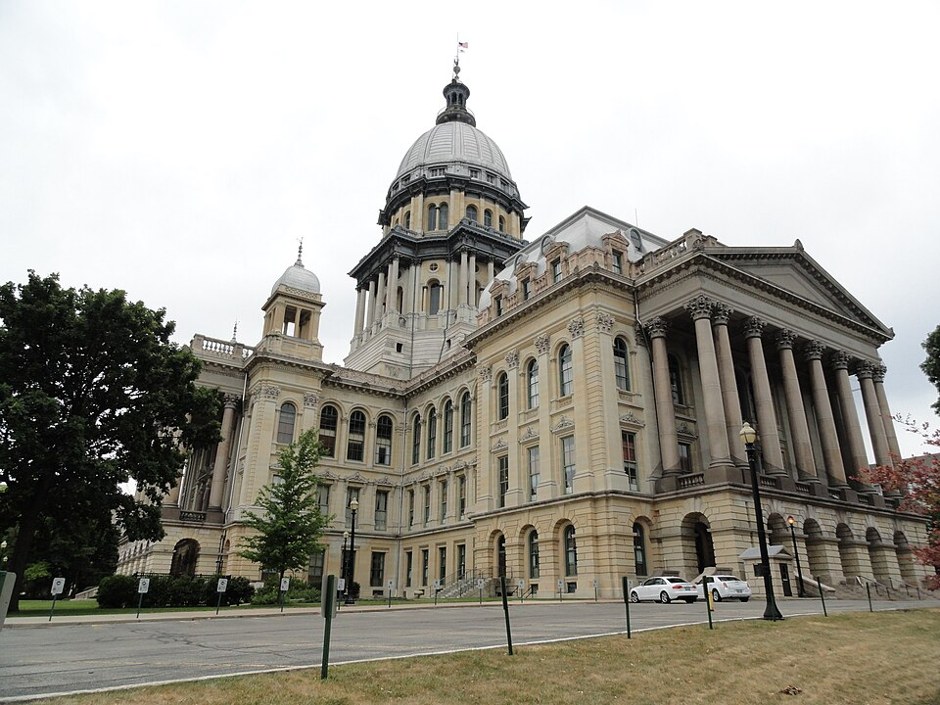
Photo: Meagan Davis, CC BY-SA 3.0, via Wikimedia Commons
Illinois safe driving comes down to a few habits: keep a three-second gap, turn your headlights on from sunset to sunrise and whenever your wipers are on, and know what to do the moment something fails. Your car must also carry the equipment the law lists, from two working brake systems to a horn heard from 200 feet. This guide sets out the Illinois Secretary of State’s rules for safe driving, emergencies and required car equipment.
Key facts (Illinois Secretary of State)
- Three-second following distance on a good road in good weather; at 55 mph that is about 243 feet.
- Headlights on from sunset to sunrise, whenever you cannot see objects 1,000 feet away, and whenever your wipers are on.
- Dim high beams 500 feet before meeting a vehicle and 300 feet before passing one.
- Brakes: from 20 mph, the foot brake must stop you within 30 feet and the parking brake within 55 feet.
- Smoke or fire: pull off, turn off the engine, move away and call 911.
Safe driving rules and emergencies
- Following distance: use the three-second rule on a good road in good weather, and more in anything worse. At 55 mph, three seconds is about 243 feet. Doubling your speed quadruples your stopping distance. If you are tailgated, change lanes or ease off the road.
- Drowsiness: be rested, stop often on long trips, and keep your eyes moving by reading signs and shifting focus.
- Fog: cruise control off, more distance, dim headlights or fog lights, early signals and early braking. If it is too dense, pull off and stop.
- Rain: Illinois law requires headlights when your wipers are on. Slow down to avoid hydroplaning. If you start to skid, release the gas and ride it out. Turn around at any flooded road or viaduct.
- High winds: slow down and correct your steering when moving into the open or meeting trucks and buses.
- Winter: clear all snow and ice before you drive, turn off cruise control, brake gently in slow strokes and approach bridges and shaded spots slowly. Carry a blanket, food and a shovel. If stranded, stay in the car, run the engine only briefly with a window open and keep the tailpipe clear. Snow tires and chains do not make normal speed safe.
- Night and headlights: headlights on from sunset to sunrise and whenever you cannot see objects 1,000 feet away. Dim high beams 500 feet before meeting a vehicle and 300 feet before passing one. Do not outdrive your lights.
- Expressways: match traffic in the speed-change lane, then merge. Do not stop on the expressway; pull off if you have a problem. If you miss an exit, go on to the next one. Exits can be on either side.
- Curves and rural intersections: slow before a curve rather than braking hard in it. Slow and look both ways at any rural intersection, signed or not.
- Vehicle coming at you in your lane: slow down, pull right and sound the horn.
- Skid: ease off the gas or brakes and steer into the direction of the skid until the tires grip, then straighten.
- Wheels off the pavement: grip the wheel, ease off the gas, brake gently, check behind you and steer back gently. Do not jerk the wheel.
- Blowout or lost wheel: ease off the gas, hold the wheel firmly and do not brake suddenly. Then pull off.
- Steering failure: ease off the gas, turn on your flashers and brake very gently. Leave the ignition on so you keep what steering you have.
- Brake failure: pump the pedal. If that fails, use the parking brake and a lower gear.
- Headlight failure: try your flashers, parking lights or turn signals and pull off. If they are only dimming, drive to a service station or pull off.
- Stuck gas pedal: hook your toe under it. If it stays stuck, shift to neutral and brake gently.
- Blocked view: roll down your side window, turn on your flashers and pull off.
- Smoke or fire: pull off, turn off the engine, move away and call 911. Do not fight it yourself.
- Car in water: escape through a window if it has not sunk, because the doors may not open. If it sinks, go to the back seat, where air usually collects, then leave by a rear window.
- Power lines on your car: stay inside until help comes. If fire forces you out, jump clear without touching the car and the ground together, land on both feet, and hop or shuffle 50 feet away.
- Carbon monoxide: symptoms feel like flu, and people asleep in a running car can die without any. Have the exhaust checked every year and never run a car in a garage attached to a house.
- Refueling: engine off, no smoking, and stay with the pump.
- Aggressive drivers: speeding, running lights, tailgating, shoulder passing, cutting off, brake checks, gestures, yelling, and repeated honking or flashing all count. Do not respond or make eye contact. Keep doors locked and windows up, and leave room to pull out from behind the car ahead.
| Stranded on | What to do after pulling as far right as you can |
|---|---|
| A high-capacity road, such as a highway or major urban arterial | Stay in the car with your seat belt on, hazards on, call 911 and wait for a responder |
| A low-capacity road, such as a residential or rural road | If it is necessary and safe, get out on the side away from traffic and move away from the car. If not, stay in, belted. Hazards on and call 911 |
| The Illinois Tollway | Stay in the car with your seat belt on, hazards on, call *999 or 911 and wait for Tollway Maintenance or a responder |
The handbook’s expressway section also says to raise your hood and turn on your flashers, and never to walk along the expressway.
Equipment your Illinois car must have
| Item | Illinois requirement |
|---|---|
| Brakes | Two systems, with brakes on all wheels. From 20 mph, the foot brake must stop you within 30 feet and the parking brake within 55 feet; the parking brake must also hold on a hill |
| Headlights | Two, with no tinted or smoked lenses. On from sunset to sunrise and in rain, snow or fog that needs wipers |
| Taillights and plate light | Two red taillights visible from 500 feet; a white plate light, readable from 50 feet, on when headlights are on |
| Turn signals | Front and rear, visible from 300 feet |
| Parking lights | Front and rear, for a vehicle stopped on a highway at night (some towns allow unlit night parking) |
| Safety belts | Two sets in the front seat. Cars made in 1965 or later may not be sold or driven in Illinois without belts |
| Mirror | A rearview mirror showing at least 200 feet behind |
| Windows | Safety glass; windshield clear of snow, ice, moisture and distorting defects. No tint on the windshield except a 6-inch strip along the top |
| Wipers, horn, muffler | Wipers that clear ice, snow and moisture; a horn heard from 200 feet; a muffler with no cutouts, bypasses or changes that add noise |
| Bumpers and suspension | Front and rear bumpers on vehicles of 9,000 pounds or less. Do not lift the body more than 3 inches above the chassis frame |
Restricted: flashing or moving lights other than signals and hazards; red lights visible from the front; more than one spotlight; backup lights when moving forward; loads 4 feet or more past the rear without a red flag by day or a red light at night; a TV or video screen the driver can see while moving; radar jammers; and studded tires, apart from narrow exceptions such as rural mail carriers from November 15 to April 1. Running board, cowl and fender lights and antique vehicles have their own limits.
Common questions
When must I use headlights in Illinois?
From sunset to sunrise, whenever you cannot see objects 1,000 feet away, and whenever your wipers are on in rain, snow or fog.
What is the three-second rule?
Pick a fixed object and count three seconds after the car ahead passes it. At 55 mph, three seconds is about 243 feet. Use more time in bad weather.
What should I do if my brakes fail?
Pump the pedal. If that fails, use the parking brake and a lower gear.
What should I do if I am stranded on an Illinois highway?
Pull as far right as you can, then stay in the car with your seat belt on and hazards on, call 911 and wait for a responder. On the Illinois Tollway, call *999 or 911.
Can I have tinted headlights in Illinois?
No. Illinois requires two headlights with no tinted or smoked lenses.
Back to the full licensing path in Learning to drive in Illinois: complete guide. Related reading: Illinois Scott’s Law explained for new drivers for stopped emergency vehicles, vehicle emergencies for US drivers and the Illinois road test.
Sources
- Illinois Secretary of State, “2026 Illinois Rules of the Road” (DSD A 112, July 2026), Chapter 11 (safe driving and emergencies) and Chapter 12 (equipment)