
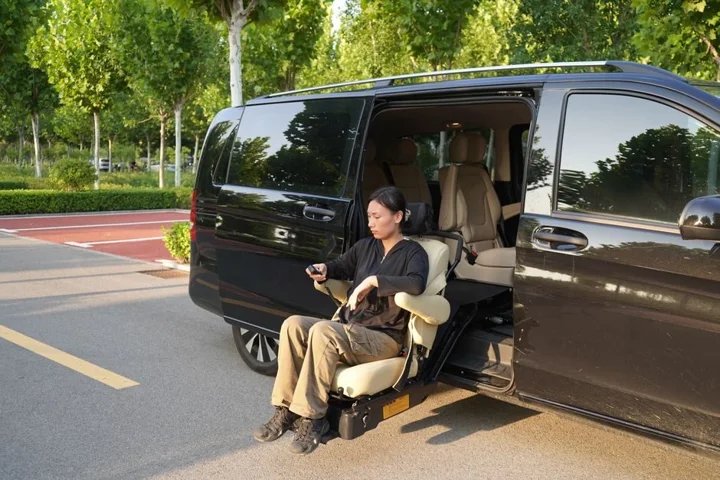
Photo: MingAo WelfareCar / Pexels. Illustrative photograph.
You can learn to drive in Ireland with a disability through the same steps as everyone else: the theory test, a learner permit, 12 Essential Driver Training (EDT) lessons and the driving test. Some steps work differently. You may need a medical report for your permit, your permit or licence may be limited to an adapted car, and you can ask the Road Safety Authority (RSA) for accommodations on test day. This guide covers each stage, plus the tax relief scheme for adapted vehicles.
Key facts
- Some conditions need a medical report (form D501) with your learner permit application, including a physical disability that needs vehicle adaptations.
- Code 100 on a learner permit restricts you to a vehicle adapted to suit your disability.
- If you pass in an adapted car, the adaptation is recorded on your licence.
- Tell the RSA Driver Testing Section in advance, or tick “special accommodations” when booking on MyRoadSafety.
- EDT still applies: all 12 lessons, and six months on your first learner permit, before the test.
- The Revenue tax relief scheme for drivers with disabilities needs a Primary Medical Certificate and an adapted vehicle.
Step 1: the theory test with support
The Driver Theory Test offers an English voiceover, self-service dyslexia support with an on-screen Lexicon, ISL videos, an in-person reader, a recorder if you cannot use a touchscreen, extra time and a separate room. Some are ticked at booking; others need up to 20 business days to arrange through 0818 606 106. Full details: Irish theory test languages and supports.
Step 2: the learner permit and the medical report
When you apply to the National Driver Licence Service (NDLS), the RSA list of specified conditions decides whether you need a medical report from your doctor on form D501. Conditions on the form include:
- a physical disability that needs adaptations to a vehicle for you to drive
- persistent problems with arms or legs that restrict you to an adapted vehicle
The D501 must be submitted within one month of the date of the medical examination. The form also covers eyesight and other medical conditions; see medical and eyesight requirements for an Irish learner permit.
What code 100 means
If code 100 appears on your learner permit, you may only drive a vehicle adapted to suit your disability. That applies to your lessons, your practice and your test car.
Automatic transmission on its own is a different matter. Passing in an automatic gives you an automatic-only licence; see Irish automatic licence code 78.
Step 3: EDT lessons in an adapted car
EDT has no disability exemption. You complete all 12 lessons with an RSA Approved Driving Instructor (ADI), and you cannot be scheduled for your test until your ADI confirms all 12 are done. Questions to ask an instructor before booking:
- Do you have a car with the adaptations I need, or can you teach in my own adapted car?
- Have you taught learners with a similar disability?
- Is the car dual controlled with my adaptations fitted?
Lesson plans: EDT explained and EDT lesson by lesson. Your accompanying driver rules are the same as for any learner: see accompanying a learner driver in Ireland.
Step 4: the driving test with accommodations
| What the RSA does | What you do |
|---|---|
| Makes arrangements so you are not delayed on the day | Notify the Driver Testing Section in advance if you have restricted movement, a disability that could affect your driving, a severe hearing problem, or drive an adapted vehicle. On MyRoadSafety, select “special accommodations”. |
| Gives a little more time to go through the test if you have a disability or are deaf or hard of hearing | Keep normal progress on the road. Extra time does not mean you can drive more slowly than traffic and speed limits allow. |
| Allows an interpreter for the oral part (rules of the road questions) | Bring someone aged 16 or over who is not a driving instructor. They cannot be in the car for the driving part. |
| Tests with code 100 are generally conducted by a supervising tester | Use a test car with your adaptations fitted. |
| Most test centres are wheelchair accessible | Contact your centre before the test to confirm. |
If a disability affects your control of the car during the test, the RSA’s procedures say the test should be stopped. The car must still meet the normal rules on NCT, tax, insurance and L plates: see your car for the Irish driving test.
Tax relief for adapted vehicles: the Drivers and Passengers with Disabilities Scheme
Revenue runs a scheme that gives repayment or remission of VAT and Vehicle Registration Tax on an adapted vehicle, exemption from motor tax for that vehicle, and a fuel grant. Main conditions for a driver, from Revenue’s leaflet revised March 2026:
- You must hold a Primary Medical Certificate, assessed and issued by the Senior Area Medical Officer at your local HSE office. If refused, you can appeal to the Disabled Drivers Medical Board of Appeal.
- You must be severely and permanently disabled and meet at least one of six medical criteria in the legislation, for example being wholly or almost wholly without the use of both legs.
- You must be unable to drive a vehicle unless it is specially adapted. Automatic transmission and other optional extras from the manufacturer do not count as adaptations.
- Leased vehicles do not qualify, and you must keep the vehicle for a minimum period or repay some relief.
| Driver with a disability: level of adaptation | Maximum relief |
|---|---|
| Adapted vehicle | €10,000 |
| More specific adaptations | €16,000 |
| Extensive adaptations | €22,000 |
| Wheelchair accessible vehicle with certain adaptations | €48,000 |
Apply through Revenue’s myAccount. A Department of Finance press release records that a working group has recommended replacing the scheme with a needs-based adaptation grant. No replacement date has been announced, so check the current position with Revenue before you buy a car.
Common questions
Can I learn to drive in Ireland if I have a disability?
Yes. You follow the same theory test, learner permit, EDT and test process. You may need a medical report, an adapted car and test-day accommodations.
Do I get fewer EDT lessons?
No. All 12 EDT lessons apply. Reduced EDT is only for some holders of a foreign licence.
Will my licence say I need an adapted car?
If you pass in a car adapted to suit a disability, for example with additional controls, the adaptation is recorded on your licence.
Can I bring a sign language interpreter to the driving test?
For the oral part only. The interpreter must be 16 or over, must not be a driving instructor, and cannot be in the car while you drive.
Can a learner get the tax relief?
Revenue’s leaflet does not set a licence condition; it is based on the Primary Medical Certificate and an adapted vehicle. Confirm your situation with Revenue before buying.
Who do I contact about test arrangements?
The RSA Driver Testing Section, or use the special accommodations option when booking on MyRoadSafety.
Back to the complete guide to learning to drive in Ireland. See also booking the Irish driving test and how to get a learner permit.
Sources
- Road Safety Authority, “List of conditions that require a medical report” (rsa.ie)
- Road Safety Authority, “Medical report form D501” (rsa.ie)
- Road Safety Authority, “I need special assistance for my test” (rsa.ie)
- Road Safety Authority, “Standard procedures and requirements for conducting driving tests” (rsa.ie)
- Road Safety Authority, “FAQs for car learner drivers” (rsa.ie)
- Theory Test Service, “Test Day Assistance/Support” (theorytest.ie)
- Revenue, “Drivers and Passengers with Disabilities: Tax Relief Scheme (VRT7)” (revenue.ie)
- Department of Finance, “Minister McGrath introduces additional reliefs for wheelchair accessible vehicles under the DDS” (gov.ie)