
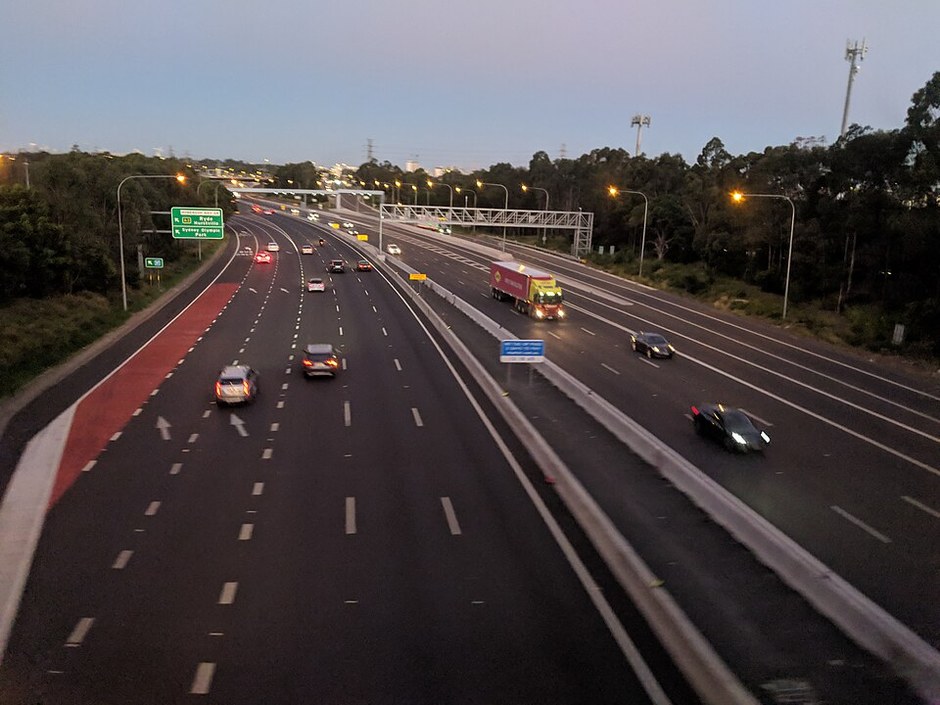
Photo: MDRX, CC BY-SA 4.0, via Wikimedia Commons
The NSW Hazard Perception Test (HPT) is a touch-screen test of 15 video clips that you must pass before the Driving Test. If you are under 25, you can sit it after 10 months on your learner licence; at 25 or older, as soon as you have your Ls. It costs $58 per attempt (from 1 July 2026) and a pass is valid for 15 months. Below: how the test works, the gap and following-distance figures from the official Hazard Perception Handbook, and how to practise.
Key facts
- 2 practice clips, then 15 test clips picked at random from a larger pool.
- Each clip is seen once. You cannot change an answer.
- Under 25: at least 10 months on your learner licence first.
- Valid 15 months: pass the Driving Test inside that time or resit the HPT.
- Fee $58 each attempt (from 1 July 2026). No limit on attempts.
- Available in English, Arabic, Chinese, Croatian, Greek, Korean, Serbian, Spanish, Turkish and Vietnamese, with an audio version in each.
How the NSW HPT works
- Book and pay through Service NSW (online, on 13 22 13 or at a service centre). No service centre in your town? Call 13 22 13 for the nearest test location.
- At the service centre, staff check your licence and eligibility and take you to a touch-screen kiosk or laptop.
- Read the welcome screen and instructions. Ask for headphones if you want the audio version.
- Do the 2 practice clips. You get feedback (good, could be better or unsafe) and can repeat them.
- Do the 15 test clips. Each starts with a 3-second still picture and a description, such as “You are driving along a 2-way street in a 60km/h speed zone. You wish to keep driving straight ahead. Touch the screen when you would slow down.”
- Touch the screen when you would act (slow down, turn, overtake or cross). If acting would be unsafe, do not touch at all.
- Confirm on the next screen whether you touched or not.
- Your result shows at the end, with tips. Ask staff to print it if you want a copy.
A touch registers with a sound and a flash. Touch once only. The dashboard in each clip shows your speed and whether the indicator is on.
What the clips test
The HPT is built on the five crash types that make up almost 80% of NSW casualty crashes and are the most common for P drivers:
- Rear-ending the vehicle in front.
- Colliding with a vehicle from the left or right.
- Colliding with a vehicle from the opposite direction.
- Running off a straight road into an object or parked car.
- Running off a curve into an object or parked car.
It assesses three skills: keeping a safe distance, selecting safe gaps, and identifying hazards.
Most of these crashes happen in daylight, in fine weather, on dry roads in built-up areas. Compared with full licence holders, P drivers crash more often on local streets, in the dark and into roadside objects such as trees and fences. The handbook links this to four habits: following too closely, going too fast for the conditions, not looking far enough ahead, and accepting gaps that are too small when turning, crossing or overtaking. Up to a third of NSW P driver crashes come from choosing too small a gap at an intersection.
The numbers to know: gaps and distances
The Hazard Perception Handbook gives these minimum gaps for a 60 km/h zone. It says they are guides, not hard rules.
| Situation | Minimum gap (60 km/h) |
|---|---|
| Following the vehicle ahead | 3 seconds; more at night and in rain, fog or ice |
| Turning left into traffic | 6 seconds from the right (about 100 m) |
| Turning right | 4 seconds to the right (about 70 m), 6 seconds to the left (about 100 m), 4 seconds to the front if there is oncoming traffic |
| Turning right at traffic lights | 4 seconds from oncoming vehicles (about 70 m) |
| Crossing an intersection | 3 seconds to the right (about 50 m), 4 seconds to the left (about 70 m) |
| Overtaking | Your own passing time plus at least 3 seconds |
| Space to the side | At least 1 metre |
| Someone following you too closely | You cannot control the space behind, so ease off slightly to widen the gap in front and brake more gently if you need to |
| U-turn | A longer gap than a right turn: you start from a standstill on a tight turn and must reach the speed of the traffic you join |
A safe gap is one where no other road user has to slow down or change lanes because of you. In faster zones the gap stays the same in seconds but grows in metres: 6 seconds at 80 km/h is about 135 m.
Scanning routine from the handbook
- Look up to 12 seconds ahead (about 200 m at 60 km/h, 300 m at 90 km/h).
- Check your mirrors every 8 to 10 seconds.
- Head check your blind spots before turning or changing position.
- Look for change and movement, but do not miss stationary hazards such as a parked truck.
- Use See, Think, Do: see the hazard, think about what could happen, do something to stay safe.
- When several hazards appear at once, deal with the main one first.
Important situations covered in the handbook
- Pedestrians, cyclists and motorcyclists: give them plenty of room; listen for motorcycles you cannot yet see.
- Trucks and buses: they hide other road users. A longer following distance lets you see around them.
- Roadworks, crashes and breakdowns: scan early so you can slow and position yourself in time.
- Emergency vehicles: you often hear a siren before you see it.
- Animals: slow down where animal warning signs appear, especially at night on country roads. See kangaroos and wildlife on Australian roads.
Expecting the unexpected
The handbook warns that other road users do not always do what you expect, such as stopping at red lights, giving way at a Give Way sign, or not dashing onto the road. Its advice: scan well ahead, watch other drivers’ heads and eyes, check for people hidden by other vehicles, and slow down to buy time and space. In practice:
| Situation | Response |
|---|---|
| A car is reversing out of a parking space ahead (its brake and reversing lights are on) | Assume the driver has not seen you until you make eye contact. Slow down, move away in your lane and set up the brake |
| A pedestrian on a quiet street steps out without looking | Slow down early wherever people are close to the kerb, and cover the brake |
| Someone may be hidden behind a parked car, truck or bus | Leave a wider gap, ease off and be ready to stop |
| You have a green light, but a driver on the cross street may not stop for their red | Glance left and right as you approach the intersection and cover the brake if a car is coming fast |
When several hazards appear at once, deal with the main, most immediate one first.
How to practise for the HPT
Transport for NSW says the Hazard Perception Handbook is the way to prepare, and that third-party HPT practice websites are not the same as the NSW test. The handbook’s practice method:
- Observe traffic as a pedestrian, for example counting gaps at a busy T-intersection.
- Ride as a passenger with an experienced driver and say when you would go.
- Drive the same situations yourself while your supervisor notes when they would have gone, then compare.
- Do commentary driving: say out loud what you see and what you will do.
Real driving matters most. Plenty of logged hours in different conditions, and the Safer Drivers Course, build the same skills. See the NSW learner log book guide.
Fail, cheat or run out of time
- Fail: pay again and resit when ready. Same-day resits depend on availability.
- Cheating or getting help: you cannot resit for 6 weeks and must pay again.
- Pass expires: if you do not pass the Driving Test within 15 months, you must pass the HPT again.
Next step: the NSW Driving Test. Full overview: learning to drive in NSW.
Common questions
Can I do the NSW HPT before 10 months on my Ls?
Not if you are under 25. The 10-month minimum applies to every under-25 learner. If you are 25 or older, there is no waiting period.
Can I book the Driving Test as soon as I pass the HPT at 10 months?
Not if you are under 25. The HPT opens at 10 months, but the Driving Test needs 12 months on your Ls, 120 logged hours (20 at night) and age 17 or over. At 25 or older, a current HPT pass is the only extra requirement. Passing the HPT does not give you a licence; it only lets you move on to the Driving Test. See the NSW Driving Test for what to bring and the car checks.
How many clips are in the NSW HPT?
15 test clips, after 2 practice clips that do not count.
When exactly should I touch the screen?
When you would really act on the road: as soon as there is a safe gap, or as soon as a hazard means you should slow down. The practice clips rate responses as good, could have been better, or unsafe, so use them to calibrate. If no safe action comes up, do not touch.
What is checked when I arrive?
Staff check your licence details and that you are eligible to sit the test before taking you to the kiosk.
Can I take the HPT in my language?
Yes, in 10 languages with audio. A free interpreter is available for other languages; call 13 22 13. Staff can also read and explain questions for people with additional needs if you arrange it before booking.
Are online HPT practice tests worth it?
Transport for NSW says third-party HPT sites are not connected to it and will not help you pass. Use the official handbook and real driving.
Sources
- NSW Government, “Hazard Perception Test” (nsw.gov.au)
- Transport for NSW, “Hazard Perception Handbook” (nsw.gov.au)
- Transport for NSW, “Road User Handbook” (nsw.gov.au)
- NSW Government, “Licence and test fees” (nsw.gov.au)