
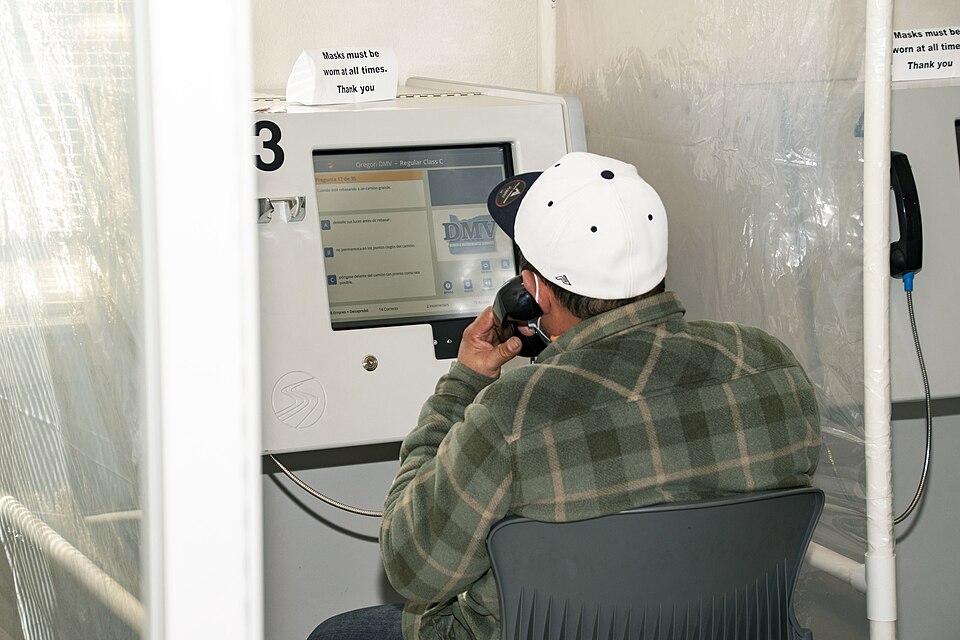
Photo: OregonDOT, CC BY 2.0, via Wikimedia Commons
For your first learner permit in the US, you usually need proof of identity, your Social Security number and proof of where you live. Under 18s also need a parent or guardian’s signature, and many states want a school form too. This checklist covers what almost every state asks for, then the state-specific extras that most often send people home empty-handed.
The core checklist (most states)
- Proof of identity and date of birth. Usually an original or certified US birth certificate, or a valid US passport. Photocopies, hospital certificates and laminated copies are commonly refused.
- Proof of lawful presence, if you are not a US citizen. For example a Permanent Resident Card, or a foreign passport with your visa and immigration documents.
- Social Security number. Some states want the card. Others just record the number and check it with the Social Security Administration.
- Proof of residency, often two documents with your name and home address, such as a utility bill, bank statement or lease.
- Name change proof, if your name is different from your birth certificate (a marriage certificate or court order).
- Parent or guardian consent if you are under 18. Usually they sign the application in person, or on a notarized form.
- School or driver’s ed paperwork, if your state requires it (see the table below).
- The fee. See license costs by state.
What if nothing has your name and address on it?
Most teens don’t have bills in their own name. States usually let you use a parent’s residency documents plus proof of the relationship, such as your birth certificate showing that parent. California and Alabama both describe this option. Check your state’s list for the exact rule.
REAL ID or standard: does it change the documents?
Yes. The federal REAL ID minimum is:
- proof of your full legal name and date of birth
- your Social Security number
- two proofs of address
- proof of lawful status
States can ask for more. Some states issue a standard license with fewer documents. In New Jersey, for example, a standard license needs one proof of address and a REAL ID needs two. REAL ID enforcement began on May 7, 2025, for domestic flights and some federal buildings. You don’t need one to drive. Details: REAL ID and your first US driver’s license.
State extras that catch people out
| State | Extra document for under 18s |
|---|---|
| Alabama | School enrollment or graduation form DL-1/93 (under 19); 2 proofs of principal residence |
| Georgia | Proof of school enrollment; two Georgia residency documents |
| Hawaii | Parental consent from each living parent or legal guardian (Honolulu form CS-L (DL) 239) |
| Idaho | Verification of school compliance, diploma or equivalency certificate; a liability signer |
| Kentucky | School Compliance Verification Form TC 94-200 (No Pass/No Drive) |
| Maryland | Under 16: school attendance record. The MVA cannot issue the permit with more than 10 unexcused absences in the previous semester |
| Mississippi | School attendance form, valid for only 30 days |
| Nevada | DMV 301 school attendance form |
| New Jersey | 6 Points of ID, proof of address and a Social Security number (or ITIN or affidavit) |
| North Carolina | Driver education certificate. The Driving Eligibility Certificate is no longer needed from October 1, 2026 |
| Pennsylvania | DL-180 application with the physical completed by a health care provider |
| Tennessee | Form SF-1010, Certification of Compulsory School Attendance (or diploma or GED) |
| Texas | Verification of Enrollment and Attendance (VOE), valid 30 days (90 days in summer), plus the driver education certificate |
West Virginia also links school attendance to licensing, and Florida law bars a learner’s license for a minor who isn’t meeting school attendance requirements. Check your state’s own page before you book.
State document checklists
For the largest states, use the detailed checklists:
- California permit documents
- Texas permit documents
- Florida permit documents
- New York permit documents
- Pennsylvania permit documents
- Illinois permit documents
- Ohio permit documents
- Georgia permit documents
- North Carolina permit documents
- Michigan permit documents
For every other state, start from its state guide via learning to drive in the USA.
Before you leave home
- Originals or certified copies only, unless your state says otherwise.
- Names match across documents, or you have the name change proof.
- Residency documents are recent enough. Alabama, for example, wants a utility bill under 90 days old.
- School forms are still in date (30 days in Mississippi and Texas).
- Your parent or guardian is coming with you, or the notarized form is signed.
- You’ve booked an appointment if your state needs one. See booking a DMV test appointment.
Common questions
Can I use a photocopy of my birth certificate?
Usually not. States generally want an original or a certified copy from a vital records office. Alabama and Arkansas, for example, refuse photocopies.
Do I need my Social Security card, or just the number?
It depends on the state. Some states verify the number electronically with the Social Security Administration, and DC says no document is needed if the number verifies. Others still ask to see a document showing the number. If you are not eligible for a number, DC and other states accept a letter from the Social Security Administration saying so.
How many proofs of address do I need?
Two is the most common, and it is the REAL ID minimum. Some states take one for a standard card: New Jersey asks for one for a standard license, and Kentucky asks for one (two for REAL ID) when your address has changed.
Does my parent have to come with me?
Under 18, usually yes, or they sign a notarized consent form. Florida, for example, accepts consent signed in front of the examiner or a notary. The adult signing may be taking on legal responsibility for your driving.
I’m homeschooled. What school form do I use?
States with attendance rules usually have a homeschool route. In Kentucky, the school district office completes the compliance form for homeschooled students. Ask your state’s DMV which form applies.
Sources
- Transportation Security Administration, “REAL ID” (tsa.gov)
- California DMV, “REAL ID Checklist” (dmv.ca.gov)
- DC DMV, “REAL ID Proof of Social Security Number” (dmv.dc.gov)
- Alabama Law Enforcement Agency, “Document Requirements and Fees” (alea.gov)
- Georgia DDS, “Class CP Instructional Permit” (dds.georgia.gov)
- Kentucky Transportation Cabinet, “Graduated Driver Licensing Program” (drive.ky.gov)
- Maryland MVA, “Learner’s Permit” (mva.maryland.gov)
- Mississippi Driver Service Bureau, “Mississippi Driver’s Manual” (driverservicebureau.dps.ms.gov)
- Nevada DMV, “Teen Drivers” (dmv.nv.gov)
- New Jersey MVC, “6 Points of ID” and “New Jersey Driver Manual” (nj.gov)
- NCDMV, “Learner Permit” (ncdot.gov)
- PennDOT, “Pennsylvania Driver’s Manual (PUB 95)” (pa.gov)
- Tennessee Department of Safety, “Teen Drivers” (tn.gov)
- Texas Department of Licensing and Regulation, “Verification of Enrollment and Attendance” (tdlr.texas.gov)
- Hawaii Department of Transportation, “Hawaii Driver’s Manual” (2023) (hidot.hawaii.gov)
- Idaho Transportation Department, “Idaho Driver’s Handbook” (July 2026) (itd.idaho.gov)
- Florida Legislature, “Florida Statutes s. 322.091” (leg.state.fl.us)
- Florida Highway Safety and Motor Vehicles, “Class E Knowledge Exam” (flhsmv.gov)
- Arkansas Department of Finance and Administration, “Driver Services” (dfa.arkansas.gov)