
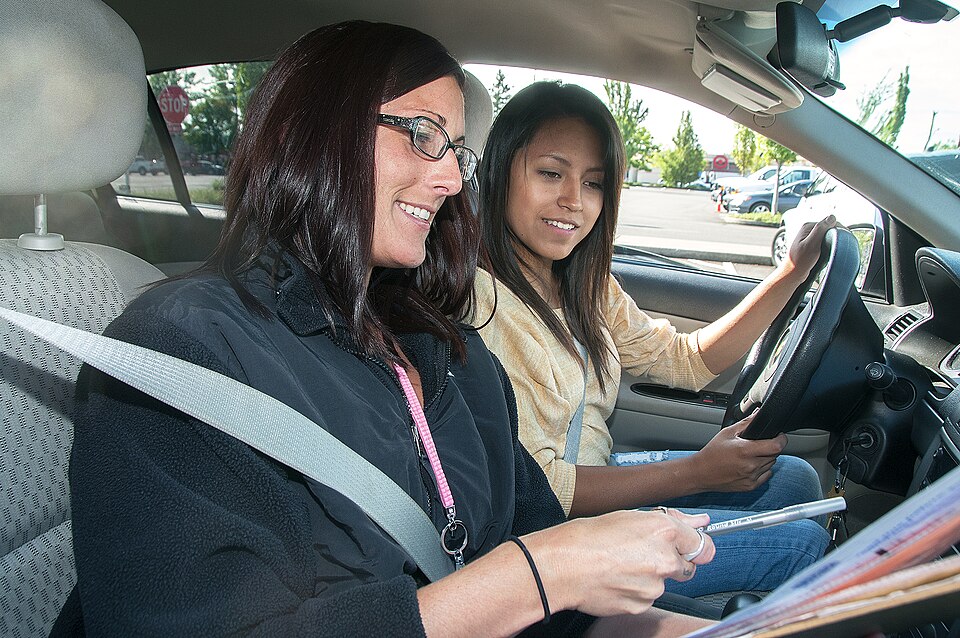
Photo: Oregon Department of Transportation, CC BY 2.0, via Wikimedia Commons
Whether the US road test includes parallel parking depends on the state. Pennsylvania, Georgia, Texas, Massachusetts and New Jersey list it. California, Florida and Ohio test backing, turnarounds or a cone course instead. This page compares the set maneuvers each state publishes, so you know what to practice before test day.
Key facts
- Every state tests general on-road driving: observation, signaling, lane position, speed, stops and right of way.
- The set maneuvers differ: parallel parking, a three-point turn (K-turn), straight-line backing, a quick stop, hill parking or a cone course.
- Several states ban self-parking features on the test, or require them to be switched off. These include Pennsylvania, Ohio, Nevada, North Dakota and New Jersey.
- Many states let approved driving schools or third-party testers give the road test, among them Michigan, Georgia, Florida, Pennsylvania, Idaho, Alaska and DC.
Does the road test have parallel parking? State by state
This table shows only what each state’s official handbook or test page says. Where a row says “check”, ask the state for the current maneuver list.
| State | Parallel parking? | Other set maneuvers the state lists |
|---|---|---|
| Alaska | Yes (parallel parking or a 3-point turn) | Quick stop, backing, turns, lane change |
| California | Not as a separate maneuver | Pre-drive safety check, backing, parking lot driving, intersections, lane changes |
| Connecticut | Check (manual says “backing and/or parking”) | Vehicle controls, turns, right of way, dashboard warning lights |
| Delaware | Yes | Three-point turn, backing 50 feet, merging, intersections, vehicle safety check |
| District of Columbia | Yes | Maneuvers, driving in traffic and turn signals; the manual also describes a turnabout |
| Florida | No | Three-point turn in a 20 to 40 ft space, straight-in parking, parking on a grade, quick stop, backing about 50 ft without mirrors or camera |
| Georgia | Yes (22 ft by 10 ft space) | Backing about 50 ft, three-point turn; pass mark 75% |
| Hawaii | Yes | Business district driving, starting on a slight grade without rolling back |
| Idaho | Check (“stall and curb parking”) | Parking lot, interstate, roundabout and railroad intersections, U-turns; 12 or fewer errors to pass |
| Kansas | Possible (one of the basic control skills; park within 12 inches) | Pre-trip vehicle safety inspection, a basic control skills test (two or more of forward and reverse two-point turnabout, three-point turnabout, left or right parallel park), then a road test with a published automatic-fail list. At 16 and 17, a driver education completion certificate can replace the tests |
| Kentucky | Yes | Vehicle controls check; stops, backing, turnabout, starting and stopping on a hill, intersection approaches, speed, turns, lane use and right of way in normal traffic |
| Maine | Yes | Driving forward and backward, turns, three-point turnaround |
| Maryland | No longer required | Closed course: pull-in parking and back-in parking in a 10 x 20 ft space and a three-point turn in a 16 x 20 ft space, then on-road. The manual still mentions a reverse two-point turn in one place, so confirm with the MVA |
| Massachusetts | Yes | Backing about 50 ft, three-point turn between curbs, hill start |
| Michigan | Off-road basic control skills test (three exercises) | Forward and reverse exercises, then on-road test |
| New Jersey | Yes | Driving in reverse, turning around, stopping, yielding |
| New York | Yes (in the DMV’s scoring guides) | Turns, intersections, backing to the curb, three-point turn |
| North Carolina | Check | Quick stop, three-point turn, backing, approach to a corner |
| North Dakota | Yes | Lane keeping, signaling, obeying signs |
| Ohio | No (cone maneuverability test instead) | Drive forward through a 9 ft by 20 ft cone box, steer around a point cone, reverse back through |
| Pennsylvania | Yes (24 ft by 8 ft space) | Vehicle controls check, then on-road |
| Rhode Island | Yes | Maneuverability test, three-point turnabout, backing |
| Texas | Yes | Straight-line backing, intersections, turns, stops, quick stop. More than 30 points of errors is a fail (DL-7 handbook) |
| Vermont | Yes | Hill start using the parking brake, turning around by reversing into a side street |
| West Virginia | Yes (left or right side) | Forward and reverse two-point turnabouts, three-point turnabout |
Not in the table: for the other states, check the current maneuver list with the state agency. In some (for example South Dakota, Wyoming and Mississippi for under-17s), approved driver education or a supervised-hours affidavit can replace the state road test. In Nebraska only a DMV-approved driver safety course waives the drive test; the 50-hour certification route still needs the vision and drive tests. Check your state guide or the DMV’s road test page.
What the main maneuvers involve
Parallel parking
You reverse into a space alongside the curb, usually between cones or poles. Pennsylvania: the whole car inside a 24 ft by 8 ft space, no touching the uprights, no crossing the line or mounting the curb, one attempt with up to 3 adjustments. Georgia: a 22 ft by 10 ft space, finishing within 18 inches of the curb. Practice guide: New York parallel parking.
Three-point turn (K-turn or turnabout)
Turn the car around in a narrow road using forward, reverse, forward. Florida gives a 20 to 40 ft wide space. Signal, check all around before each move, and do not touch the curb.
Straight-line backing
Reverse about 50 feet in a straight line, slowly, looking over your shoulder. Florida does not allow you to rely on mirrors or the camera. Georgia says under 10 mph.
Cone and closed-course tests
Ohio’s maneuverability test, Michigan’s basic control skills test and Maryland’s closed course happen off the road, before the drive. In Ohio, each cone you hit costs 10 points, and more than 25 points in either part is a fail.
Things that fail you in most states
- Breaking a traffic law, such as running a stop sign or speeding.
- A dangerous action, or the examiner having to take control.
- Hitting a curb, cone or object. Examples: West Virginia, California, Idaho.
- Phone use (Nevada), or a car that fails the pre-test equipment check.
See common reasons people fail the US driving test.
State road test guides
California, Florida, Georgia, Illinois, New Jersey, New York, North Carolina, Pennsylvania parallel parking, Texas, West Virginia, Vermont.
Common questions
Which states do not have parallel parking on the road test?
From official pages: Florida does not, California does not score it as a separate maneuver, and Ohio uses a cone course instead. Other states may change their tests, so check before you book.
Can I use my backup camera?
It depends on the state. California allows a backup camera but not as a substitute for looking. New Jersey allows backup cameras and parking sensors. Florida does not let you rely on the camera for the backing maneuver. Self-parking is generally off limits.
How long is the road test?
Examples: about 15 minutes in New York, 10 to 15 in New Jersey, about 20 in Texas, about 30 in Delaware.
Can I take the road test at a driving school?
In many states, yes. Examples include Michigan (all car skills tests are run by approved testers), Georgia, Florida, Pennsylvania and Idaho.
How soon can I retake it?
Examples: 14 days in New York and New Jersey (and for minors in California), 7 days for under-18s in Pennsylvania, the next day after a first fail in Georgia, and 24 hours in Michigan.
Sources
- California DMV, “Driving Performance Evaluation (DPE) Scoring Criteria” and “The Testing Process” (dmv.ca.gov)
- Florida Department of Highway Safety and Motor Vehicles, “Class E Knowledge Exam and Driving Skills Test” (flhsmv.gov)
- Georgia Department of Driver Services, “Drivers Manual, Section 3” (dds.georgia.gov)
- Pennsylvania Department of Transportation, “Pennsylvania Driver’s Manual (PUB 95)” (penndot.pa.gov)
- Texas Department of Public Safety, “How to Prepare for a Drive Test (DL-60)” (dps.texas.gov)
- New York DMV, “Schedule and Take a Road Test” (dmv.ny.gov)
- New Jersey Motor Vehicle Commission, “Basic Road Test” (nj.gov)
- Massachusetts RMV, “Class D and M Road Test Information Sheet” and “Massachusetts Driver’s Manual” (mass.gov)
- Maryland MVA, “Behind-the-Wheel Tests” (mva.maryland.gov)
- Ohio Department of Public Safety, “Digest of Ohio Motor Vehicle Laws, Section 11” (publicsafety.ohio.gov)
- Michigan Secretary of State, “Driving Skills Test Study Guide” and “Automatic Failures List” (michigan.gov)
- North Carolina, “19A NCAC 03B .0201” and NCDMV “Driver License Tests” (ncdot.gov)
- Driver manuals of Alaska (doa.alaska.gov), Connecticut (portal.ct.gov), Delaware (dmv.de.gov), Hawaii (hidot.hawaii.gov), Idaho (itd.idaho.gov), Kansas (ksrevenue.gov), Kentucky (drive.ky.gov), Maine (maine.gov), Maryland (mva.maryland.gov), Nebraska (dmv.nebraska.gov), North Dakota (dot.nd.gov), Rhode Island (dmv.ri.gov), Vermont (dmv.vermont.gov), West Virginia (transportation.wv.gov) and District of Columbia (dmv.dc.gov)