
Photo: Brett Sayles, Pexels
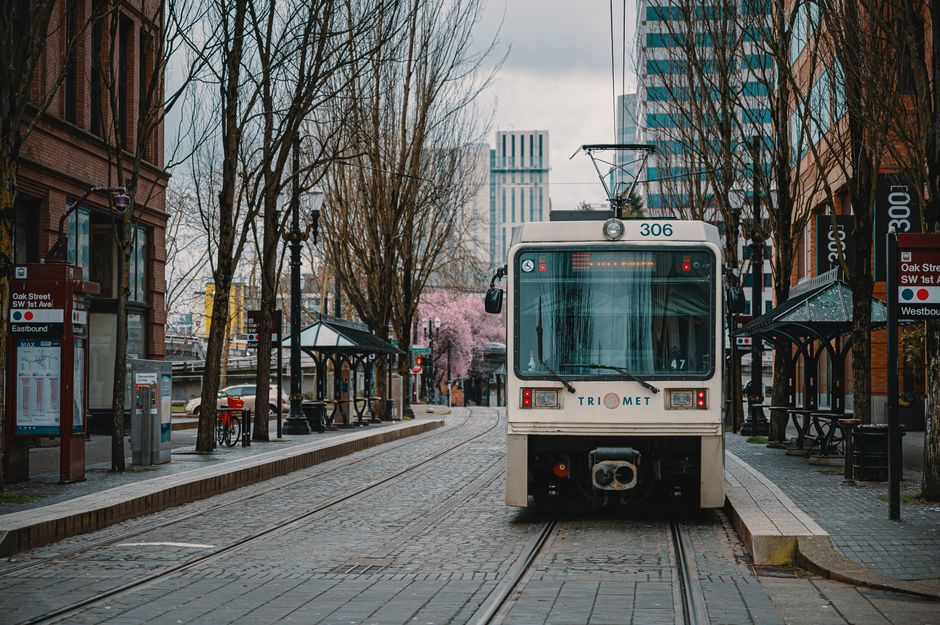
Streetcars and light rail trains run on tracks set into some Oregon streets, often in the same lanes as cars, and they stop often to pick up and drop off passengers. The Oregon Driver Manual has a dedicated section on driving around them, and its rules come up on the knowledge test. This guide is for Oregon learners and new drivers, especially anyone driving downtown.
The core rules
- Let streetcars and trains go first. Do not pass one unless it is safe.
- Stay behind a stopped streetcar or train while passengers get on or off, until it moves or the people are safely away.
- Never turn in front of one. This applies when it is coming toward you, unless it is safe, and when it is in the next lane going your way, even if it is stopped.
- Never block or park on the tracks.
- Don’t brake suddenly or make unpredictable moves near them. They cannot stop quickly.
Turning across tracks
Turns are where drivers most often get into trouble around rail vehicles. Step by step:
- Before you turn, look both ways along the tracks for streetcars or trains, including any coming up behind you in the next lane.
- Signal your turn. In Oregon you signal at least 100 feet before turning when moving in traffic.
- If there is a left turn signal, wait for the proper signal before turning left over the tracks.
- Check for people walking. Riders often run across lanes to catch a streetcar or train.
- Turn only when you are sure it is safe. Never cut in front of a streetcar or train in the lane beside you.
Passing a stopped streetcar or light rail train
The manual’s own sample question asks what to do when passing a stopped streetcar or light rail train. Its answer: watch for pedestrians and pass with caution. Do not keep your speed up. If the vehicle is stopped in your lane for passengers, stay behind it until it moves or the people are clear.
Intersections and lane changes
- When approaching tracks at an intersection, stay behind any stop line until you can cross.
- Slow down and look both ways before you cross tracks at an intersection.
- Follow pedestrian signals and let people cross.
- Check for streetcars and trains before changing lanes. One may be close behind you without you realizing.
Transit-only lanes
Some streets have lanes reserved for transit, marked in red or with signs.
- Solid red lane: transit only, not for cars. It may be marked “BUS ONLY”, “BUS BIKE ONLY” or “LRT” (light rail train).
- Striped red lines: you may enter the transit lane here to turn, park or get into a driveway.
- Signs: “Right Lane Transit Only” signs mean only transit vehicles (and bikes, if shown) may go straight through the intersection. Where a sign allows it, you may briefly use the lane to turn, or to pull over and park where that is allowed. Yield to transit vehicles and people riding bikes, and merge in behind them once they pass.
Not every transit-only lane is red, so read the signs and markings. More on markings in US pavement markings.
Parking near tracks
- Park behind the solid white line that separates the parking area from the track.
- If there is no white line, park as close to the curb as you can, away from the rails.
- Make sure the car is clear of the tracks so a streetcar or train can pass.
- Check for streetcars or trains before opening a door.
- Oregon law bans parking on railroad or light rail tracks. It also bans parking within 50 feet of the nearest rail of a crossing, and within 7 1/2 feet of tracks where it interferes with the train.
Light rail crossings outside the street
Where tracks cross a road at a signed crossing, use the railroad crossing rules:
- Stop when the red lights flash or a stop sign is posted.
- If there is no stop line, stop at least 15 feet from the nearest rail.
- Never drive around or under a gate.
- Never stop on the tracks.
If your car gets stuck on the tracks, get out and away from them. Look for the Emergency Notification System sign posted at the crossing. If a train is coming, move away at a 45 degree angle toward the train, so you are not hit by debris. The national picture is in railroad crossings: what US drivers must do.
If you hit a streetcar or train
Wait for the operator or police to tell you what to do. Then follow Oregon’s normal collision duties: exchange information, and file a DMV report within 72 hours if any of these apply:
- damage is over $2,500
- someone is injured
- someone is killed
See what to do after a car crash.
Common questions
Can I drive on streetcar tracks in Oregon?
Streetcars sometimes share the travel lane with cars, so driving along the lane is normal. You must not stop or park on the tracks, block them, or turn in front of a streetcar.
Do I have to stop behind a streetcar that is loading passengers?
Stay behind it until it moves again or the people are safely away. If you are passing in another lane, watch for pedestrians and pass with caution.
Can I drive in a red lane?
Only where striped red lines or signs allow you to enter briefly to turn, park or reach a driveway. A solid red lane is transit only.
Who has the right of way, me or the light rail train?
The manual says to always let streetcars and trains go first.
How far from the tracks must I stop at a crossing?
At least 15 feet from the nearest rail if there is no stop line.
Where can I learn the rest of Oregon’s rules?
Start with learning to drive in Oregon and the Oregon permit test guide.
Sources
- Oregon DMV, “Oregon Driver Manual: Railroad Crossings, Light Rail and Street Cars” (oregon.gov)
- Oregon DMV, “Oregon Driver Manual: Signs and Traffic Signals” (oregon.gov)
- Oregon DMV, “Oregon Driver Manual: Lane Travel” (oregon.gov)
- Oregon DMV, “Oregon Driver Manual: Turns and Intersections” (oregon.gov)
- Oregon DMV, “Oregon Driver Manual: Parking and Stopping” (oregon.gov)
- Oregon DMV, “Oregon Driver Manual: Other Important Information” (oregon.gov)