
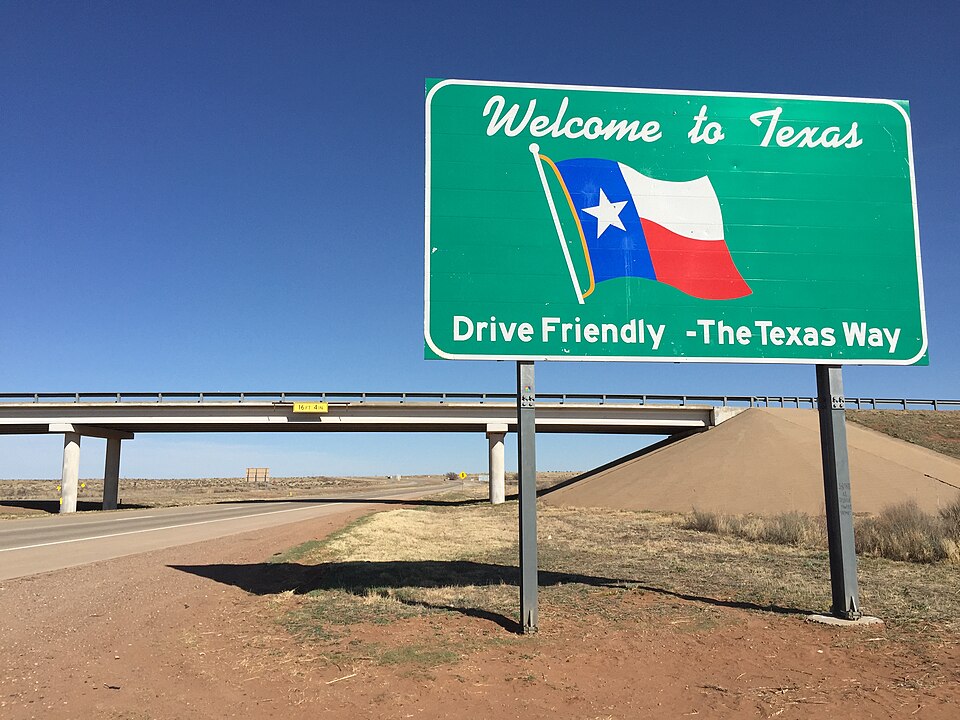
Photo: Famartin, CC BY-SA 4.0, via Wikimedia Commons
This guide is for anyone moving to Texas with a driver’s license from another US state, Canada or another country. As a new Texas resident you can drive on your old license for up to 90 days, and you must register your vehicle within 30 days. Most adults with a valid US or Canadian license swap it without retaking the knowledge or driving tests.
Key deadlines for new Texas residents
| Task | Deadline | Where |
|---|---|---|
| Register your vehicle | Within 30 days of moving | County tax assessor-collector office |
| Get a Texas driver’s license | Within 90 days of moving | Texas Department of Public Safety (DPS) driver license office |
The 90-day rule is in Transportation Code section 521.029. It applies if you are 16 or older and carry the license issued by your previous state or country. If you are stopped after more than 90 days, you have to prove you have not lived in Texas longer than that.
Transferring an out-of-state license to Texas
If you hold a valid license from another US state, a US territory or Canada
- Tests: DPS generally waives the knowledge and driving tests when you surrender a valid license. Texas law lets DPS issue the license after you pass the vision test and pay the fee (section 521.164).
- Class: you get the Texas class that matches your current license.
- Surrender: you hand in your old license.
- Driver education: the Texas rule that under-25s need a driver ed certificate does not apply if you hold a valid license from another state (section 521.1601(b)).
- Expired license: if your old license has expired, you may have to take the tests. Check with DPS before you book.
What to bring
- Your current out-of-state license
- Proof of identity, and proof of US citizenship or lawful presence
- Proof of Texas residency
- Proof of Texas vehicle registration for any vehicle you own (DPS asks for this when you surrender an out-of-state license)
- The fee
DPS sets the exact document list and accepts only certain documents. Check the DPS “Moving to Texas” page before your appointment. See REAL ID and the documents to bring.
Moving to Texas under 18
Teens face extra steps. DPS says every applicant under 18 with a valid out-of-state license must take the Texas driving test. You also need to complete the free Impact Texas Teen Drivers (ITTD) course and bring a printed certificate dated within 90 days of the test. A parent or guardian must come with you to sign.
The DL-7 handbook (January 2026) says a 15 to 17 year old with a valid out-of-state instruction permit and a VOE form is issued a Texas learner license, then holds it for six months. A 16 or 17 year old with a valid out-of-state license gets a provisional license after passing the driving exam.
Driver education hours from another state do not transfer to a Texas course (TDLR). If you are under 18 and still on a permit, you will usually need to enroll in a Texas driver education course. Once licensed, Texas’s under-18 rules apply to you: the passenger limit, the midnight to 5 a.m. limit and the ban on phones. See Texas provisional license rules and ITTD explained.
Moving to Texas with a foreign driver’s license
Texas law lets DPS sign driver license agreements with foreign countries (section 521.0305). DPS lists agreements with France, Germany, South Korea, Taiwan and the United Arab Emirates. If you are 18 or older and hold a valid, unexpired license from one of these countries, DPS can waive the knowledge and driving tests. DPS can change this list, so check its current version before you apply.
From any other country, expect to take the full process: vision test, knowledge test and driving test. You may also need an adult driver education course if you are 18 to 24 (see ITAD and the 6-hour adult course). DPS says a minor with a license from a country other than the US or Canada must take the knowledge test.
Nonresidents 16 or older with a valid home license may drive vehicles covered by a Class C or M license. Nonresident active-duty military, their spouses and dependent children may drive on a valid home-state license. Someone returning from military service with a license issued abroad by the armed forces has 90 days.
Visiting rather than moving? See driving in the US on a foreign license.
Registering your vehicle in Texas within 30 days
- Emissions test (some counties only). Get a passing emissions inspection first if you live in Bexar, Brazoria, Collin, Dallas, Denton, El Paso, Ellis, Fort Bend, Galveston, Harris, Johnson, Kaufman, Montgomery, Parker, Rockwall, Tarrant, Travis or Williamson county. Use a DPS-certified inspection station.
- Texas-compliant insurance. You need at least $30,000 per injured person, $60,000 per crash for injuries and $25,000 for property damage. If your policy was issued in another state, bring the whole policy so the county office can check the limits.
- Register at the county tax office. Bring your insurance card and proof of ownership, such as your previous state’s title or registration. First-time Texas registrants fill in Form 130-U (Application for Texas Title and/or Registration).
Safety inspection: no longer needed for most cars
Since January 1, 2025, non-commercial vehicles do not need a safety inspection before registration. You pay an inspection program replacement fee at registration instead. Commercial vehicles still need a safety inspection. Ask your county tax office what else it needs to register a vehicle brought from another state.
Registration costs (as of November 2026)
| Item | Amount |
|---|---|
| Base registration fee | $50.75 |
| TexasSure and DPS initiatives | $1 |
| Inspection program replacement fee (non-commercial, annual) | $7.50 |
| New resident motor vehicle tax | $90 for a qualifying vehicle previously registered in your name outside Texas. This is a separate tax, not a tax-difference calculation; other vehicles may instead owe motor vehicle use tax. |
| Fully electric vehicle fee (10,000 lbs or less) | $200 a year |
| Emissions inspection (if required for your vehicle) | Pay the testing station its portion when the inspection is performed. The state’s $2.75 emissions fee is collected at registration, in addition to the inspection program replacement fee. |
The Comptroller distinguishes the $90 new resident tax from motor vehicle use tax. The $90 treatment normally requires the vehicle to have been registered in your name outside Texas and brought into Texas within 30 days of becoming a resident. It does not receive credit for tax paid elsewhere. If that treatment does not apply, ask the county tax office which use-tax calculation and any permitted credit apply. Counties can add their own fees, so your registration total will be higher. Active-duty US military members and nonresident full-time students at a Texas college or university do not have to register or title their vehicles in Texas.
Common questions
How long can I drive in Texas on my out-of-state license?
Up to 90 days after you move, if you are 16 or older and carry your previous license.
Do I have to retake the driving test when I move to Texas?
Not usually, if you are 18 or older with a valid license from another state, a US territory or Canada. Under 18s must take the Texas driving test.
Can I keep my old license and get a Texas one?
No, for a US or Canadian license. You surrender it when you get your Texas license.
Do I need a safety inspection to register my car in Texas?
No, not for a non-commercial vehicle since January 1, 2025. You may need an emissions test, depending on your county.
Which do I do first, license or registration?
Registration has the shorter deadline (30 days). DPS also asks for proof of Texas vehicle registration when you surrender an out-of-state license, so register first if you own a car.
I am a college student from another state. Do I need a Texas license?
Nonresident full-time students do not need to register their vehicles in Texas. Whether you need a Texas license depends on whether you count as a resident. Ask DPS if you are unsure.
Related guides
- How to get a driver’s license in Texas
- Texas insurance and crash reporting rules
- Moving to a new state: transferring your license
- Taking the Texas road test at a driving school
Sources
- Texas Department of Public Safety, “Texas Driver Handbook” (DL-7, revised January 2026), chapter 1, Who May Drive and Out-of-State License Holders, and chapter 2 (dps.texas.gov)
- Texas Legislature, “Transportation Code Chapter 521, Driver’s Licenses and Certificates”, sections 521.029, 521.0305, 521.1601 and 521.164 (statutes.capitol.texas.gov)
- Texas Legislature, “Transportation Code Chapter 502, Registration of Vehicles”, section 502.040 (statutes.capitol.texas.gov)
- Texas Legislature, “Transportation Code Chapter 548, Compulsory Inspection of Vehicles”, section 548.510 (statutes.capitol.texas.gov)
- Texas Department of Motor Vehicles, “New to Texas” and “Register Your Vehicle” (txdmv.gov)
- Texas Comptroller of Public Accounts, Motor Vehicle Tax Guide, “New Resident Tax” and “Motor Vehicle Use Tax” (comptroller.texas.gov)
- Texas Department of Public Safety, “Moving to Texas: A Guide to Driver Licenses and IDs” (dps.texas.gov)
- Texas Department of Public Safety, “Vehicle Safety Inspection Program Changes Now in Effect” (dps.texas.gov)
- Texas Department of Licensing and Regulation, “Driver Education Student FAQ” (tdlr.texas.gov)
- Texas Department of Public Safety, “Impact Texas Teen Drivers FAQ” (impacttexasdrivers.dps.texas.gov)