
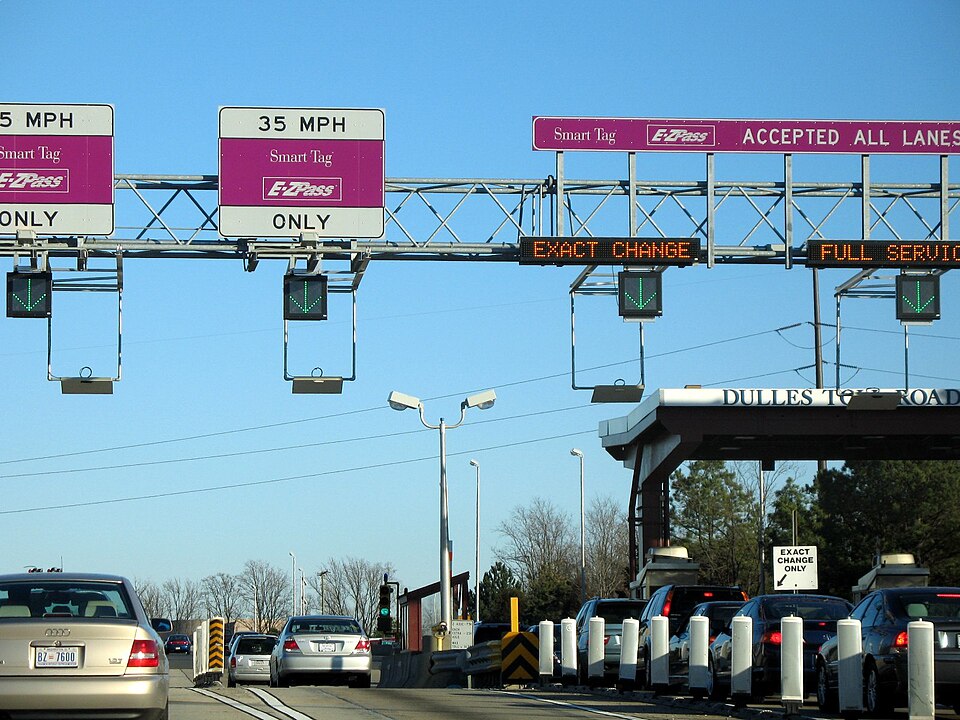
Photo: MPD01605, Public domain, via Wikimedia Commons
Most US toll roads charge you electronically as you drive under an overhead gantry, without stopping. You pay with a windshield transponder such as E-ZPass, or by a bill mailed to the car’s registered owner after a camera reads the plate. This guide is for new US drivers and families. It explains transponders, pay-by-plate, express and HOT lanes, and the rental car trap.
Key facts
- Transponder: a small tag linked to a prepaid account. Tolls are deducted as you pass a reader.
- E-ZPass: the E-ZPass Group says its member toll agencies stretch across 20 states, with over 64 million devices in use (as of November 2026).
- Pay-by-plate (toll-by-mail): cameras photograph the plate and the toll agency bills the registered owner. Expect to pay more than transponder users in many systems.
- Express and HOT lanes: FHWA describes high-occupancy toll (HOT) lanes as carpool lanes that solo drivers can use by paying a toll. The price often changes with traffic.
- Learner permits: toll roads have no special learner rule of their own. Your state’s permit and teen license limits still apply.
How do toll roads work?
There are three common setups. You may meet all three in one trip.
| Type | How you pay | What to watch for |
|---|---|---|
| All-electronic (cashless) toll road | Transponder, or a bill by mail to the plate owner | No booths and no cash. Do not stop or reverse at a gantry |
| Toll plaza with lanes | Transponder lanes, plus cash or card lanes where they still exist | Signs above each lane show what it accepts. Choose early and avoid last-second lane changes |
| Express, managed or HOT lanes | Transponder, with free or discounted travel for carpools in some systems | The posted price can change during the day. Rules on carpools differ by lane |
Transponders: E-ZPass and regional tags
Each region runs its own toll account system. E-ZPass is the largest, covering member agencies in 20 states. Other systems include FasTrak in California, and state systems in places such as Texas and Florida. Some tags work across several systems and some do not, so check the toll agency’s coverage map before a long trip.
Setting one up
- Open an account with your local toll agency online or by phone.
- Register every car you will use and keep the plate numbers up to date.
- Mount the tag where the instructions say, usually high on the windshield.
- Set up auto top-up so the balance does not run out.
- When you sell a car or change plates, update the account straight away.
Parents adding a teen: the account belongs to whoever opened it, and tolls and any violations follow the plate. Make sure the car your teen drives is on the account.
Pay-by-plate and toll-by-mail
No transponder? Most cashless roads still let you through. A camera reads the plate and the toll agency mails a bill to the registered owner. Rules vary, but several things are common:
- The plate rate is often higher than the transponder rate.
- Unpaid bills can add late fees and further penalties, which each state and toll agency sets.
- If you have just moved, update your address with the DMV or the bill may go to your old home.
Some agencies also let you pay a trip online soon after driving it. Check the toll agency’s own site, and be wary of text messages asking you to pay unpaid tolls through a link. Go to the agency’s website directly instead.
Express lanes and HOT lanes explained
FHWA describes HOT lanes as HOV (carpool) lanes that also let vehicles without enough people pay a toll to use them. Under FHWA’s congestion pricing guidance, carpools, transit buses and emergency vehicles may ride free or at a reduced rate. Toll rates can be fixed by time of day or set dynamically, rising when traffic is heavy so the lane keeps moving. FHWA notes that communities use different names, such as Express Lanes, but the basic operation is the same.
Switchable tags for carpools
Some systems use a switchable transponder where you declare how many people are in the car. In the San Francisco Bay Area, the FasTrak Flex tag has positions for 1, 2 and 3+ occupants:
- Set it before you start the trip.
- Solo drivers pay the full toll on every Bay Area express lane.
- Two-person discounts vary by lane, and 3+ ride free on the Bay Area express lanes.
- FasTrak says the California Highway Patrol checks occupancy visually, and a carpool citation can exceed $400.
Other regions have different rules. Read the signs at each lane entrance. Carpool lane basics, including when you may enter or leave, are in HOV and carpool lanes explained.
Driving through a toll gantry: what to do
- Keep your speed steady. Electronic gantries read at traffic speed. Follow any posted limit.
- Never stop, reverse or cut across lanes because you think you are in the wrong one. The toll will be billed by plate.
- At plazas, pick your lane early using the overhead signs, and watch for cars changing lanes.
- Merging back after a plaza works like any freeway merge. See freeway driving for new drivers.
Rental cars and borrowed cars
This is where new drivers get surprised.
- Many rental companies bill you for tolls you drive, often adding their own daily or per-toll service fee. Read the toll section of the rental agreement before you leave the lot.
- If you bring your own transponder, check whether the rental agreement allows it and add the rental plate to your account for the dates you have it. Remove it when you return the car.
- In a borrowed car, any toll bill goes to the owner. Agree up front who pays.
Moving states? Your toll account may still work, but you need to update the plates and address once you re-register the car. See moving to a new state.
Common questions
Can I drive on a toll road with a learner permit?
Toll roads do not have their own permit rules. Your state’s permit supervision rules apply, and some teen license limits, such as curfews, apply on any road.
What happens if I drive through a toll without a transponder?
On a cashless road, the camera reads your plate and a bill goes to the registered owner. Pay it on time to avoid extra fees.
Does E-ZPass work in every state?
No. The E-ZPass Group says its members cover 20 states. Check coverage before traveling elsewhere.
Are express lanes worth it for a new driver?
They can be calmer than packed general lanes, but entry and exit points are limited. Know your exit before you enter.
Can I use the carpool lane with my parent in the car?
If the lane’s minimum is two people, a learner and supervisor usually count as two. Check the occupancy rule on the signs and, for a tolled lane, set any switchable tag correctly.
I got a text saying I owe tolls. Is it real?
It might not be. Do not click the link. Log in to your toll account or contact the toll agency directly.
Back to the main guide: learning to drive in the USA.
Sources
- E-ZPass Group, “E-ZPass Group home page” (e-zpassgroup.org)
- Federal Highway Administration, Office of Operations, “High Occupancy Vehicle (HOV) Lanes” (ops.fhwa.dot.gov)
- Federal Highway Administration, Office of Operations, “HOT Lanes Marketing Toolkit: HOT Lanes, Cool Facts” (ops.fhwa.dot.gov)
- Federal Highway Administration, Office of Operations, “Congestion Pricing: A Primer” (ops.fhwa.dot.gov)
- Bay Area FasTrak, “What are the switch positions on a FasTrak Flex and FasTrak CAV toll tag for?” and “Using your FasTrak Flex Toll Tag FAQs” (bayareafastrak.org)