
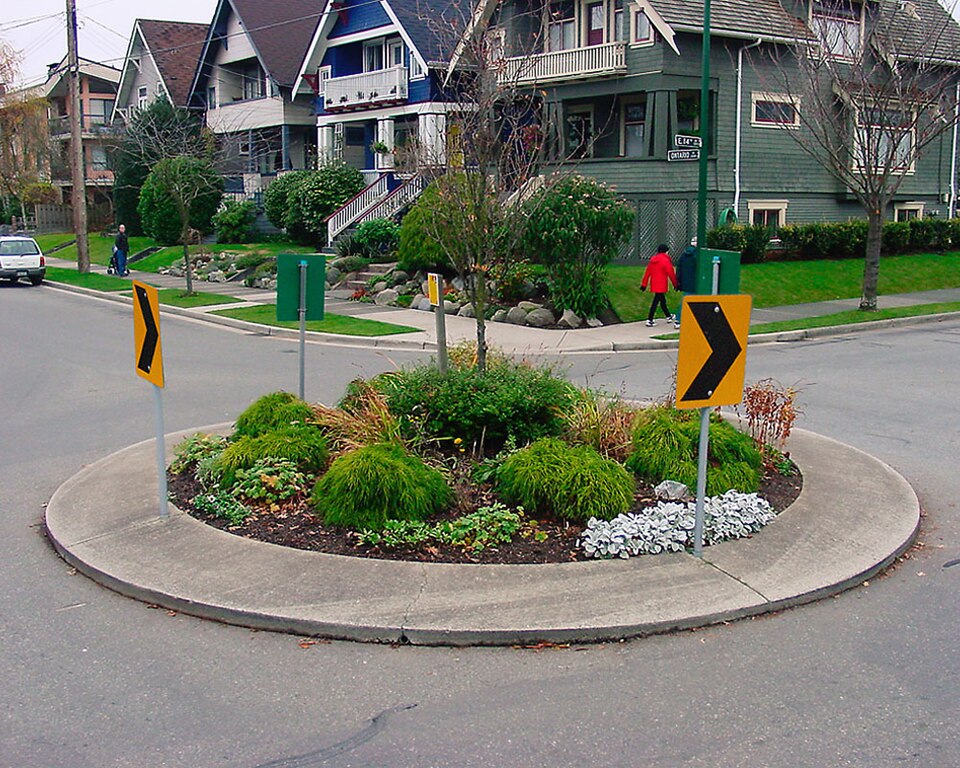
Photo: Richard Drdul, CC BY-SA 2.0, via Wikimedia Commons
This is a study guide to BC’s rules of the road from ICBC’s Learn to Drive Smart chapter 4: who yields at each type of intersection, how traffic circles differ from roundabouts, lane choice, HOV and bus lanes, when U-turns are illegal, passing and parking distances. The short answer on roundabouts: yield to traffic already in it, go counter-clockwise, never change lanes inside, and signal right before you exit.
Right-of-way at BC intersections
| Situation | Who goes first |
|---|---|
| Uncontrolled intersection | The vehicle that arrived first. If two arrive together, the vehicle on the left yields to the one on the right. Treat an unmarked T-intersection the same way. |
| Four-way stop | First to arrive and stop fully goes first. Same time: the one on the right. Facing each other: the left-turner yields to the one going straight. |
| Two-way stop | Through-street traffic has the right-of-way. Between two stopped drivers, the one turning left yields, unless already in the intersection and turning. |
| Yield sign | Traffic on the through road. Enter without stopping only if it is clear. |
| Left turn on a green light | Oncoming traffic; wait for a safe gap. If the light turns yellow while you are in the intersection, you may complete the turn. |
| Lights out or all flashing | Treat it as a four-way stop. |
| Traffic control person present | Follow their directions. |
Red lights and arrows
- After a full stop on a steady red, you may turn right, or turn left onto a one-way street, unless a sign forbids it.
- A flashing green arrow with a steady red: you may turn left; through traffic stops.
- When the advance arrow ends and only the green light shows, you can still turn left but must yield to pedestrians and oncoming traffic.
- A stale green (green for a while) may turn yellow soon. Pick your “point of no return” as you approach.
- Backing into an intersection or over a crosswalk is illegal.
Where to stop
- Just before the stop line, if there is one.
- No stop line: just before the crosswalk, marked or unmarked. An unmarked crosswalk exists at an intersection wherever the sidewalk edges on either side would join if extended across the road, so missing paint does not mean there is no crossing.
- No line, crosswalk or sidewalk: just before you enter the intersection.
Traffic circle vs roundabout in BC
| Traffic circle | Roundabout | |
|---|---|---|
| Where | Mostly residential neighbourhoods | Usually larger, sometimes multi-lane |
| Yield to | Traffic in the circle; posted signs. Arriving together: the vehicle on your right. No signs: treat as uncontrolled. | Pedestrians in the approach crosswalk, then traffic already in the roundabout |
| Direction | Counter-clockwise; turn right to enter and right to leave | Counter-clockwise |
| Lanes | Single | Left lane: straight or left. Right lane: right or straight. No lane changes inside. |
| Exit | Turn right out | Signal right before you exit; yield to pedestrians at the exit crosswalk |
In a roundabout, do not ride alongside trucks or buses: they may need more than one lane. If an emergency vehicle is coming, do not block the circle; stop before entering, or exit and then stop.
Using lanes correctly
- On multi-lane highways use the right-hand lanes. On freeways with three or more lanes each way, use the centre or right lanes.
- Turn into the matching lane: from a two-way road onto a two-way road, centre lane to centre lane. One-way to one-way, left lane to left lane.
- In a designated lane, follow the arrows. Do not move into or out of it inside the intersection.
- Two-way left-turn lanes are shared by both directions; watch for oncoming turners.
- Where there are two turning lanes, finish in the matching lane: far-left lane into the far-left lane, the next lane into the next lane. Read the lane-use signs and markings before the turn.
- You may turn left mid-block, even across a solid double yellow line, if it is safe, does not impede traffic and no sign prohibits it.
- Legally, you must signal every lane change. Do not change lanes in an intersection.
- Leftmost lane rule: where there are two or more marked lanes in your direction (not counting bus, HOV or designated-use lanes), the limit is 80 km/h or more and traffic is moving at 50 km/h or more, you must leave the leftmost lane when a vehicle comes up behind you in it, if it is safe. Exceptions: you are passing another vehicle, letting traffic merge, getting ready to turn left or exit, or passing an official vehicle stopped at the roadside. It never means speeding up or cutting into an unsafe gap.
Cul-de-sacs
A cul-de-sac is a street closed at one end, and most are built with a turning area so you can come back out without reversing. Slow down well before the end and keep to the right as you go around. Nearly all of them are residential, so expect children playing, cars backing out of driveways and people stepping out from between parked vehicles.
If parked cars or a tight layout leave no clean way round, stop somewhere safe and rethink rather than squeezing through. A missed turn that lands you in a cul-de-sac is a good chance to practise slow, careful observation, not a quick steering exercise.
Other ways to turn around are a series of turns at intersections, a legal U-turn, or a two-point or three-point turn. In a two-point turn you stop near the side of the road, back into a driveway, then drive out the other way. In a three-point turn you turn sharp left mid-block, stop short of the curb, back up to your right, then drive off in the opposite direction. Only do either when it is clear and no other traffic is near.
When is a U-turn illegal in BC?
- if it interferes with other traffic
- on a curve
- on or near a hill crest where other traffic cannot see you within 150 metres
- where a sign prohibits it
- at an intersection with a traffic light
- in a business district, except at an intersection without a traffic light
- where a municipal bylaw prohibits it
HOV, bus and bicycle lanes
- HOV lanes (white diamond) are for buses and carpools; on some roads motorcycles, bicycles and taxis too. Signs show the hours and minimum occupants. Most run 24 hours. Enter and exit only at broken lines.
- Bus lanes are for buses and sometimes cyclists. Vanpools of six or more may use them if a “Vanpool Permitted” tab is shown.
- Bicycle lanes: do not drive, stop or park in one. Cross only where the line is broken or to enter or leave a driveway, and yield to cyclists.
- To turn right off a street with a reserved lane, move into it where permitted and when safe.
Passing and merging
- Pass on the right only on a roadway with two or more lanes, or when the driver ahead is turning left. Never use the shoulder.
- Stay within the speed limit while passing.
- Speeding up while someone is passing you is illegal.
- Whenever you move into another lane, pulling out from the curb or changing lanes, traffic already in that lane has the right-of-way, whether it is a car, a motorcycle or a bicycle. Leave a gap big enough that nobody has to slow down for you.
- On a highway passing lane, keep right unless you are passing. When a sign shows the passing lane is ending, drivers in both lanes must merge before it ends.
- If your own lane ends ahead, adjust your speed within the limit and wait for a safe gap. If the lane beside you is ending, help those drivers in by adjusting your speed or moving over.
- On a freeway entrance, obey any ramp meter (a signal that lets vehicles onto the ramp a few at a time) and start scanning freeway traffic for a gap while still on the ramp. Match speed in the acceleration lane (solid white line), then merge in the merging area (broken line). Avoid stopping in either.
- Most exits are numbered. Know yours before you set off so you can move to the right lane in good time. Signal, keep your speed until you are in the exit lane, then slow down gradually.
- Missed your exit? Carry on to the next one. Never reverse or cut across the painted area.
- When someone is merging beside you, help if it is safe: move left a lane or adjust your speed to open a gap.
Leaving a driveway or alley
In a business or residential area, pulling out of a driveway, alley, parking lot or private road is two checks. First stop before the sidewalk, or where people may be walking, and yield to pedestrians. Then move up and yield to traffic on the road, waiting for a safe gap. A clear road does not cancel the sidewalk stop, and a hedge or parked van that blocks your view is a reason to creep forward slowly and look again.
BC parking distances
| Do not park | Distance |
|---|---|
| From a fire hydrant | Within 5 m |
| From a crosswalk or intersection | Within 6 m |
| From a stop sign or traffic light | Within 6 m |
| From the nearest rail of a railway crossing | Within 15 m |
Also illegal: on a sidewalk or boulevard, across a driveway, lane or intersection entrance, in a bicycle lane, on a bridge or in a highway tunnel, where you block a sign, at yellow or red curbs, and in disabled spaces unless you display a valid permit and the vehicle is there to transport a person with a disability, who may be the driver or a passenger. Park within 30 cm of the curb.
Wheels on a hill
- Uphill with a curb: turn the wheels left.
- Uphill without a curb, or downhill with or without one: turn right.
- Rolling or mountable curb, uphill: turn right.
- Set the parking brake. Automatic in park; manual in reverse facing downhill, first facing uphill or on the level.
Common questions
Who yields at a BC roundabout?
Drivers entering yield to pedestrians in the crosswalk and to traffic already in the roundabout.
Can I turn right on red in BC?
Yes, after a full stop and when clear, unless a sign forbids it. You may also turn left on red onto a one-way street.
Can I cross a double solid yellow line in BC?
Not to pass another vehicle. You may cross it to turn left mid-block, into a driveway for example, if it is safe and not prohibited. You may also cross a single or double yellow centre line to pass a cyclist, pedestrian or other vulnerable road user with the legal gap, if it is safe; see Sharing BC roads.
What if two cars reach an uncontrolled intersection together?
The car on the left yields to the car on the right.
Can I drive in an HOV lane alone?
Only if signs allow it for your vehicle type. Otherwise you can cross one only to turn, at a broken line.
How close to the curb must I park?
Within 30 cm (one foot), parallel to the curb.
Back to the full guide: Learning to drive in BC. Related: BC road signs, signals and markings, ICBC knowledge test, Sharing BC roads.
Sources
- ICBC, “Learn to Drive Smart, chapter 4: Rules of the road” (icbc.com)
- ICBC, “Graduated licensing” (icbc.com)
- Province of British Columbia, Motor Vehicle Act, sections 119, 151.1, 176 and 179 (bclaws.gov.bc.ca)
- Province of British Columbia, Motor Vehicle Act Regulations, B.C. Reg. 26/58, Division 38, sections 38.03 and 38.08 (bclaws.gov.bc.ca)