
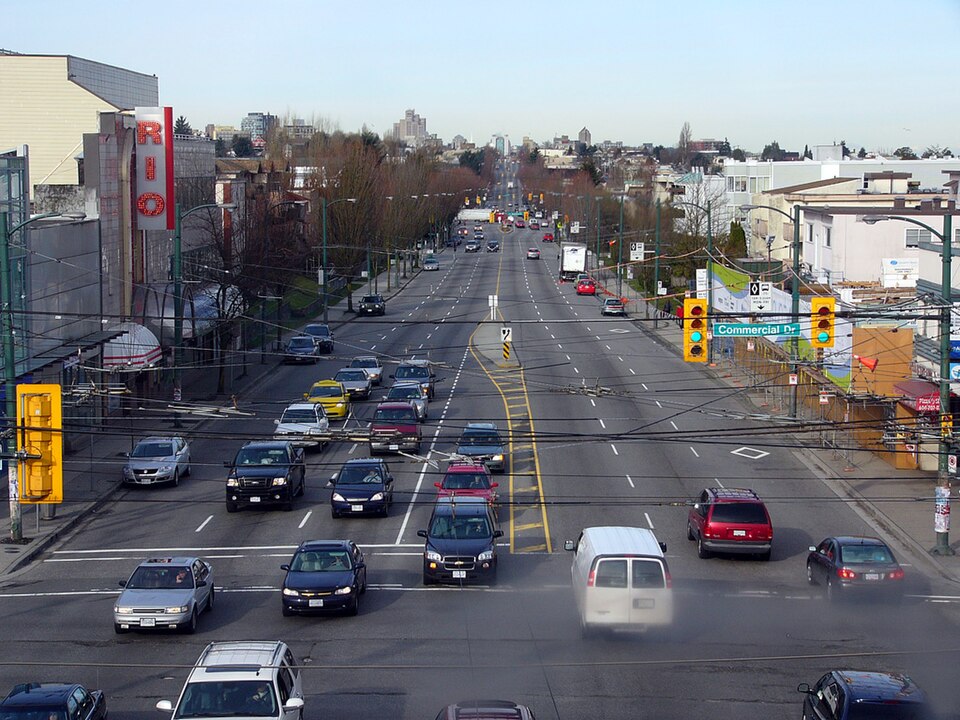
Photo: Philippe Giabbanelli, CC BY 3.0, via Wikimedia Commons
See-think-do is the driving method in ICBC’s Learn to Drive Smart guide and the core of what BC examiners score on the Class 7 road test. See: scan for hazards. Think: decide which hazard is most dangerous and pick the safest solution. Do: act using speed control, steering, space margins and communication. This guide turns each step into habits and numbers you can practise and that the knowledge test asks about.
The numbers to know
| Habit | ICBC guideline |
|---|---|
| Look ahead | At least 12 seconds: 1 to 2 blocks in the city, half a kilometre on the highway |
| Observation cycle (ahead, sides, mirrors) | Every 5 to 8 seconds |
| Following distance, good conditions | At least 2 seconds |
| High-speed roads; behind a large vehicle or motorcycle; when tailgated; on unpaved roads | At least 3 seconds |
| Bad weather, uneven or slippery roads | 4 seconds |
| Stopped behind another vehicle | About one car length (more behind a large vehicle) |
| Reaction time | About 0.75 seconds to see-think plus 0.75 seconds to do, before the car begins to slow |
| Shoulder check | At least 45 degrees over the shoulder you are moving toward |
| Passing a cyclist or pedestrian | At least 1.0 m; 1.5 m where the limit is above 50 km/h; 0.5 m if they are on a sidewalk or protected cycle lane |
See: observation and hazard perception
Where to look
- Ahead: 12 seconds, scanning side to side for parked cars, doors and children.
- Behind: rear-view mirror before you slow or stop; side mirror before any change of position.
- Blind spots: shoulder check before pulling out, pulling over, changing lanes, turning and opening your door. Cameras and blind spot detectors do not replace it.
- Intersections: left, centre, right, then left again. ICBC notes almost 60 per cent of BC crashes happen at intersections.
- Backing up: 360-degree check, then turn your body to look out the rear window.
Four kinds of hazard
- Space conflicts: two road users heading for the same space, such as a car backing out of a driveway.
- Surprises: anything unpredictable, like a car door swinging open in front of a cyclist.
- Vision blocks: a stopped bus, a hill crest, a truck in the next lane, fog.
- Poor road conditions: gravel, ice, deep puddles, pavement turning to gravel.
On the road test you name hazards out loud. Practise by calling them out on every drive and asking your supervisor what you missed.
Think: assess the risk, choose a solution
When several hazards appear at once, decide which is most dangerous first. Then predict the result of each option: can you slow down without skidding, is there space to steer onto the shoulder, will the horn help? The right answer usually depends on where the space is.
Scenario from the handbook
On a two-lane highway curve, a car passes you over a solid double yellow line, a truck appears in the oncoming lane and a branch lies ahead. The passing car may cut in front of you to escape the truck. The handbook lists three options: slow down, steer out of the way, or sound the horn. Weigh each one: is the road too slippery to brake hard, is there room on the shoulder, is there a car close behind?
Do: the four skills
Speed control
- Default BC limits: 50 km/h in cities and towns, 80 km/h outside, 20 km/h in lanes and alleys within municipalities, unless signs say otherwise.
- The posted limit is the maximum for ideal conditions.
- Slow before a curve, not in it. If you lose traction in a curve, ease off the accelerator rather than braking.
- Cover the brake when you see a hazard ahead.
- Coasting downhill in neutral or with the clutch in is illegal.
- Never drive faster than you can stop within the distance you can see.
- Physics works against you at speed. Traction drops on wet, sandy or slippery roads and with worn or badly inflated tires. Inertia keeps you going straight in a curve. Gravity lengthens your stopping distance downhill. A high centre of gravity (SUVs, pickups, camper vans, roof loads) makes a vehicle more likely to tip on a fast curve.
Steering
- Both hands on the outside of the wheel, at 9 and 3 or 10 and 2. With an airbag, 9 and 3 or 8 and 4 may be better.
- Look well ahead where you want to go; your hands follow your eyes.
Lane tracking
ICBC uses “lane tracking” for getting into the correct lane before a turn and ending up in the correct lane after it. Turning right, go from the right lane into the right lane of the cross street, unless markings allow a turn from a centre lane. Turning left on two-way roads, arc smoothly from the centre lane into the centre lane; from a one-way street, turn from the left lane; onto a one-way street, finish in the left lane.
Space margins
- Use the following distances in the table above.
- If someone tailgates, slow slightly to open more space in front, change lanes or let them pass.
- On a two-lane road stay fairly close to the centre line; in the curb lane keep away from opening doors.
- Elsewhere, drive near the centre of your lane and stay out of other drivers’ blind spots. On a multi-lane road the right lane is often the safest choice.
- Gaps from a stop in ideal conditions: about 2 seconds per lane to cross, 5 seconds to turn right and reach 50 km/h, 7 seconds to turn left. Add 2 seconds for safety.
Communication
- Signal early, clearly and only for what you mean; check it cancels.
- Tap the brake to flash brake lights before slowing.
- Use the horn only when it helps prevent a crash.
- Make eye contact with pedestrians and cyclists. Avoid waving people through.
- Read vehicle language: lane position and speed tell you more than a signal that might be wrong.
How to practise the two-second rule
- Pick a fixed object ahead, like a sign.
- When the vehicle ahead passes it, count “one thousand and one, one thousand and two.”
- If you reach the object before you finish, drop back.
- On a highway, count to three.
Common questions
What does see-think-do mean in BC?
See hazards, think about the risk and the safest response, then do the manoeuvre using speed control, steering, space margins and communication.
Is see-think-do on the ICBC knowledge test?
The test covers the content of Learn to Drive Smart, which includes chapter 5. Learn the following distances and scanning times.
Does the Class 7 road test score see-think-do?
Yes. ICBC says it assesses observation, hazard perception, speed control, space margins, steering and communication.
What is the safe following distance in rain?
Four seconds in bad weather or on slippery roads.
Why does ICBC say not to wave pedestrians across?
They may step into hazards you cannot see, such as a car in the next lane.
Back to the full guide: Learning to drive in BC. Related: ICBC Class 7 road test, Sharing BC roads, Emergency strategies for BC drivers.
Sources
- ICBC, “Learn to Drive Smart, chapter 4: Rules of the road” (icbc.com)
- ICBC, “Learn to Drive Smart, chapter 5: See-think-do” (icbc.com)
- ICBC, “Learn to Drive Smart, chapter 9: Your licence” (icbc.com)
- ICBC, “Tuning Up for Drivers” (icbc.com)
- ICBC, “Graduated licensing” (icbc.com)