
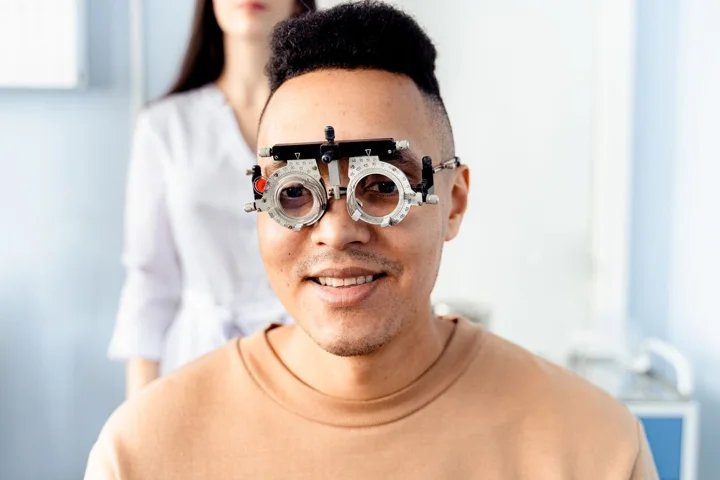
Photo: Antoni Shkraba / Pexels. Illustrative photograph.
No: bioptic telescopes are not accepted for driving in Great Britain or the Republic of Ireland. The DVLA states that “bioptic telescope devices are not accepted by DVLA for driving”, and Ireland’s medical fitness guidelines say the same of the NDLS. You must meet the eyesight standard with ordinary glasses or contact lenses if you need them. This differs from many US states, where bioptic driving is allowed under conditions.
Where each part of the UK and Ireland stands
| Jurisdiction | Position (as of November 2026) | Source |
|---|---|---|
| Great Britain | Not accepted | DVLA “Assessing fitness to drive”, visual disorders, updated 26 September 2025 |
| Northern Ireland | No separate DVA statement found; ask the DVA Drivers Medical Section before relying on one | nidirect |
| Republic of Ireland | Not accepted by the NDLS | Slainte agus Tiomaint medical fitness to drive guidelines (2020 edition) |
Why the DVLA does not accept bioptics
GOV.UK’s note “Bioptics: current GB driving standards” (published 22 September 2011) gives the main reason: bioptic devices can affect the field of vision so much that the visual field standard cannot be met. For a car licence that standard is at least 120 degrees across. The note says the Secretary of State’s Honorary Medical Advisory Panel’s main concern is road safety.
The panel looked at the issue again in October 2022. Its minutes record that:
- a bioptic is used for an average of about 2% of driving time, so the other 98% is driven with reduced visual acuity
- using the device impinges on the binocular visual field
- the position that bioptics are unacceptable for driving remains unchanged, and the topic will be reviewed in future
What if a licence was issued to someone using a bioptic?
The 2011 GOV.UK note warns that licences held by people relying on bioptics may be invalid, and that there could be serious insurance implications. If you meet the standard only through a bioptic, you do not meet it for GB driving, and you must not drive.
The standard you must meet instead
- GB and Northern Ireland: read a number plate from 20 metres, 6/12 acuity with both eyes (or the only eye), and the 120-degree field standard. See driving eyesight rules and sight in one eye or a visual field problem.
- Republic of Ireland: 6/12 binocular acuity and a 120-degree field. See the Irish eyesight standard.
Where bioptic driving is allowed
Many US states allow bioptic driving under conditions, such as extra training, daylight-only limits or regular eye checks, but the rules differ from state to state. See bioptic driving laws by state.
If you have low vision
- Ask your optometrist or eye clinic whether you meet the standard with ordinary glasses or lenses, and about low-vision services.
- If you are registered blind (severely sight impaired), you qualify automatically for a Blue Badge in England for when you travel as a passenger: see Blue Badge for new drivers.
- Rules can change after review. Check the current DVLA, DVA or NDLS position before making plans.
Want to practise the eyesight check? Our sister site Driving Eyesight Test has a free 20-metre number plate practice for the UK and an Ireland eyesight report page on drivingeyesighttest.com. It is a practice screen, not an eye test.
Back to the guides: Great Britain, Northern Ireland, Ireland.
Sources
- DVLA, “Visual disorders: assessing fitness to drive”, updated 26 September 2025 (gov.uk)
- DVLA, “Bioptics: current GB driving standards”, published 22 September 2011 (gov.uk)
- Secretary of State’s Honorary Medical Advisory Panel on Driving and Visual Disorders, minutes of 20 October 2022 (gov.uk)
- National Office for Traffic Medicine and Road Safety Authority, “Slainte agus Tiomaint: Medical Fitness to Drive Guidelines”, 2020 edition (ndls.ie)
- Department for Transport, “Can I get a Blue Badge?” (gov.uk)