Category: Applies to all countries

  • Pregnancy and Learning to Drive in the UK and Ireland

    Pregnancy and Learning to Drive in the UK and Ireland

    Photo: Ivan S / Pexels. Illustrative photograph.

    In Great Britain, pregnancy does not stop you having lessons or taking your test: GOV.UK says you can take the driving test at any stage of pregnancy, as long as you are able and willing to do an emergency stop. In Northern Ireland and Ireland, ask the DVA or RSA if you have any concerns. You must still wear a seat belt unless a doctor has given you a medical exemption certificate.

    Seat belts in pregnancy: the law

    Great Britain Northern Ireland Republic of Ireland
    Must you wear one? Yes. Highway Code Rule 99 allows exemptions only for holders of medical exemption certificates (and some delivery drivers). Yes, unless a doctor certifies you as exempt. Produce the certificate if police ask. Yes. The RSA says pregnancy is not an automatic exemption; only a doctor can exempt you on medical grounds.
    Penalty for not wearing one Fine of up to £500 £500 fine and 3 penalty points for a driver Check the current figure with the RSA or Garda

    How to wear the belt around a bump

    • Lap strap: as low as possible across your hips, under the bump, not over it.
    • Diagonal strap: between your breasts and around the side of the bump, over your shoulder rather than your neck.
    • Keep the belt snug.

    The RSA warns against lap-only belts, which can seriously injure an unborn baby in sudden braking or a crash. If you are unsure about seating position or comfort, ask your midwife.

    Taking the practical test while pregnant

    Great Britain

    GOV.UK says you can take a driving test at any stage of pregnancy, but you must be able and willing to do an emergency stop. Mention your pregnancy when you book if you want the examiner to know.

    Northern Ireland and Ireland

    If you are pregnant, talk to your midwife or doctor about any test-day concerns, and ask the DVA or RSA in advance if you are worried about the emergency stop or the length of the test.

    If you need to move your test

    In GB, as of November 2026:

    • change or cancel a car test with at least 10 full working days’ notice to keep your fee (Monday to Saturday count; Sundays and public holidays do not)
    • you can change a car test up to 2 times; after that you must cancel and rebook
    • if illness or injury means you cannot give that notice, you can ask DVSA for a short-notice refund, with a fit note or medical certificate as evidence

    In Northern Ireland and Ireland, check the notice period with the DVA or RSA before you change a booking. More on GB cancellations: when a driving test is cancelled or goes wrong.

    Pregnancy-related conditions and your licence

    • Gestational diabetes on insulin: in GB you only tell the DVLA if insulin continues for more than 3 months after the birth, or you have disabling hypos. Ireland’s guidelines give the same 3-months-after-delivery rule for the NDLS. See diabetes and learning to drive (GB) and diabetes and your Irish learner permit.
    • Fainting or light-headedness: the DVLA lists pregnancy with fainting or light-headedness as a temporary condition. Usually you do not need to tell the DVLA when clinical advice is not to drive for less than 3 months. Your doctor will tell you if you do.
    • Ireland: Slainte agus Tiomaint says pregnancy should not normally be a barrier to driving, but fainting, severe sickness (hyperemesis gravidarum), high blood pressure in pregnancy and recovery from a caesarean section may need a caution about driving. It also says seat belts should continue to be worn.

    When it is safe to drive after a caesarean or with symptoms is a question for your doctor or midwife.

    Practical points for lessons

    • Adjust the seat and steering wheel before each lesson so you can reach the pedals comfortably, and readjust as your bump grows.
    • Plan shorter lessons with breaks if you get tired.
    • Your instructor can pause a lesson at any time if you feel unwell.

    Related guides: GB medical conditions and disability, Northern Ireland medical conditions and disability, Ireland medical conditions and disability, seat belts and child car seats (UK), seat belts in Ireland.

    Sources

    • GOV.UK, “Driving test: if you have a disability, health condition or learning difficulty” (gov.uk)
    • Department for Transport, “The Highway Code: Rules for drivers and motorcyclists (89 to 102)” (gov.uk)
    • GOV.UK, “Seat belts: the law” (gov.uk)
    • GOV.UK, “Change your driving test appointment” (gov.uk)
    • DVLA, “Diabetes mellitus: assessing fitness to drive” and “Miscellaneous conditions: assessing fitness to drive”, updated 7 November 2025 (gov.uk)
    • nidirect, “Wearing a seat belt and exemptions” (nidirect.gov.uk)
    • Road Safety Authority, “Safe use of seat belts during pregnancy” (rsa.ie)
    • National Office for Traffic Medicine and Road Safety Authority, “Slainte agus Tiomaint: Medical Fitness to Drive Guidelines”, 2020 edition (ndls.ie)

  • Bioptic Telescopes and Driving in the UK and Ireland

    Bioptic Telescopes and Driving in the UK and Ireland

    Photo: Antoni Shkraba / Pexels. Illustrative photograph.

    No: bioptic telescopes are not accepted for driving in Great Britain or the Republic of Ireland. The DVLA states that “bioptic telescope devices are not accepted by DVLA for driving”, and Ireland’s medical fitness guidelines say the same of the NDLS. You must meet the eyesight standard with ordinary glasses or contact lenses if you need them. This differs from many US states, where bioptic driving is allowed under conditions.

    Where each part of the UK and Ireland stands

    Jurisdiction Position (as of November 2026) Source
    Great Britain Not accepted DVLA “Assessing fitness to drive”, visual disorders, updated 26 September 2025
    Northern Ireland No separate DVA statement found; ask the DVA Drivers Medical Section before relying on one nidirect
    Republic of Ireland Not accepted by the NDLS Slainte agus Tiomaint medical fitness to drive guidelines (2020 edition)

    Why the DVLA does not accept bioptics

    GOV.UK’s note “Bioptics: current GB driving standards” (published 22 September 2011) gives the main reason: bioptic devices can affect the field of vision so much that the visual field standard cannot be met. For a car licence that standard is at least 120 degrees across. The note says the Secretary of State’s Honorary Medical Advisory Panel’s main concern is road safety.

    The panel looked at the issue again in October 2022. Its minutes record that:

    • a bioptic is used for an average of about 2% of driving time, so the other 98% is driven with reduced visual acuity
    • using the device impinges on the binocular visual field
    • the position that bioptics are unacceptable for driving remains unchanged, and the topic will be reviewed in future

    What if a licence was issued to someone using a bioptic?

    The 2011 GOV.UK note warns that licences held by people relying on bioptics may be invalid, and that there could be serious insurance implications. If you meet the standard only through a bioptic, you do not meet it for GB driving, and you must not drive.

    The standard you must meet instead

    Where bioptic driving is allowed

    Many US states allow bioptic driving under conditions, such as extra training, daylight-only limits or regular eye checks, but the rules differ from state to state. See bioptic driving laws by state.

    If you have low vision

    • Ask your optometrist or eye clinic whether you meet the standard with ordinary glasses or lenses, and about low-vision services.
    • If you are registered blind (severely sight impaired), you qualify automatically for a Blue Badge in England for when you travel as a passenger: see Blue Badge for new drivers.
    • Rules can change after review. Check the current DVLA, DVA or NDLS position before making plans.

    Want to practise the eyesight check? Our sister site Driving Eyesight Test has a free 20-metre number plate practice for the UK and an Ireland eyesight report page on drivingeyesighttest.com. It is a practice screen, not an eye test.

    Back to the guides: Great Britain, Northern Ireland, Ireland.

    Sources

    • DVLA, “Visual disorders: assessing fitness to drive”, updated 26 September 2025 (gov.uk)
    • DVLA, “Bioptics: current GB driving standards”, published 22 September 2011 (gov.uk)
    • Secretary of State’s Honorary Medical Advisory Panel on Driving and Visual Disorders, minutes of 20 October 2022 (gov.uk)
    • National Office for Traffic Medicine and Road Safety Authority, “Slainte agus Tiomaint: Medical Fitness to Drive Guidelines”, 2020 edition (ndls.ie)
    • Department for Transport, “Can I get a Blue Badge?” (gov.uk)
  • Driver Assistance Systems (ADAS) Explained for Learners (UK)

    Driver Assistance Systems (ADAS) Explained for Learners (UK)

    Photo: Abdulvahap Demir / Pexels. Illustrative photograph.

    Driver assistance systems (ADAS) such as automatic emergency braking, lane assist and parking sensors can warn you or step in, but they do not drive the car and they do not see everything. In Great Britain the Highway Code is clear: you must have proper control of your vehicle at all times and you are still responsible when a system is in use. This guide explains the common systems, their limits, which ones you can use on the GB driving test, and how to learn a new car’s technology safely.

    Key facts

    • Highway Code rule 150: do not rely on driver assistance systems such as motorway assist, lane departure warnings or remote control parking. They are there to assist, but you should not reduce your concentration.
    • You are responsible: rule 150 says you are still responsible for the vehicle if you use a driver assistance system, and you must have full control over these systems at all times.
    • GB test, allowed: electronic parking brake, hill-start assist, cruise control, speed limiters, parking sensors and cameras, lane assist, blind spot monitoring and traffic sign recognition.
    • GB test, not allowed to use: self-parking, Tesla autopilot and your own sat nav.
    • DVSA’s Ready to Pass skills list includes understanding any driver assistance technology fitted to your vehicle.

    Common systems and what they cannot do

    Names differ between manufacturers, and two systems with similar names can behave differently. Your car’s handbook is the authority on yours.

    System What it generally does Limits to remember
    Automatic emergency braking (AEB) Warns and may brake if it detects a likely collision ahead May not detect every vehicle, pedestrian or cyclist, or work in all weather and speeds. It is a last resort, not a following-distance tool.
    Lane departure warning and lane keeping assist Warns or steers gently if you drift out of your lane Needs visible lane markings; faded lines, road works and snow can confuse it. It does not check whether a lane change is safe.
    Blind spot monitoring Lights a warning if a vehicle is beside or behind you Does not replace a look over your shoulder. Fast-approaching or small road users may be missed.
    Parking sensors and cameras Beep or show a picture near obstacles Low kerbs, thin posts and small children can be missed. Dirt on a camera hides things.
    Cruise control and adaptive cruise Holds a set speed; adaptive versions also keep a gap to the vehicle ahead You still choose a safe speed for the conditions. Adaptive systems may react late to stopped traffic or vehicles cutting in.
    Speed limiters and traffic sign recognition Shows the speed limit or stops you exceeding a set speed Can misread signs or miss temporary limits. The sign on the road is what counts.
    Hill-start assist and auto hold Holds the brakes briefly or while stopped May only hold for a short time. See hill starts explained.
    Self-parking and remote parking Steers (and sometimes drives) into a space Not allowed during the GB test. Rule 150 says you are still responsible if you use a remote parking app or device.

    Driver assistance and the GB driving test

    GOV.UK lists what you can and cannot use in your own car on the test.

    You can use a car with You cannot use during the test
    Electronic parking brake, hill-start assist, cruise control, speed limiters, parking sensors and cameras, lane assist, blind spot monitoring, traffic sign recognition Self-parking, Tesla autopilot, your own sat nav (the examiner sets up a sat nav for you)

    Being allowed is not the same as being enough. Sensors and cameras can help during a parking manoeuvre, but you still need full observation all around the car. A blind spot light is not a blind spot check. If you rely on technology instead of looking, you can still pick up faults for observation. See driving test manoeuvres and driving test faults.

    The test car must also not have any warning lights showing safety issues. A driver assistance fault light can be one of them. See dashboard warning lights.

    How to learn a car’s systems safely

    1. Read the handbook first. Find out what each system does, when it switches on, and its dashboard symbols.
    2. Learn the states while parked. Many displays show a system as off, available, active or unavailable using different colours or symbols.
    3. Try it somewhere quiet with your instructor, such as cruise control on a quiet main road, not for the first time in heavy traffic.
    4. Know how to switch it off and how to override it, for example by braking or steering.
    5. Keep your normal routines. Mirrors, blind spot checks and planning stay exactly the same.
    6. In a different car, start again. Ready to Pass asks learners to adapt quickly when driving a different vehicle. Do not assume a feature you used before is fitted or switched on.

    When the system steps in

    If the car beeps, brakes or steers during a lesson, treat it as feedback. Ask what you could have spotted earlier:

    • A forward collision warning usually means the gap was too small or you saw the hazard late. Highway Code rule 126 says allow at least a two-second gap on high-speed roads, at least double on wet roads.
    • A lane departure warning may mean distraction or tiredness.
    • A parking sensor alarm may mean your observations were not good enough.

    The system stepping in does not mean your original plan was safe. It means the plan needed help.

    Distraction from screens

    Rule 150 also warns about distraction from in-car systems such as sat navs, multimedia and screens. Do not be distracted by maps or screen information while driving; if necessary, find a safe place to stop. Set up the sat nav, music and driving modes before you move off. Rule 149 says you must not use a hand-held phone or similar device while driving. See mobile phones, sat navs and in-car technology.

    Safety ratings and assistance technology

    Euro NCAP includes active safety technology in its ratings for new cars, and sometimes publishes a second rating for cars fitted with an optional safety pack. If you are buying, check that the exact car has the equipment the rating assumed. See choosing your first car.

    Ireland

    The same principle applies: the driver is in control and responsible. Check the RSA’s current test vehicle requirements before your Irish test, rather than assuming the GB list applies. See your car for the Irish driving test.

    Common questions

    Can I use parking sensors on my driving test?

    In GB, yes. GOV.UK lists parking sensors and cameras as allowed. You still need to look all around the car during manoeuvres.

    Can I use cruise control on the test?

    GOV.UK lists cruise control among the features a test car can have. Using it is not required, and you must still choose a safe speed.

    If the car brakes automatically and avoids a crash, is it my fault?

    In law you are still responsible for the vehicle. Treat any intervention as a sign to leave more space and look further ahead.

    Why does my car keep steering me back in the lane?

    That is lane keeping assist. It reacts to lane markings, not to hazards, and it can usually be switched off. Ask your instructor whether to use it while learning.

    Does adaptive cruise or lane assist make the car self-driving?

    No. They are driver assistance systems: they help, but you are driving. The Highway Code says the driver remains responsible when a driver assistance system such as motorway assist is in use.

    Does traffic sign recognition mean I can ignore speed limit signs?

    No. The system can be wrong. You must obey the limit shown on the road. See UK speed limits.

    Related: learning to drive an automatic, safety and your vehicle. Guides: learning to drive in Great Britain and learning to drive in Ireland.

    Sources

    • Department for Transport, “The Highway Code: General rules, techniques and advice for all drivers and riders (103 to 158)” (gov.uk)
    • GOV.UK, “Driving test: cars, using your own car” (gov.uk)
    • GOV.UK, “Driving test: cars, what happens during the test” (gov.uk)
    • DVSA, “Control and positioning” (readytopass.campaign.gov.uk)
    • Euro NCAP, “The ratings explained” (euroncap.com)
  • Learning to Drive an Automatic Car: Controls and Creep (UK, IE)

    Learning to Drive an Automatic Car: Controls and Creep (UK, IE)

    Photo: Mike Bird / Pexels. Illustrative photograph.

    An automatic car has two pedals, accelerator and brake, and changes gear for you, so there is no clutch to master and no stalling in the usual sense. You still need to learn the gear selector, low-speed creep, parking and hill control properly, and in both Great Britain and Ireland passing your test in an automatic limits your licence to automatics. This guide covers the controls, how to drive one smoothly, and what the choice means for your licence.

    Key facts

    • Two pedals = automatic. GOV.UK says manual cars have three pedals and automatic and semi-automatic cars have two. Most electric cars have two pedals.
    • Licence (GB): if you take your test in an automatic or semi-automatic car, you will only be able to drive automatic and semi-automatic cars after passing.
    • Licence (Ireland): passing in an automatic also restricts you to automatics (code 78). See Ireland automatic test and code 78.
    • The GB test is the same for manual and automatic cars, according to GOV.UK.

    The controls

    The gear selector

    Position What it does When you use it
    P (Park) Locks the transmission When parked, with the parking brake on. Most cars only let you start the engine in P or N.
    R (Reverse) Drives backwards Only when the car is stopped
    N (Neutral) Disconnects drive Rarely; for example if the car needs to be pushed or towed. Not for coasting.
    D (Drive) Normal forward driving Almost all your driving
    Other modes (L, B, S, M, paddles) Low gears, stronger engine or regenerative braking, sport or manual selection Check your handbook; your instructor will say if you need them

    Selectors vary a lot: levers, dials, buttons and stalks behind the steering wheel. Learn yours while parked. Always check the display shows the gear you meant before you release the brake, especially when switching between D and R during a manoeuvre.

    The pedals

    Instructors usually teach you to use only your right foot, for both accelerator and brake. Keep your left foot flat on the floor. Using two feet makes it easy to press both pedals at once.

    How to move off in an automatic

    1. Footbrake down. Start the car (in P or N).
    2. Select D (or R), keeping your foot firmly on the brake.
    3. Release the parking brake. On some cars an electronic parking brake releases itself as you pull away.
    4. Observe: mirrors, blind spot, signal if needed, final look. Highway Code rule 159 says move off only when it is safe.
    5. Ease your foot off the brake. Many cars creep forward on their own. Move to the accelerator and press gently if you need more speed.

    DVSA examiner guidance lists checking the gear lever or selector is in neutral before starting the engine as part of a safe start. Many automatics also start in P; follow your handbook.

    Creep: useful, but learn your car

    Many automatics move slowly forward in D, or backward in R, as soon as you release the brake. That creep is very handy for manoeuvres and queues: you control speed with gentle brake pressure, not the accelerator.

    But not all cars behave the same way:

    • Some electric and hybrid cars creep only if a setting is switched on.
    • Creep may not be enough to hold you on a steep hill. See hill starts explained.
    • Electric cars can be almost silent. A quiet car is not necessarily off, and it can move as soon as you release the brake in D.

    Slowing down, stopping and parking

    • Slowing: lift off the accelerator early. In electric and hybrid cars, regenerative braking may slow you more strongly than you expect. Then brake early and lightly, as Highway Code rule 117 advises.
    • Stopping in traffic: hold the footbrake. If you will be stopped for a while, apply the parking brake. Some cars have an auto-hold feature: learn its dashboard light.
    • Parking: stop with the footbrake, apply the parking brake, select P, then switch off. Do not rely on P alone on a slope.
    • Never select N while moving to “save fuel”. Coasting reduces your control (Highway Code rule 122), and examiners can mark coasting in neutral as a fault. See coasting and downhill control.

    Manoeuvres in an automatic

    Use creep and the footbrake to keep the car at walking pace. You will switch between D and R often, so:

    1. Stop fully before changing direction.
    2. Select the new direction and check the display.
    3. Look all around again before you move.

    Parking sensors and cameras are allowed on the GB test, but self-parking is not, and sensors do not show everything. See driver assistance systems explained and driving test manoeuvres.

    Is an automatic easier?

    The car control is simpler, which frees attention for observation and planning. Learners still have to master the same road skills: junctions, roundabouts, hazards and judgement. Examiners mark these the same way in either type of car.

    Automatic Manual
    Pedals Two Three
    Stalling Not in the usual sense Common while learning
    Hill starts Easier, but learn how your car holds on a slope Needs clutch control and handbrake timing
    Licence after passing (GB and Ireland) Automatics only Manual and automatic

    For the full decision, including cost and future plans, see automatic or manual: which should you learn. To upgrade later in GB, see automatic licence restrictions and upgrading to manual.

    Common questions

    Is an electric car an automatic for the driving test?

    If it has two pedals, it counts as automatic. GOV.UK defines automatic and semi-automatic cars as having two pedals, and passing in one gives you an automatic-only licence.

    Can an automatic car stall?

    Not in the way a manual does, because there is no clutch for you to mishandle. If an automatic cuts out, follow the handbook and treat it as a possible fault.

    Do I use my left foot for the brake?

    Instructors normally teach right foot only for both pedals, to avoid pressing both at once. Follow your instructor’s advice.

    Should I put it in N at traffic lights?

    Generally no. Stay in D with the footbrake on, and use the parking brake for longer waits. Check your handbook for your car.

    Are automatic lessons more expensive?

    Prices are set by instructors, not by DVSA or the RSA, so compare local quotes. See cost of learning to drive in GB.

    Can I learn in an automatic and take my test in a manual?

    Yes, but you would need to learn manual control first. The licence you get depends on the car you pass in.

    Related: clutch control (if you choose manual), smooth, eco-safe driving. Guides: learning to drive in Great Britain and learning to drive in Ireland.

    Sources

    • GOV.UK, “Driving test: cars, using your own car” (gov.uk)
    • GOV.UK, “Driving test: cars, what happens during the test” (gov.uk)
    • DVSA, “Carrying out driving tests: examiner guidance, 1. Car driving test” (gov.uk)
    • Department for Transport, “The Highway Code”, rules 117, 122 and 159 (gov.uk)
    • Road Safety Authority, “Driving test vehicles: car” (rsa.ie)
  • Hill Starts Explained: Manual, Automatic and Hill Assist (UK, IE)

    Hill Starts Explained: Manual, Automatic and Hill Assist (UK, IE)

    Photo: Michał Robak / Pexels. Illustrative photograph.

    A hill start means moving off on a slope without rolling back and without over-revving the engine, while still checking it is safe to go. You will be asked to do one on the driving test in Great Britain, and the hill start is also part of the Irish driving test. This guide gives step-by-step methods for manual and automatic cars, explains hill-start assist and electronic parking brakes, and covers what examiners look for.

    Key facts

    • GB test: GOV.UK says you will be asked to pull over and pull away during the test, including a normal stop, pulling out from behind a parked vehicle and a hill start.
    • What the examiner wants: DVSA examiner guidance says candidates should move off without rollback and/or excessive engine revs. If stopping on a hill is not possible on the route, an extra stop is carried out instead.
    • Driver aids: GOV.UK allows cars with hill-start assist and an electronic parking brake on the GB test.
    • Ireland: the RSA lists a hill start among the skills tested, and its standard procedures say the tester asks you to pull in and stop on a hill. See Irish driving test manoeuvres.

    How to do a hill start in a manual car (uphill)

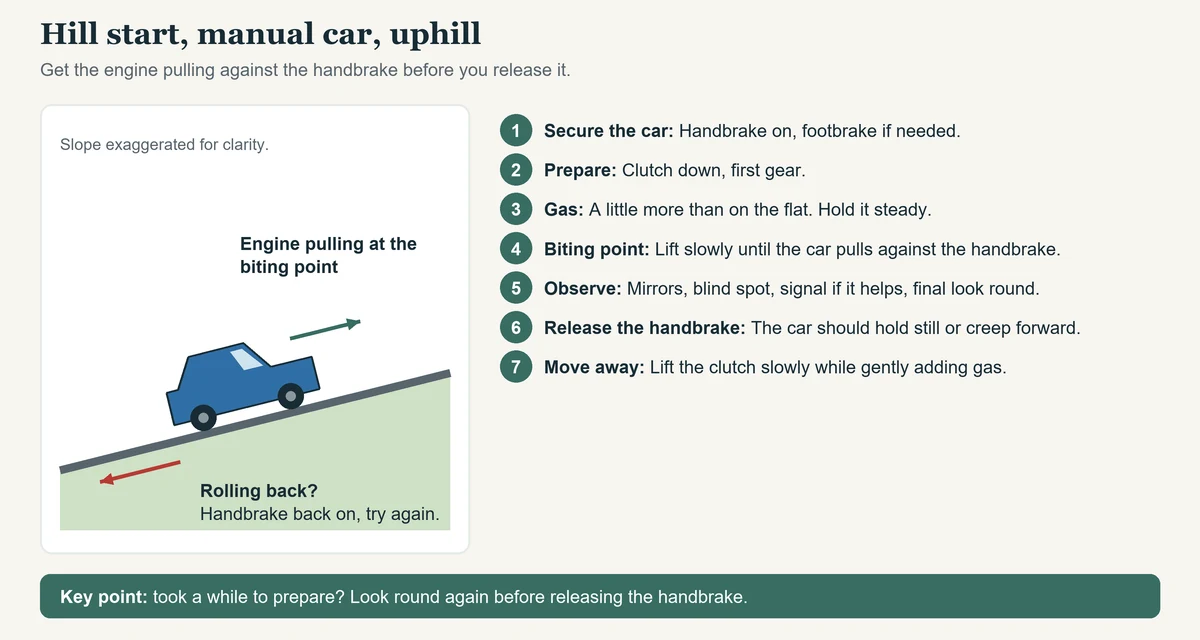
    The car is held by the handbrake. Your job is to get the engine pulling before you release it.

    A car on an uphill slope with a green arrow forward and a red roll back arrow, beside seven numbered steps: secure the car, prepare, gas, biting point, observe, release the handbrake, move away.
    The uphill hill start method for a manual car. Illustrative diagram, not to scale.
    1. Secure the car: handbrake on, footbrake if needed while you prepare.
    2. Prepare: clutch down, first gear.
    3. Gas: a little more accelerator than on the flat. Hold it steady.
    4. Biting point: lift the clutch slowly until you feel and hear the car pulling against the handbrake. On a steep hill you may need to lift slightly beyond your flat-road biting point.
    5. Observe: mirrors, blind spot, signal if it would help anyone, then a final look round. Highway Code rule 159 says move off only when it is safe.
    6. Release the handbrake. The car should hold still or creep forward. If it starts to roll back, put the handbrake back on and try again.
    7. Move away: lift the clutch slowly the rest of the way while gently increasing the gas.

    If you spent a while preparing, look round again before releasing the handbrake. The road behind may have changed. For more on the biting point, see clutch control for learner drivers.

    Starting downhill in a manual

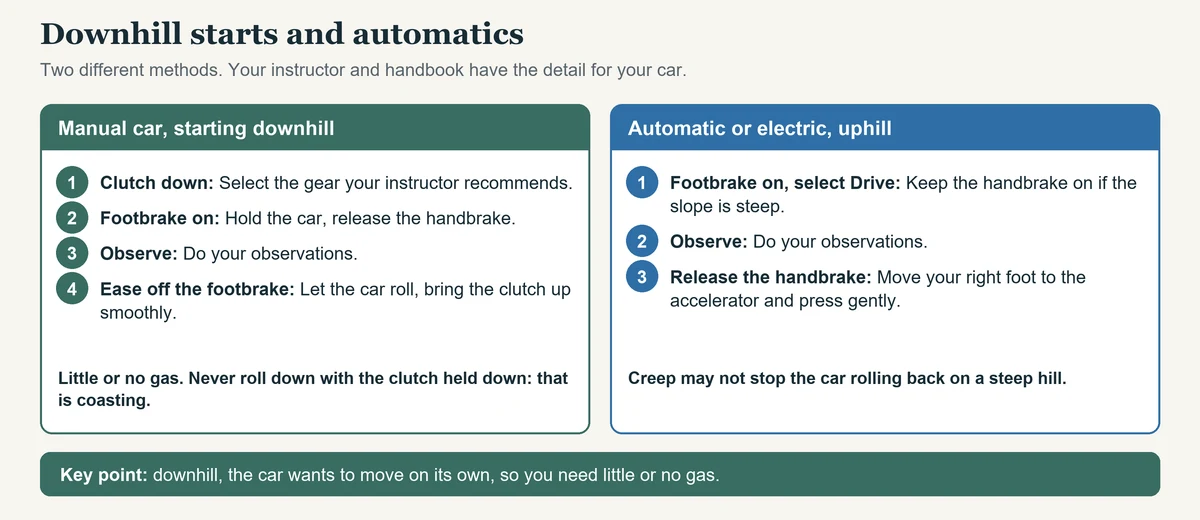
    Going downhill the car wants to move on its own, so the method is different. The usual approach your instructor will teach:

    Two panels: four steps for starting downhill in a manual car using the footbrake, and three steps for an uphill start in an automatic or electric car.
    Downhill starts in a manual and hill starts in an automatic follow different methods. Illustrative diagram, not to scale.
    1. Clutch down, select the gear your instructor recommends (often first, sometimes second on a gentle slope).
    2. Hold the car on the footbrake and release the handbrake.
    3. Do your observations.
    4. Ease off the footbrake to let the car roll, and bring the clutch up smoothly to connect the engine.

    You need little or no gas. Do not roll down the hill with the clutch held down: that is coasting, which Highway Code rule 122 warns against. See coasting and downhill control.

    Hill starts in an automatic or electric car

    1. Footbrake on, select Drive. Keep the handbrake on if the slope is steep.
    2. Do your observations.
    3. Release the handbrake, move your right foot from the brake to the accelerator and press gently.

    Some automatics creep forward when you release the brake; on a steep hill that creep may not be enough to stop the car rolling back. Learn how your car behaves on a slope from the handbook and your instructor. See learning to drive an automatic.

    Hill-start assist and electronic parking brakes

    Many newer cars have one or both. They are allowed on the GB test, but you need to understand them.

    Feature What it usually does What to check in your car’s handbook
    Hill-start assist Holds the brakes briefly after you lift your foot off the footbrake, giving you time to move to the accelerator When it switches on, and how long it holds (often only a short time)
    Electronic parking brake A switch instead of a lever. Some release automatically when you move off How to apply and release it, and whether it releases itself when you pull away
    Auto hold Holds the car while stopped, even after you take your foot off the brake How to switch it on and off, and the dashboard light that shows it is active

    Do not treat any of these as a replacement for securing the car. If a system is off, faulty or times out, the car can roll. DVSA examiners can mark a fault for “parking brake: failure to apply or release correctly and when necessary”, whatever kind of handbrake it is. For more on car technology, see driver assistance systems explained.

    What the examiner looks for

    • Observation: full checks before moving, including the blind spot.
    • Control: no rollback and no excessive revving.
    • Judgement: waiting for a safe gap rather than pulling out because you feel pressured.
    • Calm recovery: if you stall, secure the car, restart, and observe again. See stalling and how to recover.

    How serious a fault is depends on what happened. Rolling back a little on an empty road is different from rolling towards the car behind. See driving test faults explained.

    Hill start problems and fixes

    What happens Likely cause Fix
    Rolls back when you release the handbrake Not at the biting point yet Handbrake back on; lift the clutch a little more until the car pulls
    Engine screams, car moves slowly Too much gas, clutch slipping Less gas; lift the clutch more smoothly
    Stalls as you release Too little gas, or clutch lifted too fast A little more gas; hold the biting point
    Forgot the blind spot while concentrating on control Control took all your attention Prepare the controls first, then observe, then release
    Car moves before you expected Hill-start assist or auto hold released Learn the timing of your car’s system on a quiet slope

    How to practise

    1. Talk through the method while parked.
    2. Start on a gentle slope on a quiet road with your instructor.
    3. Do several in a row, with full observations each time.
    4. Move to steeper hills, then hills with parked cars and traffic.
    5. Practise stopping and moving off at junctions on a slope, where you must also judge a gap.

    Common questions

    Do you fail the driving test for rolling back?

    Not automatically. DVSA examiners look for moving off without rollback, so rolling back is a fault, but how it is marked depends on how far you rolled and whether it caused risk to anyone.

    Will I definitely get a hill start on my GB test?

    GOV.UK says you will be asked to do one. If there is no suitable hill on the route, DVSA guidance says the examiner carries out an extra stop instead.

    Can I use hill-start assist on the test?

    Yes, in GB. GOV.UK lists hill-start assist and electronic parking brakes among the features you can use.

    Should I hold the car on the clutch instead of the handbrake?

    No. Holding a car on a hill with the clutch wears it and is easy to get wrong. Use the handbrake or footbrake while you wait.

    Is the Irish hill start different from the GB one?

    The control skill is the same. The way it fits into the test differs: see Irish driving test manoeuvres.

    Related: moving off and mirror signal manoeuvre, the practical driving test. Guides: learning to drive in Great Britain and learning to drive in Ireland.

    Sources

    • GOV.UK, “Driving test: cars, what happens during the test” (gov.uk)
    • GOV.UK, “Driving test: cars, using your own car” (gov.uk)
    • DVSA, “Carrying out driving tests: examiner guidance, 1. Car driving test” (gov.uk)
    • DVSA, “Control and positioning” (readytopass.campaign.gov.uk)
    • Department for Transport, “The Highway Code”, rules 122 and 159 (gov.uk)
    • Road Safety Authority, “Preparing for your test” and “Standard procedures for conducting driving tests” (2025) (rsa.ie)
  • Clutch Control for Learner Drivers: Biting Point and Creep (UK)

    Clutch Control for Learner Drivers: Biting Point and Creep (UK)

    Photo: Dave Fox Cars / Unsplash. Illustrative photograph.

    Clutch control is how you move a manual car smoothly at low speed: finding the biting point, holding it, and feeding the clutch up while you keep looking at the road, not your feet. This guide is for learners in the UK and Ireland in manual cars. It explains what the clutch does, how to find the biting point, how to creep slowly for manoeuvres, and the clutch habits examiners mark as faults.

    Key facts

    • DVSA’s Ready to Pass skills list asks learners to use the foot controls (accelerator, brake, clutch) smoothly and progressively, and to adapt quickly when driving a different vehicle.
    • On the GB driving test, examiners can mark “clutch: uncontrolled use” and coasting “with clutch pedal depressed” as faults.
    • The biting point is in a different place in every car. Learn it by feel in the car you drive.
    • Automatic cars have no clutch pedal. If you pass in one, you can only drive automatics (see learning to drive an automatic).

    What does the clutch actually do?

    The clutch connects the engine to the wheels.

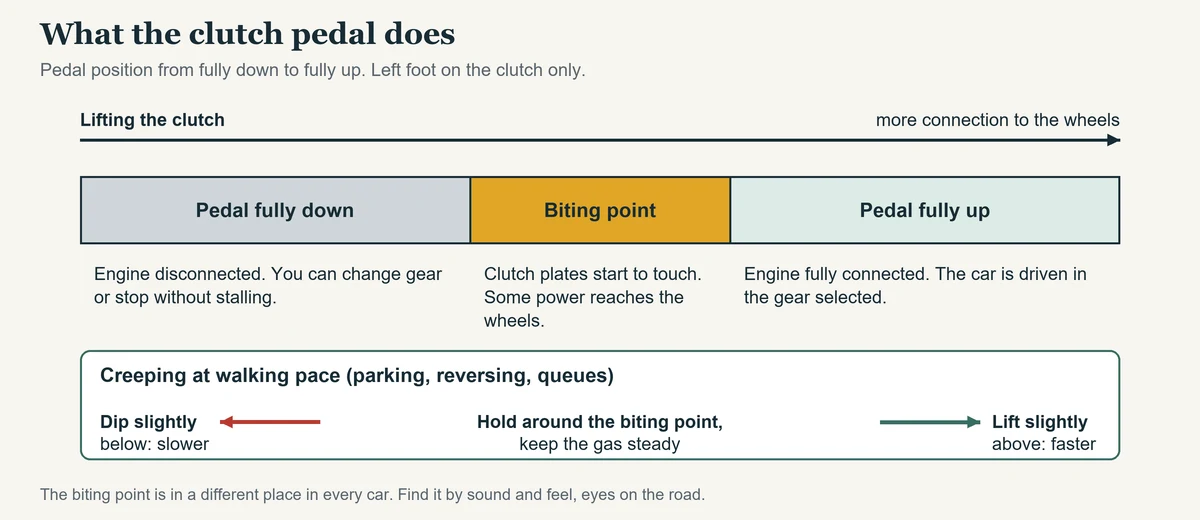
    A bar showing clutch pedal travel: fully down disconnects the engine, the biting point lets some power reach the wheels, fully up connects the engine. Below, dipping slightly below the biting point slows the car and lifting slightly above speeds it up.
    Clutch pedal positions and how small movements around the biting point control creeping speed. Illustrative diagram, not to scale.
    • Pedal fully down: engine disconnected. You can change gear or stop without stalling.
    • Pedal fully up: engine fully connected. The car is driven by the engine in whatever gear you have selected.
    • In between (the biting point): the clutch plates start to touch and some power reaches the wheels. This is the zone where clutch control happens.

    Use your left foot for the clutch only. The right foot works the accelerator and the footbrake.

    How to find the biting point

    Do this first with your instructor in a quiet, flat place.

    1. Footbrake or handbrake on. Clutch fully down. Select first gear.
    2. Press the accelerator slightly and hold it steady. Your instructor will tell you how much your car needs.
    3. Lift the clutch very slowly until you hear the engine note drop slightly and feel the car want to move. On some cars the front of the bonnet rises a little. That is the biting point.
    4. Hold your foot still. Do not lift further yet.
    5. Press the clutch back down and repeat until you can find it without looking.

    The signals are sound and feel: engine note, a slight vibration, the car pulling against the brake. Your eyes should be free for the mirrors and the road.

    Moving off with clutch control

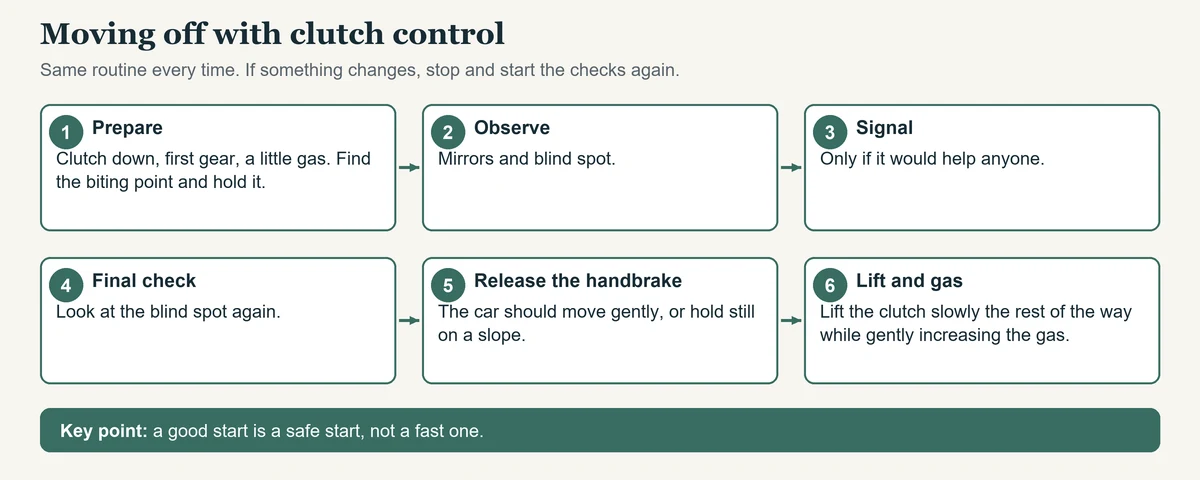
    Once you can find the biting point, moving off is the same routine every time. Highway Code rule 159 says before moving off you should use all mirrors, look round for blind spots, signal if necessary, look round again, and move off only when it is safe.

    Six numbered steps for moving off: prepare at the biting point, observe, signal if needed, final blind spot check, release the handbrake, then lift the clutch while adding gas.
    The moving off routine with clutch control. Illustrative diagram, not to scale.
    1. Prepare: clutch down, first gear, a little gas, find the biting point and hold it.
    2. Observe: mirrors and blind spot.
    3. Signal if it would help anyone.
    4. Final check of the blind spot.
    5. Release the handbrake. The car should move gently, or hold still on a slope.
    6. Lift the clutch slowly the rest of the way while gently increasing the gas.

    If something changes during these steps, a cyclist appears or a car pulls out, stop and start the checks again. A good start is a safe start, not a fast one. On a slope, see hill starts explained.

    Creeping slowly for manoeuvres and queues

    Parking, reversing and crawling traffic all need the car to move at walking pace or slower. In a manual, you do that by holding the clutch around the biting point:

    • Lift slightly above the biting point to move a little faster.
    • Dip slightly below it to slow down.
    • Cover the footbrake, or use it gently, if the road slopes.
    • Keep the gas steady rather than pumping it.

    Holding the clutch at the biting point for short spells is normal. Holding it there for long periods, or using the clutch to hold the car on a hill instead of the brakes, wears the clutch and is uncontrolled. For test manoeuvres, see driving test manoeuvres explained.

    Stopping and changing gear

    • Stopping: brake first. Press the clutch down just before the car stops, so the engine does not stall. Pressing it too early means you are coasting.
    • Changing gear: clutch down fully and promptly, change gear, then lift the clutch smoothly. Do not ride the clutch between changes.
    • Turning: keep the clutch up and the car in gear through the turn. Holding the clutch down round a corner removes engine braking and steering feel.

    Highway Code rule 122 explains why holding the clutch down while moving is coasting: engine braking is lost, speed builds downhill, the footbrake works harder, steering response is affected and it may be harder to select a gear when you need one. See coasting and downhill control.

    Common clutch problems and fixes

    Problem Likely cause What to practise
    Car jerks forward, then stalls Clutch lifted too fast past the biting point Hold at the biting point for a second, then lift slowly
    Engine revs loudly but car barely moves Too much gas, clutch held too low Less gas; lift the clutch a little more
    Car rolls back on a slope Handbrake released before the biting point was found Find the biting point first, then release
    Jerky gear changes Clutch dropped quickly after the change Lift smoothly through the biting point
    Stalls when stopping Clutch pressed too late Clutch down just before the car stops
    Looking down at the pedals Not yet confident by feel Stationary drills: find the biting point with eyes forward
    Foot resting on the clutch while driving Habit Rest your left foot flat on the floor away from the pedal

    Stalls happen to every learner. What matters is a calm restart and fresh observations: see stalling and how to recover.

    A practice plan

    1. Stationary: find and hold the biting point, eyes forward, ten times.
    2. Flat, quiet road: move off and stop repeatedly, with full observations each time.
    3. Slow control: creep at walking pace in a quiet car park or road, steering gently.
    4. Gentle slopes: uphill and downhill starts with your instructor.
    5. Traffic: queues, junctions and roundabouts where you must move off promptly.
    6. A different car: if you practise privately as well as with an instructor, expect the biting point to be somewhere else. Spend a few minutes finding it before you drive.

    In Great Britain, private practice needs a supervisor who meets the rules and insurance that covers you. See supervising a learner driver. In Ireland, see accompanying a learner driver in Ireland.

    Common questions

    How long does it take to learn clutch control?

    It varies. Many learners get the basic biting point in the first lesson or two, but smooth slow control in traffic and on hills takes longer. There is no official number of hours.

    Is it bad to hold the car at the biting point?

    For a few seconds while you get ready to move, it is normal. For longer, use the handbrake or footbrake to hold the car and save the clutch.

    Should I press the clutch when braking?

    Not straight away. Brake first and press the clutch just before the car stops, or when the engine would otherwise labour at low speed. Your instructor will show you for your car.

    Why does the biting point feel different in my parents’ car?

    Every clutch is different and they change with wear. Find the new biting point while stationary before you move.

    Does clutch control matter on the Irish driving test?

    Yes. The RSA test assesses your control of the car, including moving off, the hill start and the reverse manoeuvre. See Irish driving test manoeuvres.

    Can I avoid the clutch by learning in an automatic?

    Yes, but in both GB and Ireland passing in an automatic restricts your licence to automatics. See automatic or manual and Ireland’s code 78.

    Related: your first driving lesson, vehicle handling. Guides: learning to drive in Great Britain and learning to drive in Ireland.

    Sources

    • DVSA, “Control and positioning” (readytopass.campaign.gov.uk)
    • DVSA, “Carrying out driving tests: examiner guidance, 1. Car driving test” (gov.uk)
    • Department for Transport, “The Highway Code: General rules, techniques and advice for all drivers and riders (103 to 158)” (gov.uk)
    • Department for Transport, “The Highway Code: Using the road (159 to 203)” (gov.uk)
    • GOV.UK, “Driving test: cars, using your own car” (gov.uk)
  • Choosing Your First Car: Total Cost and Checks (UK and Ireland)

    Choosing Your First Car: Total Cost and Checks (UK and Ireland)

    Photo: Koons Automotive / Unsplash. Illustrative photograph.

    The cheapest first car to buy is often not the cheapest to own. For a new driver in the UK or Ireland, insurance is often the biggest yearly cost, so compare the exact vehicle and its total yearly cost before you hand over any money. This guide gives a total-cost worksheet, how to read safety ratings, the official checks for a used car in Great Britain, and what to look for if you also want to use the car for your test.

    Key facts

    • Get an insurance quote on the exact car before you buy it. Model, engine size, trim and modifications all change the price.
    • GB vehicle tax (as shown on GOV.UK, November 2026): the standard rate for most cars registered from 1 April 2017 is £200 a year, plus an extra £440 a year for five years on cars with a list price over £40,000 (petrol or diesel) or £50,000 (electric). Older cars are taxed on different bands.
    • MOT history is free to check on GOV.UK with just the number plate: results, recorded mileage, failed parts and minor problems.
    • A star rating belongs to a model and test year, not to the individual car you are looking at.

    Step 1: decide what the car is for

    Write down the answers before you browse adverts:

    • Where will you mostly drive: town, motorway, rural lanes?
    • How many miles a year, roughly?
    • Will you carry passengers often? (See carrying passengers after passing.)
    • Do you hold, or are you taking, an automatic-only licence? If you pass in an automatic, you can only drive automatics. See automatic or manual.
    • Where will it be parked, and can you charge at home if it is electric?
    • Do you want to practise and take your test in it?

    Then sit in the car. Can you get a good driving position, see out well and reach the controls comfortably? A car that suits your body is safer than one that suits a review.

    Step 2: work out the total cost for a year

    Use this worksheet for each car you are considering. Fill it with real quotes, not guesses.

    Cost Where to get the figure Notes
    Purchase price The advert, after any haggling Include any finance interest if you borrow
    Insurance Quotes on the exact registration Usually the biggest yearly cost for new drivers. See why insurance costs so much.
    Vehicle tax GOV.UK vehicle tax rates (GB); motor tax rules (Ireland) In GB, check whether the expensive car supplement applies
    Fuel or charging Your yearly miles divided by realistic fuel economy Compare home and public charging prices if electric
    MOT (GB) or NCT (Ireland) Official test fees Budget for repairs the test may reveal
    Servicing Quotes from garages Check the service history for what is due
    Tyres Price of the size on the car Bigger alloy wheels often mean dearer tyres
    Repairs fund Your own estimate Older cars need a bigger buffer
    Breakdown cover, parking, road charges Providers, your council, charge schemes See ULEZ, clean air zones and Dart Charge

    Add it up and divide by 12. That monthly figure is what the car really costs you.

    Step 3: check the safety rating properly

    Euro NCAP rates new cars sold in Europe, including the UK and Ireland. Its assessment covers areas including crash protection, child safety, pedestrian and cyclist safety and active safety technology. Three points matter when you compare:

    1. The test year. Euro NCAP says its requirements are updated every three years and its assessment has evolved since the first ratings in 1997. Five stars from many years ago is not the same as five stars from a recent test.
    2. The exact version. Euro NCAP sometimes gives a second rating for cars fitted with an optional safety pack. Check that the car in front of you actually has that equipment.
    3. The individual car. A rating says nothing about whether this car has been crashed, badly repaired or poorly maintained. That is what the checks below are for.

    If the car has driver assistance features, learn what they do and do not do. See driver assistance systems explained.

    Step 4: official checks on a used car in Great Britain

    GOV.UK’s used vehicle checklist covers:

    • Vehicle details: use the DVLA vehicle enquiry service to check the make, colour, tax status and MOT expiry match what the seller told you.
    • MOT history: with the number plate you can see past results, the mileage at each test, which parts failed and any minor problems (for tests in England, Scotland and Wales). It can also show some safety recalls. Mileage that goes down between tests is a warning sign.
    • The V5C log book: check it has a ‘DVL’ watermark and that the details, vehicle identification number (VIN) and engine number match the car. Be wary of a seller who says they do not have the V5C.
    • A private history check: GOV.UK’s guide to written-off vehicles suggests one to find out if a car is stolen, has outstanding finance, has a mileage discrepancy or has been written off.
    • Written-off cars: speak to your insurer before buying one. The premium may be much higher.

    Then have the car inspected, or take someone who knows cars, and test drive it. For the paperwork you need once it is yours, see car documents: MOT, tax, insurance and the V5C.

    Northern Ireland and Ireland

    • Northern Ireland: MOT tests are carried out at DVA test centres, and the GOV.UK MOT history service includes Northern Ireland tests from 2017. See MOT in Northern Ireland.
    • Ireland: check the NCT certificate, motor tax and insurance position before buying. See tax, insurance and the NCT.

    Step 5: if you want to take your test in it (GB)

    Not every car is accepted for the GB driving test. GOV.UK says the car must, among other things:

    • be taxed, roadworthy, insured for a driving test and have a current MOT if over 3 years old
    • have no warning lights showing safety issues and no tyre damage, with legal tread on every tyre (no space-saver spare)
    • have a passenger seat belt and a proper passenger head restraint (not slip-on)
    • have an officially fitted mph speedometer and be able to reach at least 62mph
    • have an extra interior rear-view mirror fitted for the examiner during the test
    • have 4 wheels and a maximum authorised mass of no more than 3,500kg.

    Some cars cannot be used because the examiner does not get all-round vision. GOV.UK lists panel vans and models including some convertibles, the 2-door Smart Fortwo, the Toyota iQ and the Polestar 4 and 5, and says other models may be unsuitable too. Check with the test centre before buying a coupe or convertible for your test. For Ireland, see your car for the Irish driving test.

    Mistakes first-car buyers make

    Mistake Better approach
    Falling for a car, then getting an insurance quote Quote first, view second
    Comparing star counts only Compare test year, version and equipment
    Trusting the seller’s history Check MOT history and the V5C yourself
    Buying with modifications Modifications usually need declaring and can raise premiums. See modifying your first car.
    Fronting (insuring it in a parent’s name when you are the main driver) Insure it honestly, with the real main driver named; ask the insurer if unsure
    Buying cheap cover from an unknown broker Check the insurer is genuine. See ghost brokers.

    Common questions

    What is the cheapest type of car to insure for a new driver?

    There is no single answer. Smaller engines and lower-powered, unmodified cars tend to be cheaper, but the only reliable way to know is to get quotes on the exact cars you are considering.

    Should my first car be electric?

    It can be, if you can charge cheaply and the insurance quote works. Remember that electric cars have two pedals, so if you learn and pass in one you get an automatic-only licence.

    Is a newer car always safer?

    Newer designs are generally tested to tougher standards, but condition matters too. A well-maintained car with a good recent rating beats a newer one that has been badly repaired.

    Do I need an MOT on a car I have just bought?

    In GB, a car needs a current MOT once it is over 3 years old. Check the expiry date on the MOT history service before you buy.

    Can I drive my new car home as a learner?

    Only with L plates, insurance that covers you as a learner, and a qualifying supervisor. See learner driver insurance in Great Britain and supervising a learner driver.

    Guides: learning to drive in Great Britain, learning to drive in Northern Ireland and learning to drive in Ireland.

    Sources

    • GOV.UK, “Vehicle tax rate tables” (gov.uk)
    • GOV.UK, “Check the MOT history of a vehicle” (gov.uk)
    • GOV.UK, “Check a used vehicle you’re buying” (gov.uk)
    • Department for Transport, “Buying repaired written off vehicles: a consumer guide” (gov.uk)
    • GOV.UK, “Driving test: cars, using your own car” (gov.uk)
    • Euro NCAP, “The ratings explained” and “How to read the stars” (euroncap.com)
  • Driving Test Nerves: How to Stay Calm (UK and Ireland)

    Driving Test Nerves: How to Stay Calm (UK and Ireland)

    Photo: Anastasia Shuraeva / Pexels. Illustrative photograph.

    Nerves before a driving test are normal, and examiners expect them. What helps most is not a trick on the day but a routine you have already rehearsed, so the test feels like another lesson. This guide is for learners in Great Britain and Ireland: what DVSA says about nerves, a step-by-step routine from the week before to the drive itself, and what to do if you make a mistake.

    Key facts (Great Britain)

    • DVSA’s Ready to Pass campaign says 1 in 10 people who fail the driving test say it was mostly down to nerves.
    • Examiners are told to offer a few words of reassurance to candidates who are struggling with nerves.
    • The examiner will ask if you want your instructor or accompanying driver to come with you on the test, and whether you want them present for the debrief.
    • You can carry on after a mistake. GOV.UK says it might not affect your result if it is not serious, and the examiner only stops the test if your driving is a danger to other road users.
    • You can change your test free if you do it at least 10 full working days (Monday to Saturday) before the appointment. Limits on how often you can change apply from 2026: see driving test booking rules 2026.

    Are you nervous, or not ready yet?

    These feel similar but need different answers. DVSA’s Ready to Pass checklist says you are usually ready when:

    1. you do not need prompts from your instructor
    2. you do not make serious or dangerous mistakes
    3. you can pass mock driving tests
    4. you have practised ways of managing your nerves
    5. your instructor agrees you are ready.

    If points 1 to 3 are not true yet, nerves are partly your brain telling you something useful. Moving the test is often better than going in unprepared. If they are true, the nerves are just nerves, and the routine below is for you. See how to run a mock driving test.

    Build the routine before test week

    A routine works because it removes decisions. Agree it with your instructor and rehearse it on normal lessons.

    • Mock tests: do at least one in which your instructor stays silent apart from directions, like an examiner. Practise carrying on after you make a mistake.
    • Unfamiliar directions: ask your instructor to give you a destination you do not know, or set a sat nav, so getting lost stops being frightening. On the GB test you drive independently for 20 to 35 minutes and the examiner sets the sat nav for you. See independent driving on the test.
    • Same car, same start: sit in the car the same way each time: seat, mirrors, seat belt, a slow breath, then your moving-off checks. On test day, that sequence will feel automatic.
    • The show me, tell me questions: learn them until they are boring. See show me, tell me questions.
    • Talk to your instructor about the situations that make you most tense, then practise those on purpose.

    Test week

    • Avoid clashes: Ready to Pass suggests not taking the test during other stressful events, such as school exams.
    • Sleep: aim for a few good nights’ sleep beforehand. Tiredness can increase stress.
    • Book a lesson before the test if you can, so you drive the area and the car just before.
    • Check the paperwork: in GB you need your UK licence and a suitable car, and if you took your theory test in Northern Ireland, the theory certificate. GOV.UK says the test is cancelled with no refund if you do not take the right things. See what to bring to your driving test.

    The morning of the test

    1. Eat something normal. Ready to Pass warns that too much caffeine can make you feel jittery.
    2. Pack your documents the night before so there is nothing to search for.
    3. Plan to arrive in good time, without long waiting about in the car park.
    4. If you use a breathing or calming exercise, do it before you get in the car or while parked. Never try something new while driving.

    During the test

    Talking can help

    Examiners are told to be friendly to help candidates relax. It is fine to say you are nervous. If you are unsure what a direction meant, ask; a wrong guess causes more stress than a quick question.

    Stay in the moment

    Ready to Pass advises staying in the moment rather than dwelling on what has just happened. Your job is the next junction, not the last one.

    If you make a mistake

    In GB you can pass with up to 15 driving faults and no serious or dangerous faults. One wobble rarely decides the result. You do not know how the examiner marked it, so assume you are still passing and keep driving well. Thinking about the error is what causes the next one.

    If you go the wrong way

    GOV.UK says the examiner will not give you a fault for taking a wrong turning, and will help you get back on the route. Keep driving safely; what counts is how you drive, not where you go.

    Mindfulness and extra support

    Ready to Pass says mindfulness can help some people with stress and anxiety but is not right for everyone, and that some instructors are trained to build it into lessons. It points to the NHS website and the mental health charity Mind for information.

    This is preparation advice, not treatment. If anxiety is affecting your daily life or making it hard to drive safely, talk to your GP. If you have a condition that affects how you take tests, DVSA offers extra support for some candidates: see extra support for the theory and driving tests.

    Ireland: same preparation, different system

    The routine above works for the RSA test too. Rehearse the pre-test checks and the Rules of the Road questions until they feel easy, because they come before you drive and set the tone. See Irish pre-test checks and the Irish driving test explained. Notice periods for moving an Irish test are set by the RSA, so check them on rsa.ie before deciding to postpone (see booking the Irish driving test).

    If it does not go well

    A fail is feedback, not a verdict on you. Listen to the debrief, ask your instructor to hear it with you, and work on the specific faults. See failed your driving test in GB or failed the Irish driving test.

    Common questions

    Should I tell the examiner I am nervous?

    You can. Examiners know nerves are normal, and DVSA guidance asks them to offer reassurance to candidates who are struggling.

    Can my instructor sit in on my test?

    In GB, yes, if you want. The examiner asks whether you want someone to sit in the back or be with you for the result and feedback. GOV.UK says this is usually your instructor, but it can be a relative or friend. They must be over 16 and cannot take part in the test.

    Is it better to postpone the test if I am very nervous?

    If you are not ready, yes. If you are ready but nervous, postponing often makes the nerves worse next time. Use the readiness checklist above and ask your instructor.

    Do calming tablets or herbal remedies help?

    Do not take anything new before a test. Some medicines can affect driving. Ask a pharmacist or your GP before taking anything.

    What if I panic during the test?

    Slow your thinking down to the next task: mirrors, speed, the next hazard. If you feel you cannot drive safely, say so to the examiner. Your safety and other road users’ safety matter more than finishing the test.

    I passed my mock tests but fall apart on the real one. Why?

    Usually because the real test is new. Make your mocks more realistic: a new route, a silent instructor, a start at the test centre and a time limit.

    Related: top reasons people fail the driving test, stalling and how to recover. Guides: learning to drive in Great Britain and learning to drive in Ireland.

    Sources

    • DVSA, “Managing driving test nerves” (readytopass.campaign.gov.uk)
    • GOV.UK, “Driving test: cars, what happens during the test” (gov.uk)
    • GOV.UK, “Driving test: cars, what to take” (gov.uk)
    • GOV.UK, “Driving test faults and your result” (gov.uk)
    • DVSA, “Carrying out driving tests: examiner guidance, 1. Car driving test” (gov.uk)
  • Eco-Safe Driving Tips for Learners (UK and Ireland)

    Eco-Safe Driving Tips for Learners (UK and Ireland)

    Photo: Mike Bird / Pexels. Illustrative photograph.

    Eco-safe driving means planning far enough ahead that you rarely need hard acceleration or late braking. It saves fuel, but on the driving test in Great Britain it never counts against safety: DVSA examiners record eco-safe driving and talk you through it afterwards, but it does not decide whether you pass. This guide covers what examiners look at, how to drive smoothly as a learner in the UK or Ireland, and the habits that look economical but are not safe.

    Key facts

    • GB driving test: DVSA guidance for examiners says fuel-efficient driving “does not contribute to the result of the test”. It is assessed over the whole drive and discussed in the debrief, pass or fail.
    • Safety comes first. The same guidance says a candidate may give up fuel-efficient techniques so that safety is not compromised.
    • Coasting is not eco-driving. Highway Code rule 122 says coasting can reduce your control, and examiners mark it as a fault.
    • Idling: under rule 123 you must not leave an engine running unnecessarily while the vehicle is stationary on a public road.

    What does the examiner look for in eco-safe driving?

    DVSA splits eco-safe driving into two parts on the GB test report:

    Area What the examiner watches What it looks like in practice
    Control Moving off, accelerator use and gears Using the highest gear that suits the speed without making the engine labour; no harsh acceleration or high revs between gear changes
    Planning Hazard awareness, planning and anticipation, engine braking Scanning well ahead, spotting a queue or red light early and easing off rather than braking late

    The examiner guidance also notes that stopping needlessly and then moving away again wastes fuel, and that an eco-safe driver keeps the vehicle moving whenever and wherever it is safe. The key word is safe. Creeping towards a junction to avoid stopping, when you cannot see properly, is not good eco-driving. It is poor observation.

    Eco-safe points do not affect your result, but the planning behind them is the same planning that prevents serious faults. A learner who brakes late for every hazard is also a learner who reacts late. See driving test faults explained.

    Smooth driving starts with your eyes

    Most jerky driving is late driving. If you see a hazard late, you have to deal with it quickly. Look further ahead and you get time to adjust gently.

    • Traffic lights: a light that has been green for a while may change. Ease off early and you may not need to brake hard.
    • Queues: brake lights several cars ahead are your cue to lift off the accelerator now, not when the car in front stops.
    • Junctions and roundabouts: plan your speed on the approach so you can stop if needed but keep moving if it is clear and you can see.
    • Hills: look at the gradient before you reach it and choose your gear early (see coasting and downhill control).

    The Highway Code (rule 117) puts it simply: in normal circumstances the safest way to brake is early and lightly, firmer as you begin to stop, then easing the pressure just before the car comes to rest to avoid a jerky stop.

    Smooth control: accelerator, gears and brakes

    Accelerator

    Press progressively. A burst of power followed by braking wastes fuel and unsettles passengers. Accelerate firmly enough to make safe progress when joining a faster road; smooth does not mean slow.

    Gears (manual cars)

    Change up when the engine is comfortable at the new speed, and do not let it labour in too high a gear. You do not need to use every gear in order; your instructor will show you when skipping a gear suits the situation.

    Engine braking

    Lifting off the accelerator while in gear slows the car. Used with planning, it means less braking. It only works while the car is in gear with the clutch up, which is one reason coasting is a bad habit.

    Brakes

    Early and light (rule 117). In an emergency, brake immediately and firmly; eco-driving never applies when you need to stop.

    Habits that look economical but are not safe

    Habit Why it is a problem Do this instead
    Coasting in neutral or with the clutch down Rule 122: no engine braking, speed rises quickly downhill, the footbrake works harder and steering response is affected. Examiners mark it as a fault. Stay in a suitable gear with the clutch up until just before you stop
    Following closely to “slipstream” Rule 126: leave enough space to stop if the vehicle ahead suddenly slows. Allow at least a two-second gap on high-speed roads, at least double on wet roads. Keep a safe gap; it also gives you room to ease off instead of braking
    Rolling up to junctions to avoid stopping You may not see enough, and a Stop sign means stop Keep moving only when you can see it is clear
    Watching the fuel economy display Your eyes belong on the road Review your driving after the journey, not during it
    Delaying a gear change to save fuel when you need power A labouring engine gives you less response to a hazard Choose the gear that gives you control

    Electric and hybrid cars

    Many electric and hybrid cars slow down when you lift off the accelerator, using regenerative braking to recharge the battery. Some have selectable levels, and some can bring the car almost to a stop without the footbrake. Learn how your car behaves from its handbook and your instructor while somewhere quiet. Two things to know:

    • Strong regeneration can slow you more than you expect when you lift off. The driver behind may not expect you to slow, so check your mirrors before lifting off sharply.
    • The principles are the same: look ahead, ease off early, brake early and lightly. See learning to drive an automatic for two-pedal control.

    Eco-driving before you set off

    Some of the biggest savings happen when the car is parked:

    • Tyre pressures: the Highway Code (Annex 6) says tyres must be correctly inflated to the manufacturer’s specification for the load. Under-inflated tyres waste fuel and affect handling. See basic car maintenance.
    • Weight and drag: remove heavy items you do not need and take off an empty roof box.
    • Plan the route: fewer wrong turns means less fuel and less stress.
    • Engine off when parked or waiting: rule 123 says you must not leave a parked vehicle unattended with the engine running. If you are likely to be stationary for more than a couple of minutes, apply the parking brake and switch off. Leaving the engine running while stationary in traffic is allowed.

    Ireland

    Learners in Ireland need the same skills: early observation, progressive braking and good gear use are part of normal driving and of the RSA test. The Irish test is marked on faults, not fuel economy. See Irish driving test marking and good driving practice in Ireland.

    A quick self-review after each lesson

    1. Where did I brake harder than I wanted? What could I have seen earlier?
    2. Did I ever hold the clutch down or sit in neutral while moving?
    3. Did the engine labour or rev hard anywhere?
    4. Did I keep a safe gap the whole time?

    Ask your instructor which one to work on next. Fix one at a time.

    Common questions

    Can you fail the driving test for not driving economically?

    Not in Great Britain. Examiners record eco-safe driving and give feedback, but DVSA guidance says it does not contribute to the result. The faults behind poor eco-driving, such as late braking or coasting, can be marked as driving faults in their own right.

    Is it better to brake or change down to slow down?

    Generally, brake to slow down, then select the gear for your new speed. Engine braking from lifting off helps, but your instructor will show you the method for your car.

    Does switching off at traffic lights save fuel?

    The Highway Code allows the engine to run when you are stationary in traffic. Many modern cars have stop-start that switches off automatically. Do not switch off manually in a queue unless your instructor tells you to.

    Should I drive below the speed limit to save fuel?

    Drive at a speed that suits the road and conditions. Holding up traffic for no reason is not good driving, and examiners look for appropriate progress.

    Is smooth driving the same as slow driving?

    No. Smooth driving is about planning and gradual inputs. You still need to make decisive progress when it is safe, for example joining a dual carriageway.

    More: clutch control, stopping distances and the two second rule. Guides: learning to drive in Great Britain and learning to drive in Ireland.

    Sources

    • Department for Transport, “The Highway Code: General rules, techniques and advice for all drivers and riders (103 to 158)” (gov.uk)
    • Department for Transport, “The Highway Code: Annex 6, vehicle maintenance, safety and security” (gov.uk)
    • DVSA, “Carrying out driving tests: examiner guidance, 1. Car driving test” (gov.uk)
    • DVSA, “Control and positioning” (readytopass.campaign.gov.uk)
  • Making Driving Lessons Count on a Budget (GB and Ireland)

    Making Driving Lessons Count on a Budget (GB and Ireland)

    Photo: Liza Summer / Pexels. Illustrative photograph.

    If money or practice time is tight, the biggest saving is making each lesson do one clear job, then backing it up with legal private practice and free revision. This guide is for learners in Great Britain and Ireland. It covers what to agree before you pay, how to prepare for each lesson, how to practise cheaply but legally, and what not to cut.

    Key facts

    • Great Britain: no minimum number of lessons, and instructors set their own prices. DVSA says lessons are still the best way to learn.
    • Ireland: 12 EDT lessons are compulsory. ADIs set their own fees.
    • Both: private practice is cheaper than lessons, but only with an eligible supervisor and insurance that covers you.

    Before you pay: get these in writing

    • The price and length of a lesson (an hour or longer).
    • Cancellation terms and notice needed.
    • Block booking discounts, and whether unused lessons are refunded if you change instructor.
    • Whether the instructor’s car on test day costs extra.
    • How progress will be recorded.

    Do not prepay a large block just because someone promises a pass in a set number of hours. In GB there is no official figure to promise against. For the full fee picture, see the cost of learning to drive in GB or the cost of learning to drive in Ireland.

    How to get more from every lesson

    When What to do Time
    The night before Read the Highway Code or Rules of the Road section for the skill you will practise (junctions, roundabouts, a manoeuvre) 15 minutes
    Start of lesson Tell the instructor the one skill you want to improve and the question left over from last time 2 minutes
    During Focus on that skill. Ask to repeat it in a new place once you can do it with prompts. The lesson
    After Note where you needed help and agree the next task 5 minutes

    In GB, DVSA’s Ready to Pass guidance tracks 27 skills from “introduced” to “reflection”. Ask your instructor which skills are still below independent and spend lesson time there. See questions to ask your instructor.

    Free and cheap ways to keep progressing

    • Theory and hazard practice at home. See the GB theory test topics, the hazard perception test and the practice questions.
    • Commentary as a passenger. Say out loud the hazards and signs you see. It trains observation, though it does not replace driving.
    • Parked control practice. Learn the controls, lights and wipers in the car with the engine off.
    • Private practice. Once your instructor says you are ready, practise what you did in the last lesson.

    Private practice: the rules you cannot cut

    Great Britain Republic of Ireland
    Supervisor Over 21, qualified to drive that type of vehicle, held a full licence for 3 years Held a full licence in the same category for a continuous 2 years; not a novice on N plates
    Plates L plates front and back (D plates in Wales) L plates front and rear
    Insurance Your own learner policy, or cover on the owner’s policy. Some insurers need the supervisor to be over 25. You must be insured to drive that car
    If you break the rules No proper supervision: up to £1,000 fine and up to 6 points. No insurance: unlimited fine, a ban and up to 8 points. Driving unaccompanied: a fixed charge and penalty points, and the car can be detained

    Details: supervising a learner driver, learner driver insurance in GB, accompanying a learner in Ireland and learner insurance in Ireland.

    No car or supervisor?

    Tell your instructor early so the plan does not assume practice you cannot get. Longer or more frequent lessons may then make sense, or an intensive course once you have the basics. Never drive unsupervised or with an ineligible supervisor to save money: the fines and points cost far more than lessons.

    What not to cut

    • A mock test before the real one. A failed test means a new fee and a wait.
    • Insurance that actually covers you.
    • In Ireland, any of the 12 EDT lessons. You cannot sit the test until all are recorded.

    Common questions

    Are two-hour lessons better value?

    They can be, because less time is lost on pick-up and warm-up. Some learners tire in long lessons, so try one first.

    Is block booking worth it?

    Only if the terms let you leave and get unused lessons back. Read them first.

    Can I pay a friend to supervise me?

    In GB, anyone you pay to teach you must be an ADI or a registered trainee. Supervisors who are family or friends practise with you for free.

    How many lessons do I need in GB?

    There is no minimum. See how many lessons you need.

    Does private practice count towards EDT in Ireland?

    No. Only sessions with an approved ADI count towards EDT. Private practice is extra. See Essential Driver Training.

    Guides: learning to drive in Great Britain and learning to drive in Ireland.

    Sources

    • GOV.UK, “Driving lessons and learning to drive: taking driving lessons” (gov.uk)
    • GOV.UK, “Driving lessons and learning to drive: practising with family or friends” (gov.uk)
    • DVSA, “Learning to drive and practising” (readytopass.campaign.gov.uk)
    • DVSA, “Keep track of your progress learning to drive” (readytopass.campaign.gov.uk)
    • Road Safety Authority, “Car driving lessons (EDT)” (rsa.ie)
    • Road Safety Authority, “Find an Approved Driving Instructor” (rsa.ie)
    • Road Safety Authority, “Unaccompanied learner drivers” (rsa.ie)