
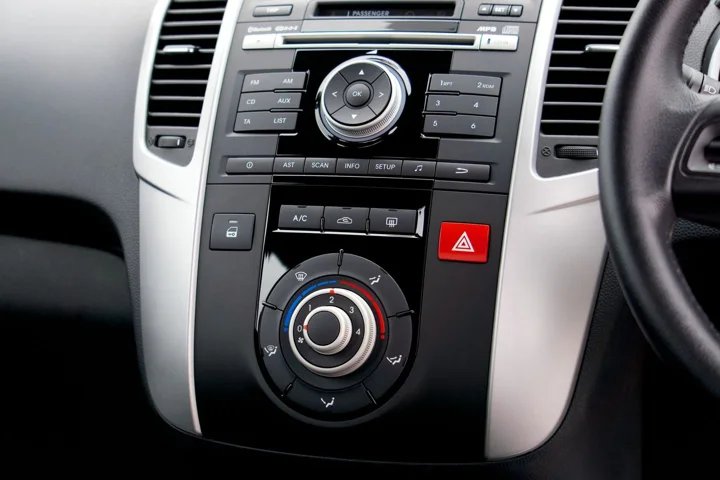
Photo: Mike Bird / Pexels. Illustrative photograph.
An automatic car has two pedals, accelerator and brake, and changes gear for you, so there is no clutch to master and no stalling in the usual sense. You still need to learn the gear selector, low-speed creep, parking and hill control properly, and in both Great Britain and Ireland passing your test in an automatic limits your licence to automatics. This guide covers the controls, how to drive one smoothly, and what the choice means for your licence.
Key facts
- Two pedals = automatic. GOV.UK says manual cars have three pedals and automatic and semi-automatic cars have two. Most electric cars have two pedals.
- Licence (GB): if you take your test in an automatic or semi-automatic car, you will only be able to drive automatic and semi-automatic cars after passing.
- Licence (Ireland): passing in an automatic also restricts you to automatics (code 78). See Ireland automatic test and code 78.
- The GB test is the same for manual and automatic cars, according to GOV.UK.
The controls
The gear selector
| Position | What it does | When you use it |
|---|---|---|
| P (Park) | Locks the transmission | When parked, with the parking brake on. Most cars only let you start the engine in P or N. |
| R (Reverse) | Drives backwards | Only when the car is stopped |
| N (Neutral) | Disconnects drive | Rarely; for example if the car needs to be pushed or towed. Not for coasting. |
| D (Drive) | Normal forward driving | Almost all your driving |
| Other modes (L, B, S, M, paddles) | Low gears, stronger engine or regenerative braking, sport or manual selection | Check your handbook; your instructor will say if you need them |
Selectors vary a lot: levers, dials, buttons and stalks behind the steering wheel. Learn yours while parked. Always check the display shows the gear you meant before you release the brake, especially when switching between D and R during a manoeuvre.
The pedals
Instructors usually teach you to use only your right foot, for both accelerator and brake. Keep your left foot flat on the floor. Using two feet makes it easy to press both pedals at once.
How to move off in an automatic
- Footbrake down. Start the car (in P or N).
- Select D (or R), keeping your foot firmly on the brake.
- Release the parking brake. On some cars an electronic parking brake releases itself as you pull away.
- Observe: mirrors, blind spot, signal if needed, final look. Highway Code rule 159 says move off only when it is safe.
- Ease your foot off the brake. Many cars creep forward on their own. Move to the accelerator and press gently if you need more speed.
DVSA examiner guidance lists checking the gear lever or selector is in neutral before starting the engine as part of a safe start. Many automatics also start in P; follow your handbook.
Creep: useful, but learn your car
Many automatics move slowly forward in D, or backward in R, as soon as you release the brake. That creep is very handy for manoeuvres and queues: you control speed with gentle brake pressure, not the accelerator.
But not all cars behave the same way:
- Some electric and hybrid cars creep only if a setting is switched on.
- Creep may not be enough to hold you on a steep hill. See hill starts explained.
- Electric cars can be almost silent. A quiet car is not necessarily off, and it can move as soon as you release the brake in D.
Slowing down, stopping and parking
- Slowing: lift off the accelerator early. In electric and hybrid cars, regenerative braking may slow you more strongly than you expect. Then brake early and lightly, as Highway Code rule 117 advises.
- Stopping in traffic: hold the footbrake. If you will be stopped for a while, apply the parking brake. Some cars have an auto-hold feature: learn its dashboard light.
- Parking: stop with the footbrake, apply the parking brake, select P, then switch off. Do not rely on P alone on a slope.
- Never select N while moving to “save fuel”. Coasting reduces your control (Highway Code rule 122), and examiners can mark coasting in neutral as a fault. See coasting and downhill control.
Manoeuvres in an automatic
Use creep and the footbrake to keep the car at walking pace. You will switch between D and R often, so:
- Stop fully before changing direction.
- Select the new direction and check the display.
- Look all around again before you move.
Parking sensors and cameras are allowed on the GB test, but self-parking is not, and sensors do not show everything. See driver assistance systems explained and driving test manoeuvres.
Is an automatic easier?
The car control is simpler, which frees attention for observation and planning. Learners still have to master the same road skills: junctions, roundabouts, hazards and judgement. Examiners mark these the same way in either type of car.
| Automatic | Manual | |
|---|---|---|
| Pedals | Two | Three |
| Stalling | Not in the usual sense | Common while learning |
| Hill starts | Easier, but learn how your car holds on a slope | Needs clutch control and handbrake timing |
| Licence after passing (GB and Ireland) | Automatics only | Manual and automatic |
For the full decision, including cost and future plans, see automatic or manual: which should you learn. To upgrade later in GB, see automatic licence restrictions and upgrading to manual.
Common questions
Is an electric car an automatic for the driving test?
If it has two pedals, it counts as automatic. GOV.UK defines automatic and semi-automatic cars as having two pedals, and passing in one gives you an automatic-only licence.
Can an automatic car stall?
Not in the way a manual does, because there is no clutch for you to mishandle. If an automatic cuts out, follow the handbook and treat it as a possible fault.
Do I use my left foot for the brake?
Instructors normally teach right foot only for both pedals, to avoid pressing both at once. Follow your instructor’s advice.
Should I put it in N at traffic lights?
Generally no. Stay in D with the footbrake on, and use the parking brake for longer waits. Check your handbook for your car.
Are automatic lessons more expensive?
Prices are set by instructors, not by DVSA or the RSA, so compare local quotes. See cost of learning to drive in GB.
Can I learn in an automatic and take my test in a manual?
Yes, but you would need to learn manual control first. The licence you get depends on the car you pass in.
Related: clutch control (if you choose manual), smooth, eco-safe driving. Guides: learning to drive in Great Britain and learning to drive in Ireland.
Sources
- GOV.UK, “Driving test: cars, using your own car” (gov.uk)
- GOV.UK, “Driving test: cars, what happens during the test” (gov.uk)
- DVSA, “Carrying out driving tests: examiner guidance, 1. Car driving test” (gov.uk)
- Department for Transport, “The Highway Code”, rules 117, 122 and 159 (gov.uk)
- Road Safety Authority, “Driving test vehicles: car” (rsa.ie)