
Photo: Michał Robak / Pexels. Illustrative photograph.
A hill start means moving off on a slope without rolling back and without over-revving the engine, while still checking it is safe to go. You will be asked to do one on the driving test in Great Britain, and the hill start is also part of the Irish driving test. This guide gives step-by-step methods for manual and automatic cars, explains hill-start assist and electronic parking brakes, and covers what examiners look for.
Key facts
- GB test: GOV.UK says you will be asked to pull over and pull away during the test, including a normal stop, pulling out from behind a parked vehicle and a hill start.
- What the examiner wants: DVSA examiner guidance says candidates should move off without rollback and/or excessive engine revs. If stopping on a hill is not possible on the route, an extra stop is carried out instead.
- Driver aids: GOV.UK allows cars with hill-start assist and an electronic parking brake on the GB test.
- Ireland: the RSA lists a hill start among the skills tested, and its standard procedures say the tester asks you to pull in and stop on a hill. See Irish driving test manoeuvres.
How to do a hill start in a manual car (uphill)
The car is held by the handbrake. Your job is to get the engine pulling before you release it.
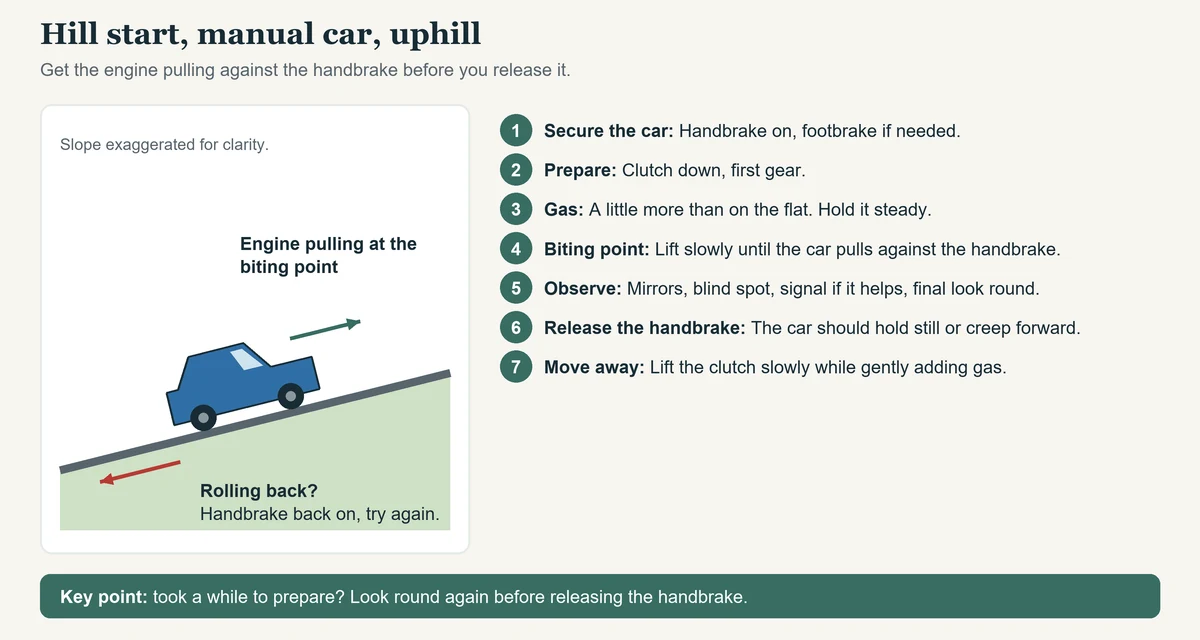
- Secure the car: handbrake on, footbrake if needed while you prepare.
- Prepare: clutch down, first gear.
- Gas: a little more accelerator than on the flat. Hold it steady.
- Biting point: lift the clutch slowly until you feel and hear the car pulling against the handbrake. On a steep hill you may need to lift slightly beyond your flat-road biting point.
- Observe: mirrors, blind spot, signal if it would help anyone, then a final look round. Highway Code rule 159 says move off only when it is safe.
- Release the handbrake. The car should hold still or creep forward. If it starts to roll back, put the handbrake back on and try again.
- Move away: lift the clutch slowly the rest of the way while gently increasing the gas.
If you spent a while preparing, look round again before releasing the handbrake. The road behind may have changed. For more on the biting point, see clutch control for learner drivers.
Starting downhill in a manual
Going downhill the car wants to move on its own, so the method is different. The usual approach your instructor will teach:
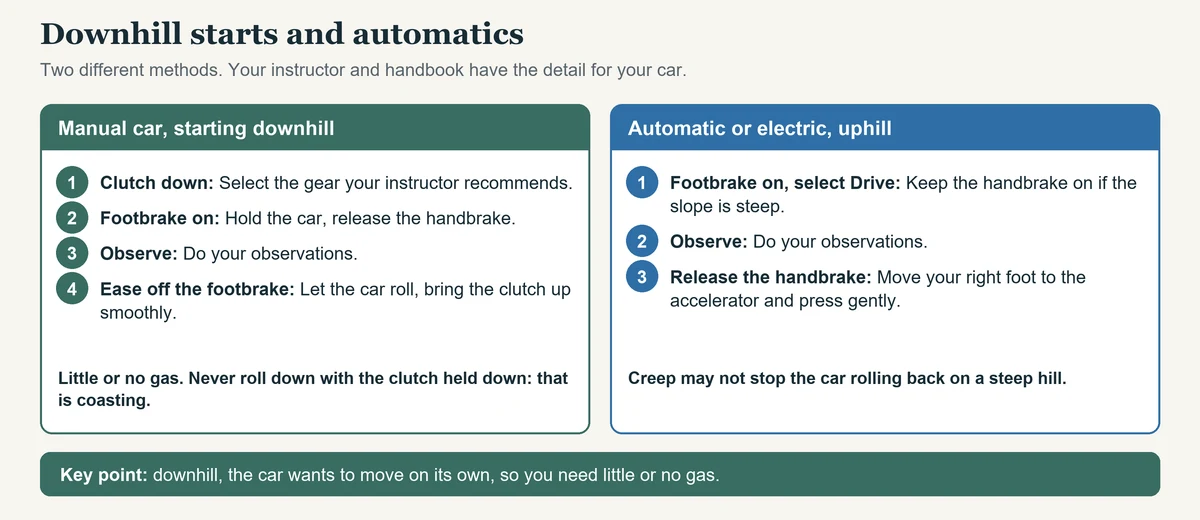
- Clutch down, select the gear your instructor recommends (often first, sometimes second on a gentle slope).
- Hold the car on the footbrake and release the handbrake.
- Do your observations.
- Ease off the footbrake to let the car roll, and bring the clutch up smoothly to connect the engine.
You need little or no gas. Do not roll down the hill with the clutch held down: that is coasting, which Highway Code rule 122 warns against. See coasting and downhill control.
Hill starts in an automatic or electric car
- Footbrake on, select Drive. Keep the handbrake on if the slope is steep.
- Do your observations.
- Release the handbrake, move your right foot from the brake to the accelerator and press gently.
Some automatics creep forward when you release the brake; on a steep hill that creep may not be enough to stop the car rolling back. Learn how your car behaves on a slope from the handbook and your instructor. See learning to drive an automatic.
Hill-start assist and electronic parking brakes
Many newer cars have one or both. They are allowed on the GB test, but you need to understand them.
| Feature | What it usually does | What to check in your car’s handbook |
|---|---|---|
| Hill-start assist | Holds the brakes briefly after you lift your foot off the footbrake, giving you time to move to the accelerator | When it switches on, and how long it holds (often only a short time) |
| Electronic parking brake | A switch instead of a lever. Some release automatically when you move off | How to apply and release it, and whether it releases itself when you pull away |
| Auto hold | Holds the car while stopped, even after you take your foot off the brake | How to switch it on and off, and the dashboard light that shows it is active |
Do not treat any of these as a replacement for securing the car. If a system is off, faulty or times out, the car can roll. DVSA examiners can mark a fault for “parking brake: failure to apply or release correctly and when necessary”, whatever kind of handbrake it is. For more on car technology, see driver assistance systems explained.
What the examiner looks for
- Observation: full checks before moving, including the blind spot.
- Control: no rollback and no excessive revving.
- Judgement: waiting for a safe gap rather than pulling out because you feel pressured.
- Calm recovery: if you stall, secure the car, restart, and observe again. See stalling and how to recover.
How serious a fault is depends on what happened. Rolling back a little on an empty road is different from rolling towards the car behind. See driving test faults explained.
Hill start problems and fixes
| What happens | Likely cause | Fix |
|---|---|---|
| Rolls back when you release the handbrake | Not at the biting point yet | Handbrake back on; lift the clutch a little more until the car pulls |
| Engine screams, car moves slowly | Too much gas, clutch slipping | Less gas; lift the clutch more smoothly |
| Stalls as you release | Too little gas, or clutch lifted too fast | A little more gas; hold the biting point |
| Forgot the blind spot while concentrating on control | Control took all your attention | Prepare the controls first, then observe, then release |
| Car moves before you expected | Hill-start assist or auto hold released | Learn the timing of your car’s system on a quiet slope |
How to practise
- Talk through the method while parked.
- Start on a gentle slope on a quiet road with your instructor.
- Do several in a row, with full observations each time.
- Move to steeper hills, then hills with parked cars and traffic.
- Practise stopping and moving off at junctions on a slope, where you must also judge a gap.
Common questions
Do you fail the driving test for rolling back?
Not automatically. DVSA examiners look for moving off without rollback, so rolling back is a fault, but how it is marked depends on how far you rolled and whether it caused risk to anyone.
Will I definitely get a hill start on my GB test?
GOV.UK says you will be asked to do one. If there is no suitable hill on the route, DVSA guidance says the examiner carries out an extra stop instead.
Can I use hill-start assist on the test?
Yes, in GB. GOV.UK lists hill-start assist and electronic parking brakes among the features you can use.
Should I hold the car on the clutch instead of the handbrake?
No. Holding a car on a hill with the clutch wears it and is easy to get wrong. Use the handbrake or footbrake while you wait.
Is the Irish hill start different from the GB one?
The control skill is the same. The way it fits into the test differs: see Irish driving test manoeuvres.
Related: moving off and mirror signal manoeuvre, the practical driving test. Guides: learning to drive in Great Britain and learning to drive in Ireland.
Sources
- GOV.UK, “Driving test: cars, what happens during the test” (gov.uk)
- GOV.UK, “Driving test: cars, using your own car” (gov.uk)
- DVSA, “Carrying out driving tests: examiner guidance, 1. Car driving test” (gov.uk)
- DVSA, “Control and positioning” (readytopass.campaign.gov.uk)
- Department for Transport, “The Highway Code”, rules 122 and 159 (gov.uk)
- Road Safety Authority, “Preparing for your test” and “Standard procedures for conducting driving tests” (2025) (rsa.ie)