

Photo: Nik / Unsplash. Illustrative photograph.
Mirrors, Signal, Manoeuvre (MSM) is the routine the Highway Code for Great Britain tells you to use before any change of speed or direction (Rule 161). DVSA examiners extend it with Position, Speed, Look (PSL) inside the manoeuvre step. This guide covers Rules 159 to 161, how MSM works when moving off and changing lanes, and the mirror faults that cost learners their test.
Key facts
- Rule 161: use your mirrors in good time before you signal, change direction or change speed.
- Mirrors do not show everything. You must look round to check blind spots.
- DVSA examiner guidance expects the MSM/PSL routine at every junction or hazard.
- Checking mirrors after or at the same time as signalling is listed by DVSA as a fault.
The routine, step by step
| Step | What you do |
|---|---|
| Mirrors | Check the interior mirror and the door mirror on the side you are moving to, early enough to judge the speed and position of traffic behind. |
| Signal | Signal if it would help or warn anyone, in good time and only once you know it will not mislead (Rule 103). |
| Manoeuvre: Position | Move to the right place on the road for what you are about to do. |
| Manoeuvre: Speed | Adjust your speed, and choose the gear, for the turn or hazard. |
| Manoeuvre: Look | Look ahead and around, including blind spots where needed, and decide whether to go, wait or stop. |
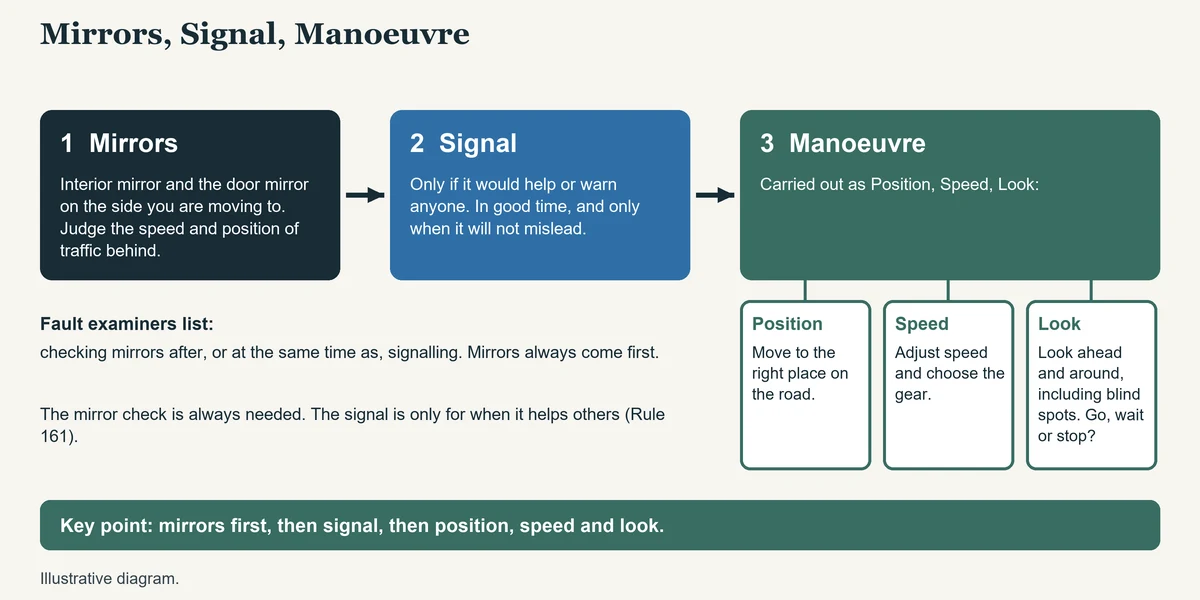
DVSA’s examiner guidance (DT1, section 11) describes it in the same order: check mirrors to judge the speed and position of vehicles behind, signal clearly and early, then carry out the manoeuvre by positioning correctly and early, adjusting speed, and looking for other traffic before acting. Examiners expect this planned approach at every junction or hazard.
Moving off safely (Rule 159)
- Use all your mirrors to check the road is clear.
- Look round to check your blind spots, the areas you cannot see in the mirrors.
- Signal if necessary before moving out.
- Look round for a final check.
- Move off only when it is safe.
Two habits make this routine work in practice:
- Get the car ready first. Seat, mirrors, seat belts and gear selection come before your final look, so that nothing pulls your eyes off the road between that look and moving.
- Keep the final check fresh. A gap you saw several seconds ago may have gone. Look for someone cycling up alongside or walking near the front of the car, not only approaching cars.
If the gap closes as you start, hold your position and wait for the next one. Having a gear selected is no reason to go.
Moving off on the test
DVSA assesses moving off from the kerb, on a slope, from behind a parked vehicle at an angle, and at junctions. Faults it lists: rolling back, not checking blind spots properly, moving into the path of oncoming traffic, and repeated stalling.
Once you are moving (Rule 160)
- Keep to the left unless signs or markings say otherwise, or you are overtaking, turning right or passing parked vehicles or pedestrians in the road.
- Keep well to the left on right-hand bends to improve your view.
- Keep both hands on the wheel where possible. Driver assistance systems may be used while you drive, but only as the manufacturer’s instructions describe.
- Watch for cyclists and motorcyclists filtering. They are harder to see than larger vehicles, so give them plenty of room. When you change direction or lane, give way to cyclists and do not cut across them.
- Choose a lower gear before a long downhill slope.
- When towing, remember the extra length affects overtaking and manoeuvring, and the extra weight affects braking and acceleration.
Changing lanes with MSM (Rule 133)
Check your mirrors. If needed, take a quick sideways glance to be sure you will not force another road user to change course or speed. Signal when it is safe, then move over when the lane is clear. On dual carriageways and roundabouts, changing lanes without checking mirrors effectively is one of DVSA’s listed faults. Lane choice itself is in lane discipline.
Worked example: turning left into a side road
- Mirrors: interior and left door mirror, well before the junction. Is a cyclist coming up on your left?
- Signal: left indicator, after any earlier side roads so it does not mislead.
- Position: keep to the left, as close as is safe (Rule 183).
- Speed: brake early, then select a suitable gear.
- Look: into the side road for pedestrians crossing or waiting to cross. Give way to them (Rule 170 and Rule H2). Final check of the left mirror for cyclists, then turn.

Junction detail: road junctions explained.
Mirror faults the examiner marks
- checking mirrors after, or at the same time as, signalling
- changing lanes on a roundabout or dual carriageway without effective mirror checks
- pulling in without a signal when one was needed for traffic behind
DVSA’s fix: read Highway Code Rule 161 and practise MSM with your instructor. Ineffective mirror use features in DVSA’s top reasons for failing: see top reasons people fail and how faults are graded.
Common questions
What does MSM stand for in driving?
Mirrors, Signal, Manoeuvre. The Highway Code uses it throughout the “Using the road” section (Rule 161).
What is PSL?
Position, Speed, Look. DVSA uses it as part of the manoeuvre step of MSM when approaching junctions and hazards.
Do I have to signal every time I use MSM?
No. The signal step is for when a signal would help other road users. The mirror check is always needed.
Which mirrors should I check before turning left?
The interior mirror and the left door mirror, plus a look for cyclists coming up on your left. Rule 160 says give way to cyclists and do not cut across them.
Do I need to look over my shoulder when moving off?
Yes. Rule 159 says look round to check your blind spots, and again for a final check, before you move off.
Back to the main guide: Learning to Drive in Great Britain. Related: signalling correctly.
Sources
- Department for Transport, “The Highway Code: Using the road (159 to 203)” (gov.uk)
- Department for Transport, “The Highway Code: General rules, techniques and advice for all drivers and riders (103 to 158)” (gov.uk)
- DVSA, “Understanding your driving test result: Car driving test” (gov.uk)
- DVSA, “Carrying out driving tests: examiner guidance (DT1), section 11: Guide to assessment and marking” (gov.uk)