

Photo: Al Rashed / Pexels. Illustrative photograph.
Lane discipline in the Highway Code for Great Britain comes down to three habits: keep left unless overtaking or turning right, follow the lane markings, and change lanes only after checking mirrors and blind spots. Rules 127 to 143 cover road lines, hatched areas, reflective studs, dual carriageways, one-way streets, and bus, cycle and HOV lanes. This guide sets them out with the MUST rules flagged.
Lines on the road: what you can and cannot cross
| Marking | Rule | What it means |
|---|---|---|
| Single broken white centre line | 127 | Cross only if the road is clear and you are overtaking or turning off. Longer lines with shorter gaps warn of a hazard ahead. |
| Double white lines, broken line on your side | 128 | You may cross to overtake if safe and you can finish before a solid line on your side. Arrows tell you to move back. |
| Double white lines, solid line on your side | 129 | You MUST NOT cross or straddle it, except to enter premises or a side road, to pass a stationary vehicle, or to overtake a cycle, horse or road maintenance vehicle doing 10 mph (16 km/h) or less, when safe. |
| Hatching with a broken border | 130 | Do not enter unless it is necessary and you can see it is safe. |
| Chevrons with a solid border | 130 | You MUST NOT enter, except in an emergency. |
| Short broken lane dividers | 131 | Keep between them. |
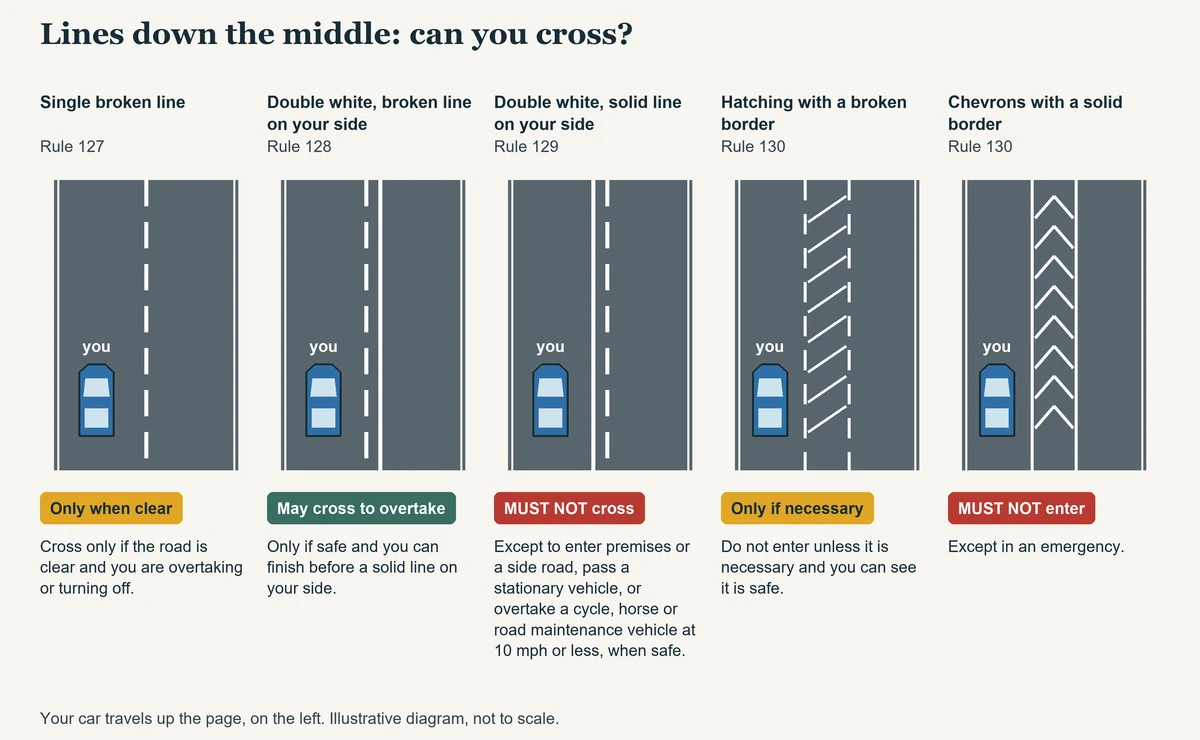
Hatching often protects drivers waiting to turn right. Driving along it just to get past a queue is convenience, not necessity, and can put you exactly where a turning driver expects to be safe.
More markings with pictures: road markings guide.
Reflective studs (Rule 132)
- White: lane lines or the middle of the road
- Red: the left edge of the road
- Amber: next to the central reservation on a dual carriageway or motorway
- Green: the edge of the main carriageway at lay-bys and slip roads
- Green/yellow: temporary changes to lanes, such as at road works
Which lane should you be in?
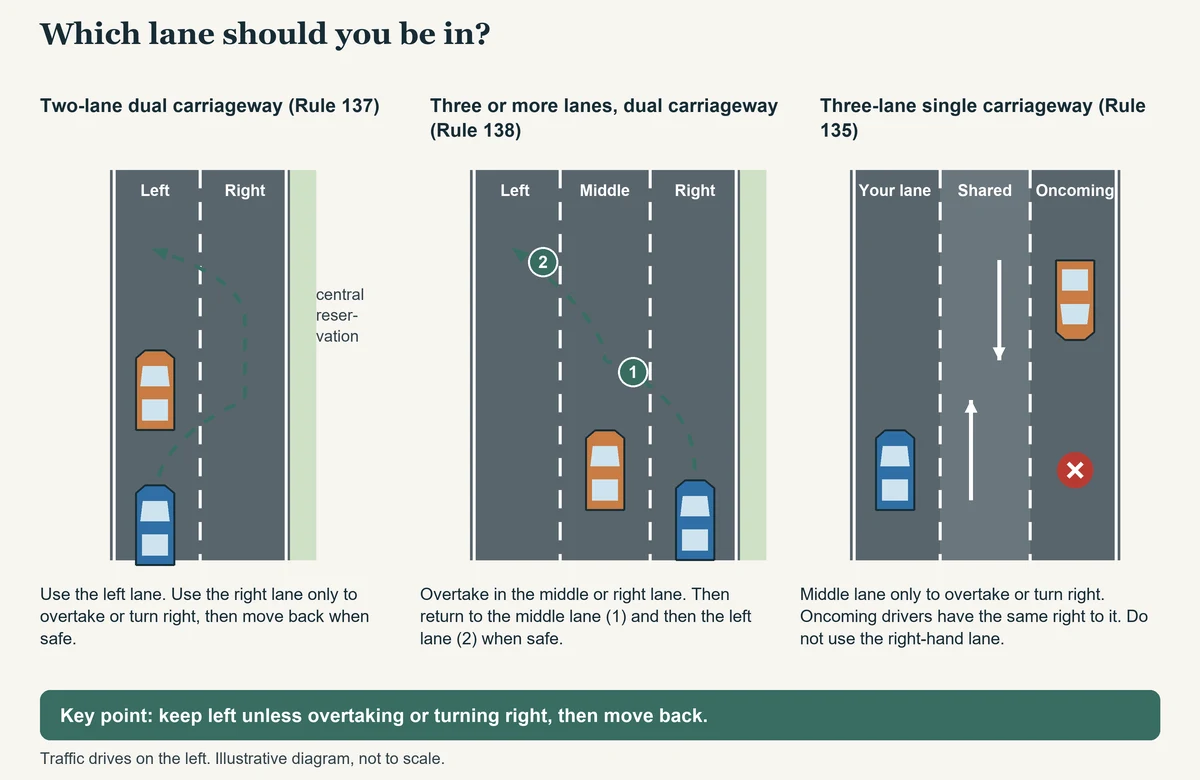
First work out what kind of road it is. A dual carriageway has a central reservation separating the two directions; the number of lanes does not decide it. A wide road with three or four lanes and no reservation is a single carriageway, and its middle lanes may be shared with oncoming traffic.
| Road | Rule | Lane to use |
|---|---|---|
| Two-lane dual carriageway | 137 | Left lane. Right lane only to overtake or turn right, then move back when safe. |
| Dual carriageway with three or more lanes | 138 | Middle or right lanes to overtake, then return to the middle and then the left lane when safe. |
| Three-lane single carriageway (no priority shown) | 135 | Middle lane only to overtake or turn right. You have no more right to it than a driver coming the other way. Do not use the right-hand lane. |
| Single carriageway with four or more lanes | 136 | Only the lanes signs or markings give you. |
| Climbing or crawler lane | 139 | Use it if you are slow or others want to pass. Watch for signs that it is ending, and plan to merge: reaching the end gives you no priority over traffic already in the next lane. |
| One-way street | 143 | Traffic MUST go the way the signs show. Left lane to go left, right lane to go right, the most suitable lane to go ahead. Pick early. |
Motorway lanes have their own rules: see your first motorway drive.
How to change lanes safely (Rules 133 and 134)
- Check your mirrors.
- If needed, take a quick sideways glance into your blind spot, so you will not force anyone to change speed or course.
- Signal when it is safe.
- Move over when the lane is clear.
- Keep the check fresh. A mirror look taken well before the move may no longer describe what is beside you, for example a motorcyclist coming through slow traffic.
- A signal does not reserve the gap. If someone is already there, hold your lane and wait.
- Look ahead again after your sideways glance, in case the vehicle in front has slowed.
- Missed your lane? Carry on in the lane you are in and find another route. A late swerve across lines is far riskier than a wrong turn.
In congestion, do not change lanes unnecessarily. Merging in turn is recommended only at very low speeds, such as approaching road works or an incident, not at high speed. Full routine: mirror, signal, manoeuvre.
Bus lanes, cycle lanes and HOV lanes (Rules 140 to 142)
- Cycle lane with a solid white line: you MUST NOT drive or park in it during its hours of operation.
- Cycle lane with a broken white line: do not drive or park in it unless it is unavoidable.
- Any cycle lane: you MUST NOT park in it while waiting restrictions apply. Give way to cyclists in the lane, including those coming up behind you. Cyclists do not have to use cycle lanes.
- Bus lanes: follow the signs and markings on who may use it. Unless signs say otherwise, do not drive in a bus lane during its period of operation. You may enter one to stop, load or unload where that is not prohibited.
- HOV and other designated lanes: you MUST NOT use them during their operating times unless signs permit your vehicle. HOV lanes need at least the number of occupants shown.
Signs, times and fines: bus lanes and cycle lanes. Turning left across a bus or cycle lane, Rule 183 says give way to vehicles using it from either direction.
What the examiner looks for
DVSA’s test result guidance lists positioning and lane discipline faults such as:
- driving too close to the pavement or the centre of the road
- staying in the right-hand lane of a dual carriageway for no reason
- straddling lanes
- changing lanes on a roundabout or dual carriageway without checking mirrors effectively
- being in the wrong marked lane, or entering a bus lane when it is not allowed
Common questions
Can I cross a solid white line to overtake a cyclist?
Yes, if the cyclist is travelling at 10 mph or less and the road is clear (Rule 129). Give them plenty of room: see overtaking cyclists.
Can I drive in the hatched area in the middle of the road?
If it has a broken border, only when necessary and safe. If it is bordered by a solid white line, you MUST NOT enter it except in an emergency.
Can I stay in the middle lane of a three-lane dual carriageway?
On dual carriageways, Rule 138 says return to the middle and then the left lane once you have overtaken. On the test, staying in the right-hand lane of a dual carriageway for no reason is listed as a fault.
When can I use a bus lane?
Outside its operating times shown on the sign, or within them if the signs allow your vehicle. You may also enter one to stop, load or unload where that is not prohibited.
What do red studs on the road mean?
Red reflective studs mark the left edge of the road.
Back to the main guide: Learning to Drive in Great Britain. Related: overtaking rules.
Sources
- Department for Transport, “The Highway Code: General rules, techniques and advice for all drivers and riders (103 to 158)” (gov.uk)
- Department for Transport, “The Highway Code: Using the road (159 to 203)” (gov.uk)
- DVSA, “Understanding your driving test result: Car driving test” (gov.uk)