

Photo: Shamba Datta / Pexels. Illustrative photograph.
In Great Britain, Rule 163 of the Highway Code says you should leave at least 1.5 metres when overtaking a cyclist at speeds up to 30 mph, and give them more space when overtaking at higher speeds. This explainer is for learner and new drivers in England, Scotland and Wales. It sets out every passing distance in Rule 163, what “more space” means in practice, and when the Code says you should not overtake at all.
Key facts: Rule 163 passing distances
- Cyclists: at least 1.5 metres at speeds up to 30 mph, more at higher speeds.
- Horse riders and horse-drawn vehicles: pass at under 10 mph with at least 2 metres.
- Pedestrians walking in the road: at least 2 metres, at a low speed.
- Motorcyclists: as much room as you would give a car.
- In bad weather (including high winds) and at night, give more space.
- If you cannot meet these clearances, wait behind and do not overtake.
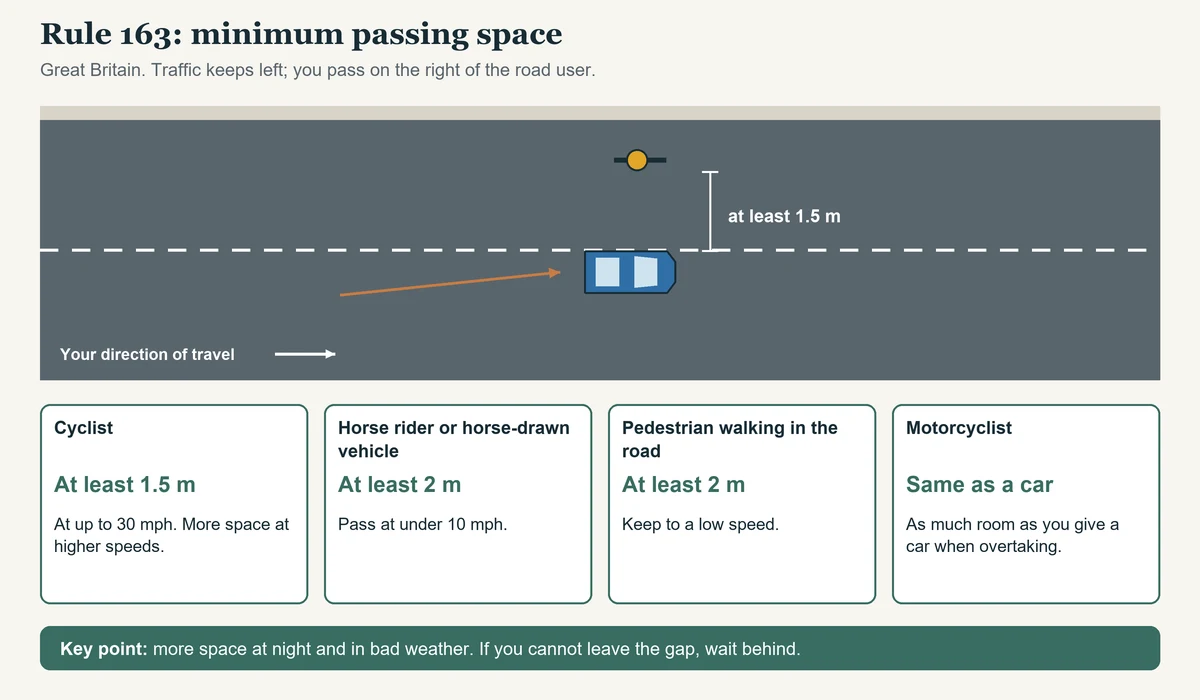
The full Rule 163 distance table
| Who you are passing | Minimum space | Speed |
|---|---|---|
| Cyclist | 1.5 metres | Up to 30 mph. Give more space at higher speeds. |
| Horse rider or horse-drawn vehicle | 2 metres | Under 10 mph |
| Pedestrian walking in the road (for example, where there is no pavement) | 2 metres | Low speed |
| Motorcyclist | As much room as a car | Normal overtaking |
These distances were added to Rule 163 in the Highway Code update of 29 January 2022. Rule 212 says the same thing in general terms: give motorcyclists, cyclists, horse riders, horse-drawn vehicles and pedestrians walking in the road at least as much room as you would when overtaking a car.
Is the 1.5 metre rule the law?
Rule 163 uses “should”, not MUST. In the Highway Code, MUST marks a legal requirement. “Should” marks advice. The Code’s introduction says that advisory rules can still be used as evidence in court to help establish liability. So an overtake that is too close can still form part of a careless or dangerous driving case. On the driving test, an examiner can mark a close pass as a serious fault.
How much is “more space” at higher speeds?
The Code does not give a figure for speeds above 30 mph. It says only to give them more space. In practice, on a 60 mph country road, that means a full overtake on the other side of the road, as you would for a car, and only when the road ahead is clear. If you cannot see far enough ahead to pass with a wide margin, Rule 166 says do not overtake.
How to overtake a cyclist safely: step by step
- Hang back. Rule 163 says do not get too close to the vehicle you intend to overtake. Staying back gives you a better view.
- Check the road ahead. Is it clear for the whole time you will be alongside, with room for 1.5 metres or more?
- Check you can legally overtake. See the list of places you must not overtake below.
- Mirrors, signal, blind spot. Use your mirrors, signal when it is safe, take a quick sideways glance if needed, then move out.
- Pass and keep the gap. Do not cut back in early. Return to the left only when you are well past.
- If in doubt, wait. A short wait behind a cyclist costs seconds.
The mirror routine is covered in detail in mirror, signal, manoeuvre.
When you should not overtake a cyclist
Rules 165 to 167 list places where you must not, or should not, overtake. For cyclists, the most relevant are:
- Approaching a junction where you plan to turn left. Stay behind the cyclist and do not cut across them (Rule 167 and Rule H3).
- At or approaching any junction, where the road narrows, or approaching a school crossing patrol or pedestrian crossing (Rule 167).
- Where you would force another road user to swerve or slow down (Rule 167).
- Approaching a bend, a hump bridge or the brow of a hill, where you cannot see far enough ahead (Rule 166).
- Where you would have to enter a bus, tram or cycle lane during its hours of operation (Rule 165).
- After a “No Overtaking” sign, until you pass a sign cancelling it (Rule 165).
Double white lines
Rule 129 says you MUST NOT cross or straddle double white lines where the line nearest you is solid. There is an exception: you may cross the line if necessary, provided the road is clear, to overtake a pedal cycle, horse or road maintenance vehicle travelling at 10 mph or less. A cyclist going faster than 10 mph cannot be overtaken by crossing a solid line nearest you.
Why cyclists move out before you overtake
Rule 72 tells cyclists to ride in the centre of their lane approaching junctions or road narrowings where it would be unsafe for drivers to overtake. Rule 67 tells them to keep at least a door’s width or 1 metre from parked cars. When a cyclist moves out, that is usually a signal that passing would not leave enough space. Read Highway Code rules for cyclists for the full picture.
Scenario: a cyclist on a 30 mph road with oncoming traffic
You are driving at 25 mph behind a cyclist on a residential road. Cars are parked on the left, and there is a steady flow of oncoming traffic.
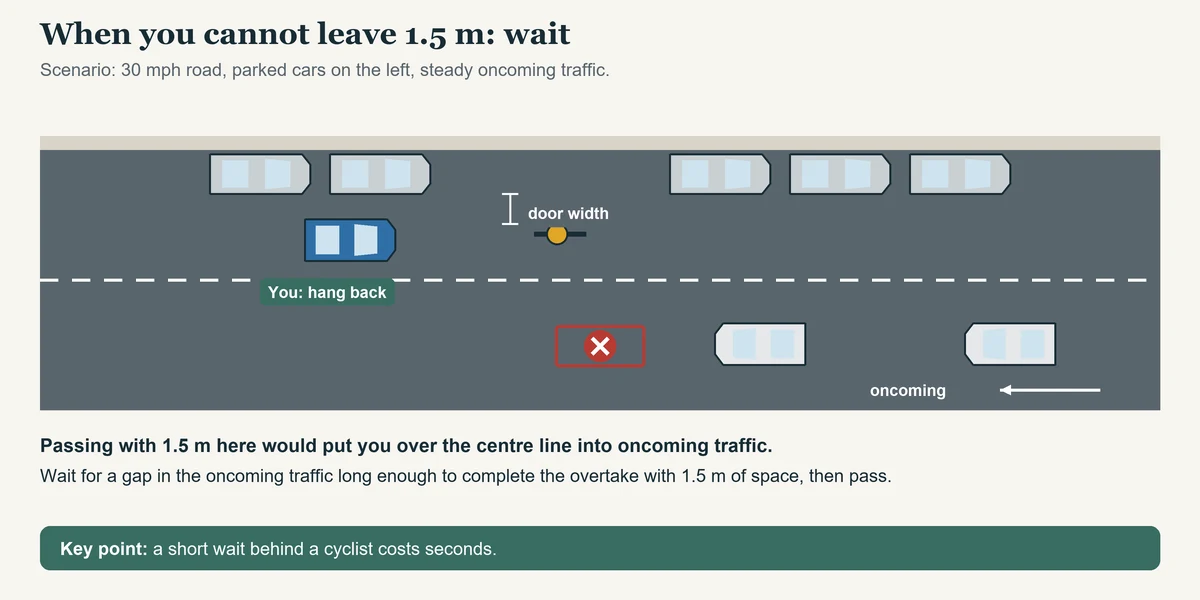
- The cyclist is riding about a door’s width from the parked cars. Passing with 1.5 metres would put you over the centre line into oncoming traffic.
- Rule 163 says that if you cannot meet the clearance, wait behind.
- Hang back and wait for a gap in the oncoming traffic long enough to complete the overtake with 1.5 metres of space, then pass.
Common questions
How much room should you give a cyclist when overtaking in the UK?
The Highway Code for Great Britain says at least 1.5 metres at speeds up to 30 mph, and more at higher speeds.
Can I overtake a cyclist on a solid white line?
Only where the solid line nearest you is part of a double white line system, the road is clear, and the cyclist is travelling at 10 mph or less (Rule 129). Otherwise you must not cross it.
Do I have to give 1.5 metres if the cyclist is in a cycle lane?
Rule 163 does not make an exception for cycle lanes. It says to give at least 1.5 metres when overtaking cyclists at speeds up to 30 mph.
What about two cyclists side by side?
Measure the gap from the outer rider. Rule 66 says cyclists can ride two abreast, and they should let you pass when it is safe, for example by moving into single file.
Does the rule apply in Northern Ireland?
This explainer covers the Highway Code for England, Scotland and Wales. Northern Ireland has its own Highway Code. See NI vs GB Highway Code differences.
Related: passing horses safely, overtaking rules in the Highway Code and the hierarchy of road users. Back to the main guide: Learning to Drive in Great Britain.
Sources
- Department for Transport, “The Highway Code: Using the road (159 to 203)” (gov.uk)
- Department for Transport, “The Highway Code: Road users requiring extra care (204 to 225)” (gov.uk)
- Department for Transport, “The Highway Code: General rules, techniques and advice for all drivers and riders (103 to 158)” (gov.uk)
- Department for Transport, “The Highway Code: Rules for cyclists (59 to 82)” (gov.uk)
- Department for Transport, “The Highway Code: Introduction” and “Updates” (gov.uk)