
Photo: Michał Robak / Pexels. Illustrative photograph.
Overtaking is one of the riskiest things a new driver does, because for a few seconds you are on the side of the road meant for oncoming traffic. In Great Britain, Highway Code Rules 162 to 169 set out when you may overtake, how to do it, where you MUST NOT, and how to behave when someone overtakes you. This guide is for learners and newly qualified drivers in England, Scotland and Wales. It turns those rules into a set of checks you can run through on the road, with the full “do not overtake” list from Rules 165 to 167.
Key facts
- Rule 165 lists five places where overtaking is illegal, such as across a solid white line on your side or after a “No Overtaking” sign.
- Rules 166 and 167 list places you should not overtake: bends, hump bridges, hill brows, junctions, crossings, level crossings and more.
- Overtake on the right. Passing on the left is only for set situations, such as a vehicle ahead signalling right.
- Vulnerable road users need a set minimum gap: at least 1.5 metres for cyclists at up to 30 mph, at least 2 metres for horse riders and pedestrians in the road.
- Being overtaken: keep a steady course and speed, never speed up, and drop back to restore a two-second gap.
Before you overtake: the three questions in Rule 162
Rule 162 says that before overtaking you should make sure:
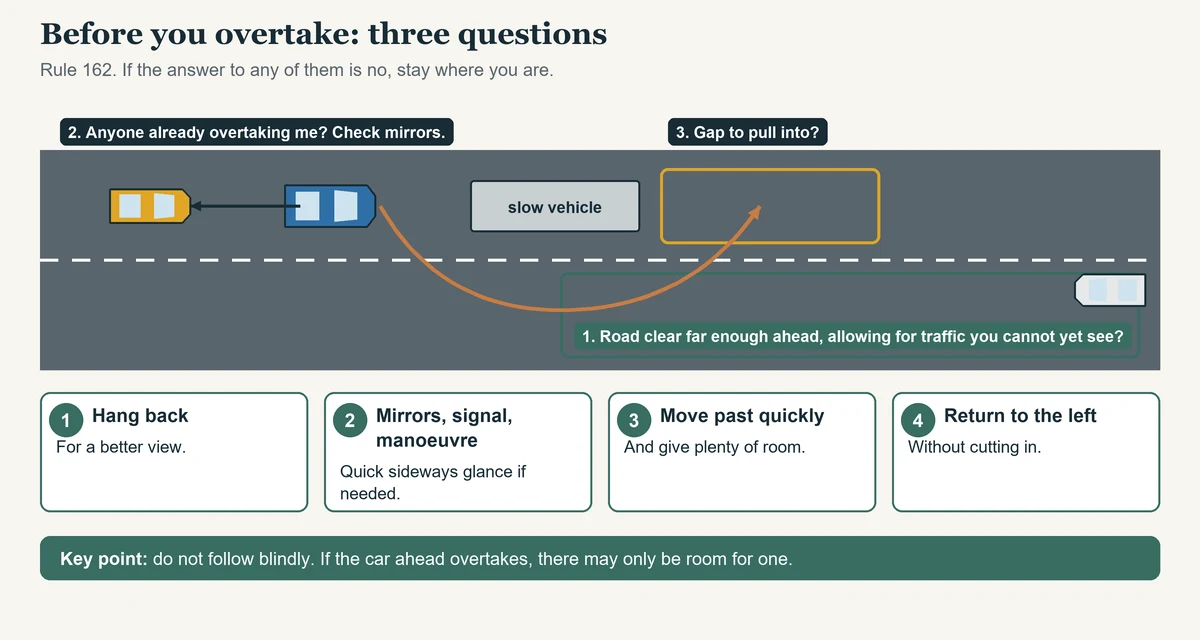
- Is the road clear far enough ahead? You need room to pass and get back in, allowing for oncoming traffic you cannot yet see.
- Is anyone already overtaking me? Check your mirrors. A car or motorcycle may be coming past.
- Is there a gap to pull into? There must be a suitable space in front of the vehicle you are passing.
If the answer to any of these is no, stay where you are. Rule 166 sums it up: do not overtake if there is any doubt.
How to overtake safely (Rule 163)
Rule 163 says overtake only when it is safe and legal. Broken down into steps:
- Hang back. Do not get too close to the vehicle you intend to pass. Staying back gives you a better view ahead.
- Mirrors, signal, manoeuvre. Check your mirrors, signal when it is safe, and take a quick sideways glance into the blind spot if necessary before moving out.
- Do not follow blindly. If the vehicle ahead overtakes, there may only be room for one. Make your own check.
- Commit and move past quickly. Once you have started, pass without dawdling and give plenty of room.
- Return to the left without cutting in. Move back as soon as you can, but not so sharply that the other driver has to brake.
Rule 163 also asks for extra care at night and in poor visibility, when speed and distance are harder to judge. When passing parked cars or other obstructions on your side of the road, give way to oncoming vehicles first.
Passing on the left: the only exceptions
Under Rule 163, you should only overtake on the left if:
- the vehicle in front is signalling to turn right and there is room to pass, or
- traffic is moving in queues and the queue on your right is moving more slowly than yours. In that case you may pass on the left, but stay in your lane.
Rule 151 adds that in slow-moving traffic you should not change lanes to the left to overtake.
How much room to give cyclists, horses and pedestrians
Rule 163 says to give motorcyclists, cyclists, horse riders and horse-drawn vehicles at least as much room as you would when overtaking a car. As a guide:
| Road user | Minimum gap | Speed |
|---|---|---|
| Cyclist | At least 1.5 metres | At speeds up to 30 mph; give more space at higher speeds |
| Horse rider or horse-drawn vehicle | At least 2 metres | Under 10 mph |
| Pedestrian walking in the road | At least 2 metres | Keep to a low speed |
Give more space in bad weather, including high winds, and at night. If you cannot leave these gaps, wait behind and do not overtake. Our guides to overtaking cyclists and passing horses safely go into more detail.
Where you MUST NOT overtake (Rule 165)
These are legal requirements. Breaking them is an offence. You MUST NOT overtake:
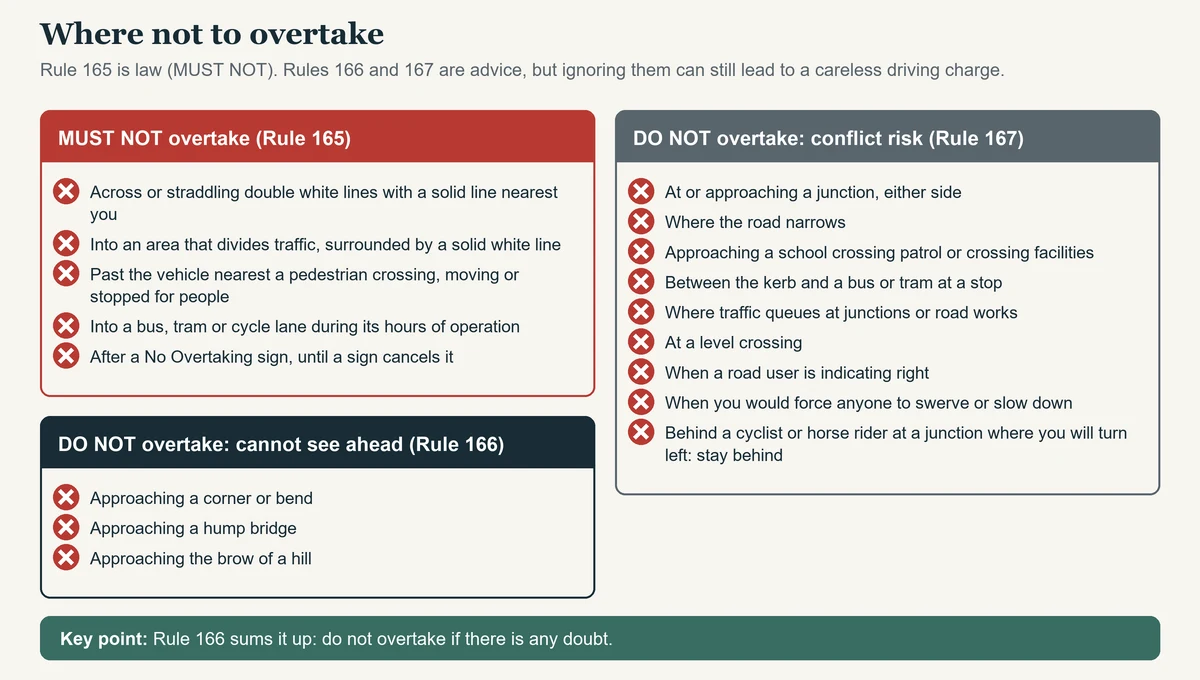
- if you would have to cross or straddle double white lines with a solid line nearest to you (but see the exceptions below)
- if you would have to enter an area designed to divide traffic, where it is surrounded by a solid white line
- the nearest vehicle to a pedestrian crossing, especially when it has stopped to let pedestrians cross
- if you would have to enter a lane reserved for buses, trams or cycles during its hours of operation
- after a “No Overtaking” sign, until you pass a sign cancelling the restriction
The solid white line exceptions (Rule 129)
Rule 129 says you may cross a solid white line on your side, if the road is clear, to pass a stationary vehicle, or to overtake a pedal cycle, horse or road maintenance vehicle travelling at 10 mph or less. You may also cross it when you need to enter adjoining premises or a side road. If the line nearer to you is broken, Rule 128 allows you to cross to overtake if it is safe and you can finish before a solid line on your side. See road markings.
Where you should not overtake (Rules 166 and 167)
These rules use “DO NOT” rather than “MUST NOT”, but ignoring them can still lead to a careless or dangerous driving charge.
Where you cannot see far enough ahead (Rule 166)
- approaching a corner or bend
- approaching a hump bridge
- approaching the brow of a hill
Where you might come into conflict with others (Rule 167)
- approaching or at a road junction on either side of the road
- where the road narrows
- when approaching a school crossing patrol
- on the approach to crossing facilities
- where a vehicle ahead is slowing to stop for a pedestrian crossing from a pedestrian island
- between the kerb and a bus or tram when it is at a stop
- where traffic is queuing at junctions or road works
- when you would force another road user to swerve or slow down
- at a level crossing
- when a road user is indicating right, even if you think the signal should have been cancelled
- when you are following a cyclist, horse rider or horse-drawn vehicle approaching a roundabout or junction and you intend to turn left: stay behind and do not cut across them
- when a tram is at a kerbside stop and there is no clearly marked passing lane
Overtaking large vehicles (Rule 164)
Lorries, buses, tractors with trailers and other long vehicles take longer to pass. Rule 164 says to:
- drop back, so you can see further ahead and the driver can see you in their mirrors
- make sure you have enough room to complete the manoeuvre before committing; if in doubt, do not overtake
- remember there may be another slow vehicle in front of the one you are following
- not assume you can follow a car that is overtaking a long vehicle, because it may abort and pull back in
See driving near lorries and buses for blind spots and spacing.
When someone overtakes you (Rules 168 and 169)
Rule 168 says that if a driver is trying to overtake you, keep a steady course and speed, slowing down if necessary to let them pass. Never obstruct them. Speeding up or driving unpredictably while being overtaken is dangerous. If they pull into the gap in front of you, drop back to restore a two-second gap (see stopping distances and the two second rule).
Rule 169 says do not hold up a long queue, especially in a large or slow vehicle. Check your mirrors often and, if necessary, pull in where it is safe to let traffic pass.
Scenario: a tractor on a country road
You are behind a tractor doing about 20 mph on a national speed limit single carriageway. A straight stretch opens up, but there is a farm entrance on the left and the road dips out of sight 300 metres ahead.
- The dip means you cannot see far enough ahead to be sure it is clear. Rule 166 says do not overtake.
- The farm entrance is a junction where the tractor might turn. Rule 167 says do not overtake approaching a junction.
- Wait for a stretch where you can see the whole overtake, with a gap to return to.
Tractor drivers often pull in to let traffic pass, as Rule 169 asks. For more on country roads, see learning to drive on rural roads.
Common questions
Is it illegal to overtake on the left in the UK?
Not always, but it should be rare. Rule 163 allows it when the vehicle in front is signalling right and there is room, or in slow queues where the lane on your right is moving more slowly. On motorways, Rule 268 says do not overtake on the left.
Can I cross a solid white line to overtake a cyclist?
Yes, if the road is clear and the cyclist is travelling at 10 mph or less (Rule 129). You still need to leave at least 1.5 metres.
Can I overtake at a pedestrian crossing?
You MUST NOT overtake the moving vehicle nearest the crossing, or the vehicle nearest the crossing that has stopped for pedestrians (Rules 165 and 191).
What should I do if someone overtakes me and cuts in?
Ease off and drop back to restore a two-second gap. Do not react or chase them.
Can I overtake in a bus lane?
Not during its hours of operation. Rule 165 says you MUST NOT overtake if it means entering a bus, tram or cycle lane while it is in operation.
How do I know when a no overtaking zone ends?
A no overtaking restriction lasts until you pass a sign cancelling it (Rule 165).
Back to the main guide: Learning to Drive in Great Britain.
Sources
- Department for Transport, “The Highway Code: Using the road (159 to 203)” (gov.uk)
- Department for Transport, “The Highway Code: General rules, techniques and advice for all drivers and riders (103 to 158)” (gov.uk)
- Department for Transport, “The Highway Code: Motorways (253 to 274)” (gov.uk)
- Department for Transport, “The Highway Code: Introduction” (gov.uk)