
Regulatory signs are the ones that give orders. Most are circles: a red ring tells you what you must not do, and a blue circle tells you what you must do. Get these wrong and you are not just driving badly, you may be breaking the law, so they matter on the theory test, the practical test and every drive afterwards.
Last reviewed: September 2026. Checked against the Highway Code and GOV.UK.
The basic rule: circles give orders
The Department for Transport’s Know Your Traffic Signs explains that most regulatory signs are circular. A red ring or red circle indicates a prohibition. A blue circle generally gives a positive (mandatory) instruction, or shows a route that only certain vehicles may use.
Highway Code rule 109 says you MUST obey traffic signs giving orders, including temporary signs.
STOP and GIVE WAY: the two exceptions
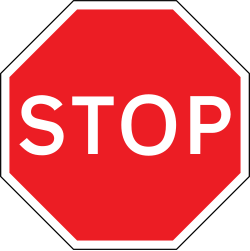

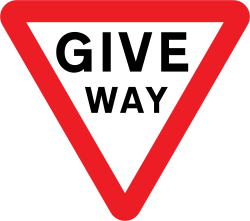

These two signs give orders but are not circles, so they stand out.
- STOP is a red octagon with STOP in white. There will be a solid white line across the road. You MUST stop behind the line, even if you can see the road is clear, then wait for a safe gap before moving off (rule 171).
- GIVE WAY is an upside-down triangle with a red border. There will usually be broken white lines across the road and sometimes a triangle painted on the approach. You MUST give way to traffic on the main road (rule 172). You only need to stop if traffic means you have to.
Know Your Traffic Signs notes that at junctions with relatively little traffic, the upright GIVE WAY sign or the painted triangle might not be used, so the broken lines alone still mean give way.
Red rings: things you must not do
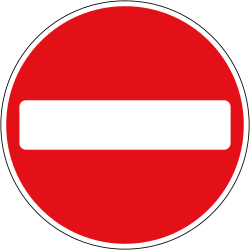





- No entry for vehicular traffic: a solid red circle with a white horizontal bar. You usually see it at the exit end of a one-way street.
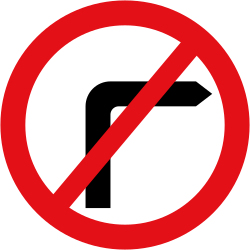
- No right turn, no left turn and no U-turns: a black arrow with a red diagonal bar across it. Know Your Traffic Signs explains that the red bar is used where changes of direction are prohibited. A time plate underneath means the ban is part-time.
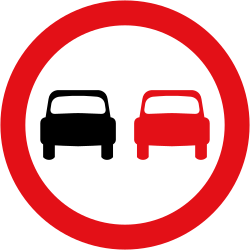
- No overtaking: two cars side by side in a red ring.
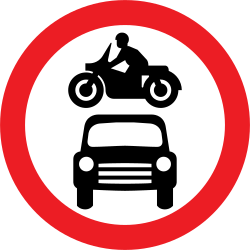
- No motor vehicles: a car and a motorcycle in a red ring.
- No vehicles except bicycles being pushed: a plain red ring with a white centre.
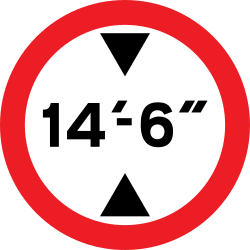
- Width, height, length and weight limits: a number in a red ring, often with arrowheads showing which dimension is limited.
Speed limit signs
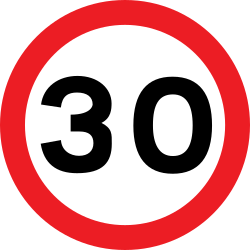

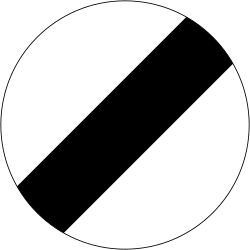

A number in a red ring is the maximum speed. You MUST NOT exceed it (rule 124). A white circle with a black diagonal stripe means the national speed limit applies for that type of road and vehicle. For cars and motorcycles, the national limits in the Highway Code are:
| Road type | Cars and motorcycles | Cars towing caravans or trailers |
|---|---|---|
| Built-up areas (England and Scotland) | 30 mph | 30 mph |
| Built-up areas (Wales) | 20 mph | 20 mph |
| Single carriageways | 60 mph | 50 mph |
| Dual carriageways | 70 mph | 60 mph |
| Motorways | 70 mph | 60 mph |
Source: Highway Code rule 124. In areas with street lighting (other than motorways), a 30 mph limit applies unless signs show otherwise, and in Wales this limit is 20 mph.
A detail that catches people out: according to Know Your Traffic Signs, small repeater signs for a 30 mph limit are only used on roads without street lighting, and national speed limit repeaters are only used on roads with street lighting. So street lights with no repeaters usually means 30 mph (20 mph in Wales).
A 20 mph zone is marked by a rectangular entry sign, and you may meet traffic-calming features inside it. A matching sign marks the end of the zone and the start of a 30 mph limit.
Blue circles: things you must do
.svg)
.svg)


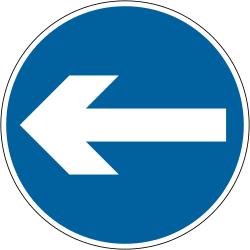
- Ahead only, turn left, turn left ahead: a white arrow on a blue circle. The arrow shows the only direction you may go.
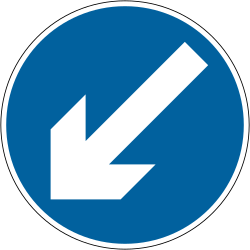
- Keep left (or right if reversed): a white arrow pointing diagonally downwards, usually on a traffic island.
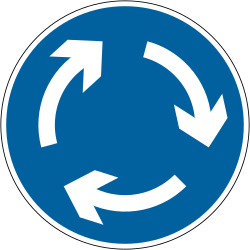
- Mini-roundabout: three white arrows in a circle. Give way to traffic from your immediate right, and you MUST pass round the central markings unless your vehicle is too large to do so (rule 188).
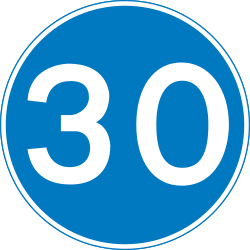
- Minimum speed: a white number on a blue circle. You should not go slower unless it is impracticable or unsafe to comply. A red diagonal line through it marks the end of the minimum speed.
Priority on narrow roads and waiting restrictions
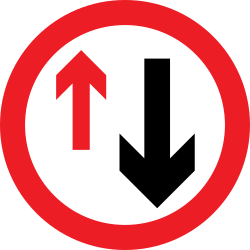

Where a road or bridge is too narrow for two-way traffic, a red-ring sign with two arrows tells you to give priority to vehicles from the opposite direction, usually with a give way line where you wait. The opposite message, that you have priority over oncoming vehicles, is shown on a blue rectangular information sign, not a circle.
Waiting and stopping restrictions use a red ring on a blue background. A single red diagonal means no waiting, and a red cross means no stopping (clearway). See our road markings guide for the yellow and red lines that go with them.
Plates that change a sign’s meaning
Plates below regulatory signs qualify their message, for example “Except for access”, “Except for loading”, a time period or a distance. Always read the plate before deciding whether a restriction applies to you.
Regulatory signs learners often confuse
- Maximum speed vs minimum speed: red ring means the most you may do; blue circle means the least you should do.
- Ahead only vs one-way traffic: ahead only is a blue circle (an order at that point); one-way traffic is a blue rectangle (information about the road). The Highway Code shows them together for this reason.
- Give priority to oncoming traffic vs priority over oncoming traffic: red ring means you give way; blue rectangle means you have priority.
- National speed limit vs end of all restrictions: the black diagonal stripe means the national limit applies. It does not remove the limit.
Practice questions
These practice questions are written by Get Driving Test Ready to help you revise. They are not official DVSA questions.
Q1. What does a sign with a red ring usually tell you?
A) Directions to a town
B) A hazard ahead
C) Something you must do
D) Something you must not do
Answer: D. Red rings or circles tell you what you must not do. Blue circles give positive instructions, triangles warn and rectangles inform. (Highway Code: traffic signs)
Practise this on the road: On your next drive, call out every red-ringed sign you pass and what it stops you doing.
Q2. You arrive at a junction with a STOP sign and can see the main road is completely clear. What MUST you do?
A) Stop only if another vehicle is approaching
B) Stop only if the traffic lights are red
C) Slow down and carry on
D) Stop behind the line, then move off when safe
Answer: D. You MUST stop behind the line at a junction with a STOP sign and a solid white line, then wait for a safe gap. (Highway Code rule 171)
Practise this on the road: At every STOP sign, bring the car to a complete stop behind the line, even when the road looks clear.
Image: Wikimedia Commons, Public domain
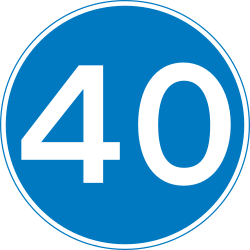
Q3. A circular blue sign shows a white number 40. What does it mean?
A) Advisory speed 40 mph
B) End of a 40 mph limit
C) Maximum speed 40 mph
D) Minimum speed 40 mph
Answer: D. A number on a blue circle is a minimum speed. A maximum speed is shown in a red ring. (Highway Code: traffic signs)
Practise this on the road: Watch for blue circular signs on a drive and say whether each one gives an order or a minimum speed.
Image: Wikimedia Commons, Public domain

Q4. What is the national speed limit for a car on a single carriageway road?
A) 50 mph
B) 40 mph
C) 60 mph
D) 70 mph
Answer: C. For cars and motorcycles the national limit is 60 mph on single carriageways and 70 mph on dual carriageways and motorways. (Highway Code rule 124)
Practise this on the road: On country roads, spot where the national speed limit starts and say what it means for a car.
Q5. You are driving on a road in England with street lights and see no speed limit signs. What limit is most likely to apply?
A) The national speed limit
B) 20 mph
C) 30 mph
D) 40 mph
Answer: C. A 30 mph limit generally applies to roads with street lights (other than motorways) unless signs show otherwise. In Wales this limit is 20 mph. (Highway Code rule 124)
Practise this on the road: In lit streets with no limit signs, check your speedometer and say which limit you think applies.
Q6. A red-ring sign with a black arrow and a red diagonal bar across it means what?
A) Priority over oncoming traffic
B) One-way traffic
C) The turn shown is compulsory
D) The turn shown is not allowed
Answer: D. A red bar across the arrow is used where a change of direction is prohibited, for example no right turn or no U-turn. (Highway Code: traffic signs)
Practise this on the road: At junctions, look for no-turn signs before you signal and plan another route if a turn is banned.
Image: Wikimedia Commons, OGL v1.0
Q7. At a mini-roundabout, which traffic should you normally give way to?
A) Traffic from your immediate right
B) No one, because it is too small to need priority
C) Traffic behind you
D) Traffic from your left
Answer: A. The mini-roundabout sign means give way to vehicles from the immediate right, and you must pass round the central markings unless your vehicle is too large. (Highway Code rule 188)
Practise this on the road: At mini-roundabouts, look right early and practise giving way to traffic from your immediate right.
Image: Wikimedia Commons, OGL v1.0
Q8. Which sign means "national speed limit applies"?
A) A white circle with a black diagonal stripe
B) A red ring with a white centre
C) A red circle with a white horizontal bar
D) A blue circle with a red diagonal lineImage: Wikimedia Commons, OGL v1.0
Answer: A. The white circle with a black diagonal stripe means the national speed limit for that road and vehicle applies. A red circle with a white bar is no entry. (Highway Code: traffic signs)
Practise this on the road: Each time you pass the white circle with a black diagonal stripe, say the limit that now applies.
Next steps
Head back to the road signs hub, compare these orders with the hazards in our warning signs guide, and practise mixed questions in the road and traffic signs topic and the rules of the road topic.