
Warning signs tell you about a hazard before you can see it: a junction hidden round a bend, a steep hill, children crossing, a level crossing. They do not give orders, but ignoring them is one of the quickest ways to end up too fast, in the wrong position or surprised. This guide explains how warning signs work, describes the ones you are most likely to meet, and finishes with eight practice questions.
Last reviewed: September 2026. Checked against the Highway Code and GOV.UK.
How to recognise a warning sign
The Highway Code’s Traffic signs section describes warning signs as “mostly triangular”. The standard design is an upward-pointing triangle with a red border, a white background and a black symbol. The Department for Transport’s Know Your Traffic Signs puts it simply: triangles warn, and all triangular signs are red.
A small rectangular plate is often added underneath to give the distance to the hazard, how far it extends, or what it is.
A few warning signs are not triangles. Examples include the black and white chevron boards that mark a sharp deviation of route, and countdown markers on the approach to a concealed level crossing, which are white with red bars.
What a warning sign asks you to do
Warning signs do not give orders, so the examiner and the theory test are looking for a sensible reaction:
- Check your mirrors so you know what is behind you.
- Ease off and slow down early if the hazard needs a lower speed.
- Think about your position on the road and whether you might need to stop.
- Avoid overtaking where the sign warns of a junction, a narrowing, a crossing or a school crossing patrol. Highway Code rule 167 lists these as places where you should not overtake.
Junction warning signs
.svg)
.svg)
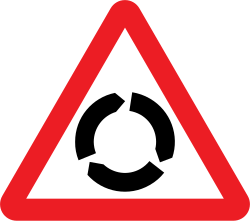

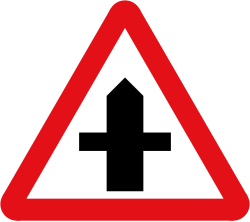
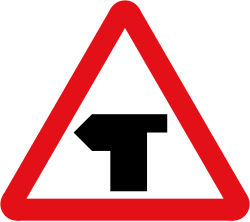
Junction signs show a simple road plan, with your road running up from the bottom. The Highway Code notes that the broader line shows the priority route.
- Crossroads: your road is crossed by another road. A thicker upright line means your road has priority, but you should still watch for vehicles emerging.
- T-junction: your road ends at a road running across. You will have to turn left or right, so expect to slow down and give way.
- Side road: a branch leaves your road on one side. Watch for traffic joining or turning.
- Roundabout: three arrows circling in the direction traffic flows. Get into the right lane early and be ready to give way to traffic from your right (rule 185).
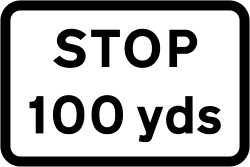

There are also triangles that warn of a STOP line or a GIVE WAY line ahead, with a plate showing the distance. They give you time to slow down before the junction comes into view.
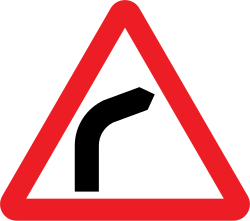
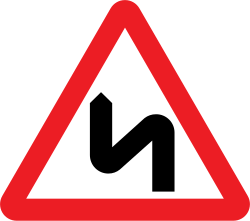
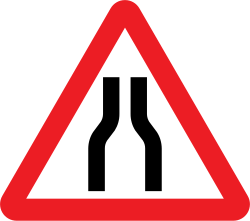
Bends, narrow roads and road layout
.svg)
.svg)

- Bend to the right (or left if the symbol is reversed): a curved arrow. Slow down before the bend, not in it.
- Double bend: an S-shaped arrow. The direction of the first curve tells you which way the road goes first.
- Road narrows: lines that draw in on one side or both sides. Oncoming traffic will be closer, and large vehicles may need more room.
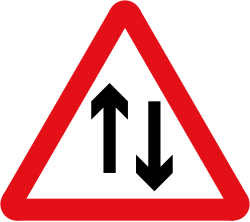
- Two-way traffic straight ahead: two arrows, one pointing up and one down. It often appears where a one-way stretch or a dual carriageway ends.

Hills, surfaces and weather
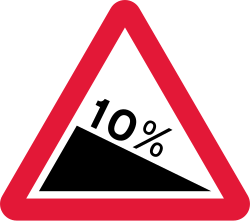


- Steep hill downwards and steep hill upwards: a sloping wedge with a gradient. The Highway Code notes gradients may be shown as a percentage or a ratio, and that 20% is the same as 1:5. Going down, choose a lower gear in good time so you do not rely only on your brakes.
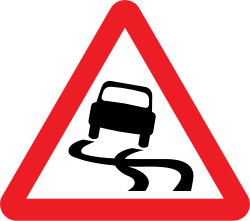
- Slippery road: a car with wavy skid marks. Reduce speed and avoid harsh braking or steering.
- Risk of ice: often shown as a triangle with a plate. In icy weather, stopping distances can be ten times greater than on dry roads (rule 230).
People, crossings and animals
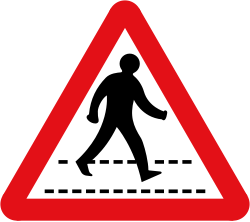



- Zebra crossing ahead: a figure walking across a crossing. Be ready to stop. You should give way to pedestrians waiting to cross and MUST give way once a pedestrian has moved onto the crossing (rule 195).
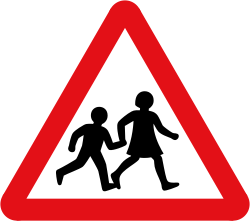
- Children going to or from school: two children walking, often with a “School” plate. The Highway Code notes that some school crossing patrol signs have amber lights which flash when the crossing is in use.
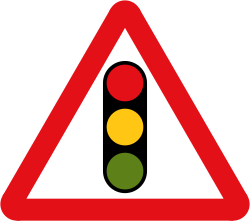
- Traffic signals ahead: a traffic light symbol, used where the lights may be hidden, for example round a bend.
- Animal signs: cattle, wild animals (a leaping deer), wild horses or ponies, and accompanied horses or ponies. For horses, pass slowly and give plenty of room.
Level crossings and trams
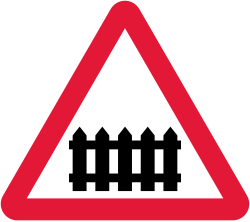


- Level crossing with barrier or gate ahead: a triangle showing a gate.
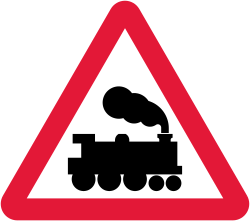
- Level crossing without barrier or gate ahead: a triangle showing a steam locomotive.
Never drive onto a crossing until the road is clear on the other side, and never stop or park on or near one (rule 291). You MUST obey flashing red stop lights (rule 293). See our traffic lights and signals guide for the light sequence.
The “other danger” sign
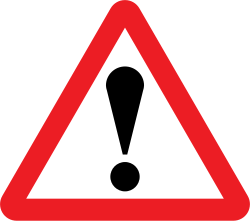
A triangle with a black exclamation mark means other danger, and a plate underneath usually names it. If there is no plate, slow down and look for the reason.
Warning signs learners often confuse
- Roundabout warning vs mini-roundabout sign: the red triangle with arrows is a warning that a roundabout is coming. The blue circle with three white arrows is an order that applies at a mini-roundabout.
- Level crossing with vs without a barrier: gate symbol means barrier or gate; steam locomotive means no barrier or gate.
- Two-way traffic straight ahead vs two-way traffic crossing: arrows pointing up and down mean oncoming traffic on your road; arrows pointing left and right mean traffic crossing your road.
- Steep hill up vs down: the two signs look alike at a glance, so check which way the wedge slopes and read the percentage before deciding on your gear and speed.
Practice questions
These practice questions are written by Get Driving Test Ready to help you revise. They are not official DVSA questions.
Q1. What shape and colour are most UK warning signs?
A) Green rectangle
B) Red octagon
C) Blue circle
D) Red-bordered triangle pointing upwards
Answer: D. Warning signs are mostly triangular, with a red border. A red octagon is the STOP sign, which is an order. (Highway Code: traffic signs)
Practise this on the road: On your next drive, call out every warning triangle you see and what it warns about.
Q2. A red-bordered warning triangle shows a black T symbol, with all its lines the same width. What should you expect ahead?
A) Your road continues and a side road joins from the left
B) The start of a dual carriageway
C) Your road ends at a road crossing in front of you
D) A crossroads where you have priority
Answer: C. This T-junction sign means the road you are on ends at a road running across it, so you will need to turn left or right and may need to give way. A version with a broader line shows which route has priority. (Highway Code rule 172; Know Your Traffic Signs (GOV.UK))
Practise this on the road: When you see a T-junction warning sign, start slowing and prepare to stop or give way.
Q3. On a junction warning sign, what does a broader line show?
A) The road with more lanes
B) The road with a lower speed limit
C) A one-way road
D) The priority route through the junction
Answer: D. The Highway Code notes that the priority through route is indicated by the broader line. (Highway Code: traffic signs)
Practise this on the road: At junction warning signs, look at which line is thicker and say whether you have priority.
Image: Wikimedia Commons, OGL v1.0
Q4. A warning triangle shows a steam locomotive. What does it mean?
A) Level crossing with barrier or gate ahead
B) Heritage railway tourist attraction
C) Level crossing without barrier or gate ahead
D) Trams crossing ahead
Answer: C. The locomotive symbol warns of a level crossing with no barrier or gate. A gate symbol is used where there is a barrier or gate. (Highway Code rule 291; Highway Code: traffic signs)
Practise this on the road: Near railways, look for level crossing signs and say whether the crossing has barriers.
Image: Wikimedia Commons, Public domain
Q5. You pass a triangle with an exclamation mark and no plate underneath. What is the best response?
A) Carry on at the same speed because it has no plate
B) Sound your horn to warn others
C) Slow down and look for the hazard
D) Stop and wait until you can see the danger
Answer: C. The "other danger" sign warns of a hazard that is not covered by a specific symbol. Slowing down and scanning gives you time to react when you find it. (Highway Code: traffic signs)
Practise this on the road: Whenever you see an exclamation mark triangle, ease off and name the hazard once you spot it.
Image: Wikimedia Commons, Public domain

Q6. A plate under a steep hill sign shows 20%. What gradient is this?
A) 1:5
B) 1:10
C) 1:2
D) 1:20
Answer: A. The Highway Code notes that gradients may be shown as a ratio, and that 20% is the same as 1:5. (Highway Code: traffic signs)
Practise this on the road: On hilly routes, read gradient signs and choose a suitable gear before the slope.
Q7. You see a warning sign for a zebra crossing, and a pedestrian has just stepped onto the crossing. What MUST you do?
A) Give way to them
B) Sound your horn so they know you are there
C) Carry on if they are on the far side
D) Flash your headlights to invite them across
Answer: A. You MUST give way when a pedestrian has moved onto a zebra crossing. You should not wave, flash your lights or use your horn to invite people across. (Highway Code rule 195)
Practise this on the road: Approaching zebra crossings, scan both pavements and be ready to stop for anyone stepping out.
Q8. Which of these warning signs is NOT a triangle?
A) Slippery road
B) Sharp deviation of route (chevrons)
C) Crossroads
D) Roundabout ahead Image: Wikimedia Commons, Public domain
Answer: B. Sharp deviation of route is shown with black and white chevron boards. Most warning signs are triangles, but the Highway Code lists these chevrons among the warning signs. (Highway Code: traffic signs)
Practise this on the road: On bends, look for black and white chevron boards and slow down before you reach them.
.svg)
Next steps
Go back to the road signs hub, then compare these warnings with the orders in our regulatory signs guide. For mixed theory revision, try the road and traffic signs topic and the hazard awareness topic, and see how spotting clues like these helps in the hazard perception test.