
Road markings are the signs painted on the road itself. Some simply guide you, like lane lines, while others carry the full force of the law, like a solid white line at a STOP junction or double white lines where the line nearer you is solid. This guide explains the markings you are most likely to meet and what each one requires.
Last reviewed: September 2026. Checked against the Highway Code and GOV.UK.
Why road markings matter
Highway Code rule 109 says you should know, understand and act on road markings as well as signs. The full set is shown in the Road markings section of the Highway Code.
Lines across the road: stop and give way
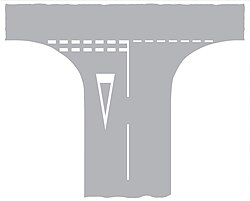

- Solid white stop line: used with a STOP sign, at traffic signals and where police control traffic. At a STOP sign you MUST stop behind the line, then wait for a safe gap (rule 171).
- Double broken white lines: give way to traffic on the major road. You MUST give way when emerging from a junction with broken white lines across the road (rule 172). The same marking can be used at mini-roundabouts.
- White triangle on the road: a warning that there is a give way junction just ahead.
- Advanced stop lines: some junctions with traffic lights have a second stop line and a marked area for cyclists. If the lights are amber or red you MUST stop at the first white line, and if you have already crossed it when the signal turns red, you MUST stop at the second line (rule 178).
Lines along the road
- Centre line: a broken white line with short lines and long gaps. Do not cross it unless you can see the road is clear and you want to overtake or turn off (rule 127).
- Hazard warning line: the same line with longer lines and shorter gaps. It means there is a hazard ahead, such as a bend or a junction. Only cross it if you are sure it is safe.
- Lane lines: short broken lines dividing wide roads into lanes. Keep between them (rule 131).
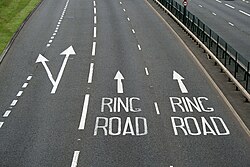

Double white lines
These are some of the most tested markings. Read the line nearest to you:
- Line nearer you is broken: you may cross to overtake if it is safe, as long as you can finish before a solid line on your side (rule 128).
- Line nearer you is solid: you MUST NOT cross or straddle it, except to enter a side road or premises, or to pass a stationary vehicle, or to overtake a pedal cycle, horse or road maintenance vehicle travelling at 10 mph or less, and only if the road is clear (rule 129).
Know Your Traffic Signs adds that stopping is prohibited on any length of road with double white lines, even if the line on your side is broken, except to pick up or set down passengers or to load or unload.
Hatched areas and chevrons
Areas of white diagonal stripes or chevrons separate lanes or protect traffic turning right (rule 130):
- If the area is bordered by a broken white line, you should not enter it unless it is necessary and safe.
- If the area has chevrons and a solid white border, you MUST NOT enter it except in an emergency.
Box junctions
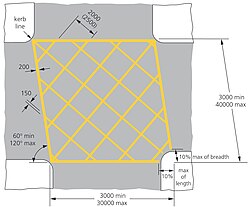

A box junction has criss-cross yellow lines. You MUST NOT enter the box until your exit road or lane is clear. You may enter and wait if you want to turn right and are only stopped by oncoming traffic or other vehicles waiting to turn right (rule 174).
Crossings and schools
- Zig-zag lines at pedestrian crossings: you MUST NOT park on the crossing or in the zig-zag area, and you MUST NOT overtake the moving vehicle nearest the crossing, or the vehicle nearest the crossing that has stopped to give way to pedestrians (rule 191).
- School entrance markings: keep the entrance clear of stationary vehicles, even if picking up or setting down children. You MUST NOT wait or park on them when upright signs show a prohibition of stopping (rule 238).
Yellow and red lines: waiting and loading
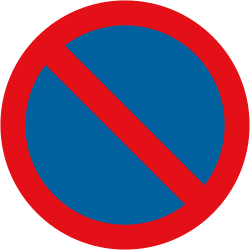

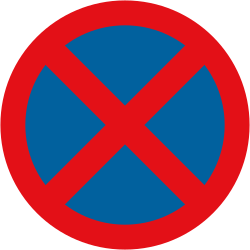

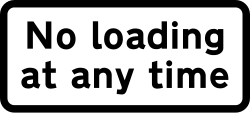

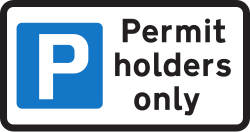

Yellow lines along the edge of the road control waiting. The Highway Code explains:
- Double yellow lines: no waiting at any time, unless signs specifically show seasonal restrictions (rule 238).
- Single yellow line: no waiting during the times shown on nearby plates, or on entry signs to a controlled parking zone.
- If no days are shown, restrictions apply every day, including Sundays and bank holidays.
- You may usually stop to load or unload, or while passengers get in or out, unless there are also loading restrictions.
- Yellow marks on the kerb show that loading and unloading is prohibited at the times shown on nearby black and white plates.
On red routes, red lines are used instead. They ban stopping to park, load or unload, or to let people in or out, except for licensed taxis and Blue Badge holders. A double red line always means no stopping at any time.
Reflective road studs
At night and in poor weather, coloured studs help you see the layout (rule 132):
| Stud colour | What it marks |
|---|---|
| White | Lanes or the middle of the road |
| Red | The left edge of the road |
| Amber | The central reservation of a dual carriageway or motorway |
| Green | The edge of the main carriageway at lay-bys and slip roads |
| Green/yellow | Temporary lane changes, for example at road works |
Road markings learners often confuse
- Centre line vs hazard warning line: longer lines with shorter gaps mean a hazard ahead.
- Which double white line applies: always the one nearest to you.
- Broken-edged vs solid-edged hatched areas: broken means only enter if necessary and safe; solid means emergency only.
Practice questions
These practice questions are written by Get Driving Test Ready to help you revise. They are not official DVSA questions.
Q1. The white centre line ahead changes to long lines with short gaps. What does this mean?
A) There is a hazard ahead
B) A bus lane starts
C) The road becomes one-way
D) You may now overtake freely
Answer: A. When a broken centre line lengthens and the gaps shorten, it is a hazard warning line. (Highway Code rule 127)
Practise this on the road: Watch the centre line on your next drive and slow down when the dashes get longer.
Q2. There are double white lines and the line nearer to you is solid. When may you cross it?
A) Whenever the road ahead looks clear
B) Never, in any circumstances
C) To pass a stationary vehicle, if the road is clear
D) To overtake a slow lorry doing 30 mph
Answer: C. You MUST NOT cross or straddle it except in listed cases, such as passing a stationary vehicle or overtaking a cycle, horse or road maintenance vehicle at 10 mph or less, when the road is clear. (Highway Code rule 129)
Practise this on the road: On bendy roads, notice which side the solid line is on and never cross it to overtake.
Q3. A hatched area has chevrons and a solid white border. When may you enter it?
A) When turning right
B) When traffic is heavy
C) Only in an emergency
D) At any time if it is safe
Answer: C. If the area is marked with chevrons and bordered by solid white lines you MUST NOT enter it except in an emergency. (Highway Code rule 130)
Practise this on the road: On your next drive, notice hatched areas and whether their borders are solid or broken.
Q4. You want to go straight on at a yellow box junction, but your exit is blocked. What should you do?
A) Enter the box and wait
B) Sound your horn
C) Wait before the box until your exit is clear
D) Enter the box only if the lights are green
Answer: C. You MUST NOT enter the box until your exit road or lane is clear. The exception is waiting to turn right when only oncoming traffic stops you. (Highway Code rule 174)
Practise this on the road: At yellow box junctions, check your exit is clear before you move into the box.
Q5. What do double yellow lines along the edge of the road mean?
A) No waiting on Sundays only
B) No stopping at any time for any reason
C) Parking for permit holders only
D) No waiting at any time, unless signs show seasonal restrictions
Answer: D. Double yellow lines mean no waiting at any time unless there are signs that specifically indicate seasonal restrictions. (Highway Code rule 238; Highway Code: road markings)
Practise this on the road: While driving, point out yellow lines and check nearby plates for times or seasonal restrictions.
Q6. What colour are the reflective studs that mark the left-hand edge of the road?
A) Amber
B) Green
C) White
D) Red
Answer: D. Red studs mark the left edge of the road. Amber studs mark the central reservation. (Highway Code rule 132)
Practise this on the road: On a dark or dual carriageway drive with your supervisor, notice the red, white, amber and green studs.
Q7. You are approaching a zebra crossing and a car ahead in the same lane has stopped to let pedestrians cross. What must you not do?
A) Wait for the pedestrians to finish crossing
B) Check your mirrors
C) Stop behind it
D) Overtake it
Answer: D. You MUST NOT overtake the vehicle nearest the crossing which has stopped to give way to pedestrians. (Highway Code rule 191)
Practise this on the road: Near zebra crossings, practise staying behind any vehicle that has stopped at the crossing.
Q8. The lights ahead turn red just after your car has crossed the first line of an advanced stop line. What should you do?
A) Stop as soon as possible, and at the latest at the second white line
B) Carry on through the junction
C) Drive past the second white line and wait there
D) Reverse back behind the first line
Answer: A. If you have crossed the first white line when the signal goes red, you should stop as soon as possible and MUST stop at the second white line, even if you are in the cyclists' area. (Highway Code rule 178)
Practise this on the road: At lights with a cycle box, practise stopping at the first line and leaving the box clear.
Next steps
Go back to the road signs hub, then read our traffic lights and signals guide, which works hand in hand with stop lines and box junctions. For mixed revision, try the rules of the road topic and the road and traffic signs topic.