
UK road signs follow a simple visual language: the shape tells you what kind of message a sign carries, and the colour narrows it down further. Once you know the system, you can work out what most signs mean even if you have never seen them before. This guide explains how that system works, points you to our detailed pages on each group of signs, and gives you a revision plan for the theory test and the practical test.
Last reviewed: September 2026. Checked against the Highway Code and GOV.UK.
Why road signs matter for your tests
Signs come up in two places. In the theory test, road and traffic signs are one of the 14 topic areas, and sign questions often appear in other topics too, such as motorway rules and rules of the road. On the practical test, the examiner watches whether you notice and obey signs and markings while you drive, including during independent driving, when you may be asked to follow traffic signs to a destination.
The Highway Code is clear that obeying signs is not optional. Rule 109 says you MUST obey all traffic light signals and traffic signs giving orders, including temporary ones, and that you should know, understand and act on all other traffic and information signs and road markings.
The full official reference is the Department for Transport’s Know Your Traffic Signs, which is free to read on GOV.UK (2023 edition). The Traffic signs section of the Highway Code shows the most common ones.
The three shapes: circles, triangles and rectangles
Know Your Traffic Signs sums up the system in three short rules. There are three basic types of sign, and each type has its own shape:
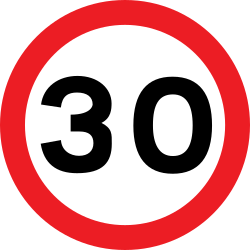
- Circles give orders. A circular sign tells you what you must do or must not do. These are called regulatory signs.
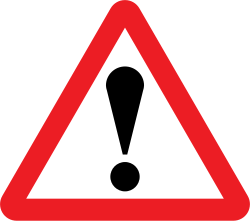
- Triangles warn. A triangular sign warns you about a hazard ahead, such as a bend, a junction or a school. Know Your Traffic Signs notes that all triangular signs are red (they have a red border).
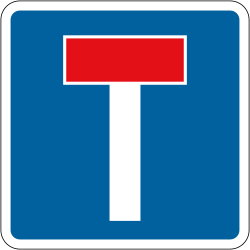
- Rectangles inform. A rectangular sign gives you information or directions, such as the route to a town, the lanes to use, or a hospital ahead.



A useful habit is to identify the shape first, before you even read the symbol. If it is a circle, ask “what am I being ordered to do?” If it is a triangle, ask “what hazard should I get ready for?” If it is a rectangle, ask “what is this telling me or where is it pointing me?”
What the colours mean
Colour is the second clue. Know Your Traffic Signs explains the main colour rules like this:
| Colour and shape | What it usually means | Example |
|---|---|---|
| Red ring or red circle | Tells you what you must NOT do (a prohibition) | Maximum speed 30 mph, no right turn, no entry |
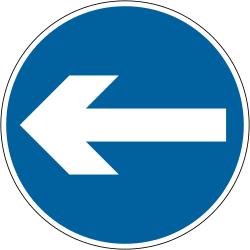
| Blue circle (no red border) | Usually gives a positive, mandatory instruction, or shows a route only certain vehicles may use | Turn left, keep left, buses and cycles only |
| Red-bordered triangle | Warning of a hazard ahead | Crossroads, bend, slippery road |
| Blue rectangle | Information signs, except on motorways where blue is used for direction signs | One-way traffic, parking, motorway directions |
| Green rectangle | Direction signs on primary routes (main A roads) | Route and town names with yellow route numbers |
| White rectangle | Direction signs on non-primary and local routes, or plates added to other signs | Local road directions, a plate saying “Except for access” |
| Brown rectangle | Tourist destinations | Castles, country parks, tourist information |
Hospital signs are a useful exception to remember. According to Know Your Traffic Signs, hospitals with accident and emergency departments are shown on red signs, while blue signs mean a hospital without A&E facilities. Road works signs are covered in their own section of the Highway Code.
Blue circles versus red circles
This is one of the most tested ideas in the whole topic, so it is worth slowing down on.
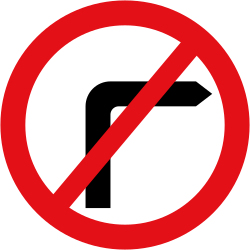
A red ring tells you something is banned. A 30 in a red ring means you must not go faster than 30 mph. A lorry symbol in a red ring means no vehicles of that type. Where a turn is banned, a red diagonal bar is added across the symbol, as on the “no right turn” and “no U-turn” signs.
A blue circle tells you something you must do. A white arrow on a blue circle pointing left means turn left. A blue circle with a number is a minimum speed, not a maximum. A blue circle with three curved white arrows is a mini-roundabout, where you give way to traffic from your immediate right.
The classic exam trap is the speed limit. A number in a red ring is the most you may do. A number on a blue circle is the least you should do, unless it is impracticable or unsafe to comply. Our regulatory signs guide explains both in detail.
.svg)

The exceptions: STOP and GIVE WAY
Know Your Traffic Signs points out that a few signs break the shape and colour rules on purpose, so they stand out. The two you must know are:
- STOP: a red octagon (eight sides) with the word STOP in white. You MUST stop behind the solid white line at the junction, even if the road looks clear, and wait for a safe gap (Highway Code rule 171).
- GIVE WAY: an upside-down triangle with a red border and the words GIVE WAY. You MUST give way to traffic on the main road when emerging from a junction with broken white lines across the road (rule 172). You only stop if you need to.
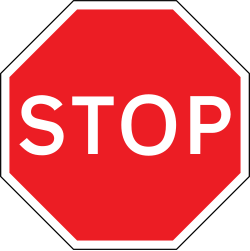

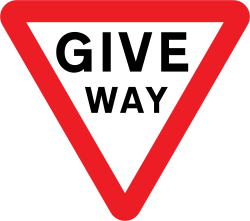

Their unusual shapes make them instantly recognisable. Notice that the GIVE WAY triangle points downwards, while warning triangles point upwards.
Plates, road markings and signals
Signs rarely work alone. Three extra layers add detail:
- Plates are small rectangles below a sign. The Highway Code notes that plates below signs qualify their message, for example by giving a distance, a time period or an exception such as “Except for access”.
- Road markings are painted on the road surface. Some carry the same legal weight as upright signs, such as a solid white line at a STOP junction or double white lines where the line nearer you is solid.
- Traffic lights and signals control who goes when, and include flashing red lights at level crossings and overhead signals on motorways.
Explore each group of signs
We have written a detailed guide for each category, with descriptions of the key signs, the ones learners commonly mix up, and eight original practice questions on each page:
- Warning signs: red triangles for junctions, bends, hills, crossings, animals and other hazards.
- Regulatory signs: circles that give orders, speed limits, STOP and GIVE WAY.
- Direction and information signs: green, white, blue and brown rectangles, and what each colour tells you.
- Road markings: white lines, yellow lines, box junctions, hatched areas and road studs.
- Traffic lights and signals: the light sequence, filter arrows, pelican and puffin crossings, and level crossing lights.
- Motorway signs: blue signs, junction numbers, countdown markers, overhead signals and the red X.
How to revise road signs (without just memorising pictures)
There are hundreds of signs, so learning them one by one is slow. These methods work better:
- Learn the system first. Spend your first session only on shapes and colours. After that, every new sign slots into a group you already understand.
- Say the category out loud. When you see a sign, say “order”, “warning” or “information” before you say what it means. It trains the instant recognition you need at 30 mph.
- Study the look-alikes side by side. Ahead only (blue circle) versus one-way traffic (blue rectangle). Maximum speed (red ring) versus minimum speed (blue circle). Give priority to oncoming traffic (red ring) versus you have priority (blue rectangle). Our category pages list the pairs learners confuse most.
- Commentary drive as a passenger. When someone else is driving, name each sign you pass and what the driver should do. It is free practice and it builds the scanning habit examiners look for.
- Link signs to rules. Many signs have a matching Highway Code rule, such as rule 171 for STOP or rule 174 for box junctions. Knowing the rule helps with the wordier theory questions.
- Practise with questions. Use the questions on each category page, then move on to our road and traffic signs theory topic for mixed revision.
Common mistakes learners make with signs
- Treating a blue circle with a number as a speed limit you must not exceed. It is a minimum speed.
- Thinking the GIVE WAY sign always means stop. It means give way; you stop only if traffic means you have to.
- Missing the plate under a sign, so missing the time, distance or exception it adds.
- Confusing the “national speed limit applies” sign (a white circle with a black diagonal stripe) with a sign that ends all restrictions. It means the national limit for that type of road and vehicle applies.
- Forgetting that in areas with street lighting, a 30 mph limit usually applies unless signs show otherwise, and that in Wales this limit is 20 mph (rule 124).
Frequently asked questions
How many road signs do I need to know for the theory test?
There is no official list of “test signs”. The safe approach is to understand the shape and colour system and know the signs in the Highway Code’s Traffic signs section well. Know Your Traffic Signs covers many more if you want extra depth.
Why are some signs a different shape from the rules?
Know Your Traffic Signs explains that a few signs, such as STOP and GIVE WAY, are given unusual shapes on purpose so they get greater prominence and can be recognised quickly.
Are Welsh road signs different?
The meanings are the same, but in Wales many signs are bilingual, in Welsh and English, and L plates may be D plates. The Highway Code notes that some older sign designs may also still be seen on roads.
What does a sign with a red border but a blue background mean?
These are mostly waiting and stopping restrictions. A blue circle with a red border and one red diagonal line means no waiting, and a blue circle with a red border and a red cross means no stopping (clearway). See our regulatory signs guide.
Do temporary signs have to be obeyed?
Yes. Highway Code rule 109 says you MUST obey traffic signs giving orders, including temporary signals and signs, such as those at road works.
Next steps
Start with the category that feels weakest, then test yourself with the practice questions at the bottom of each page. When signs feel solid, move on to the theory test hub, try the hazard perception guide, and read our practical test guide to see how signs are assessed on the road.