
Direction and information signs are the rectangles that tell you where roads go and what is ahead. Their background colour carries meaning too: blue, green, white and brown each tell you what kind of road or destination you are dealing with. Reading them quickly matters in the theory test and on the practical test, where you may be asked to follow traffic signs during independent driving.
Last reviewed: September 2026. Checked against the Highway Code and GOV.UK.
Rectangles inform
The Department for Transport’s Know Your Traffic Signs sums it up: rectangles inform. The Highway Code’s Traffic signs section describes direction signs as “mostly rectangular” and information signs as “all rectangular”. Unlike circles, most of these do not give orders, but they help you choose the right lane and route in good time, which is what examiners want to see.
What the background colour tells you
| Background | Where it is used |
|---|---|
| Blue | Direction signs on motorways, and information signs on other roads |
| Green (yellow route numbers, white lettering) | Direction signs on primary routes |
| White (black lettering) | Direction signs on non-primary and local routes |
| Brown | Tourist destinations |
Primary routes are roads of national and regional importance, and Know Your Traffic Signs notes they always have “A” numbers. Together with motorways they form the national network between major towns. All other roads, including local roads with “A” numbers, are non-primary routes.



Coloured panels and route numbers in brackets
A sign can include panels in a different colour to show a road of a different status. Know Your Traffic Signs explains:
- A blue panel means a motorway. On a primary route sign, it shows the motorway starts at the junction ahead.
- A green panel means a primary route starts at the junction ahead.
- A white panel means a local or non-primary route leads from the junction ahead.
- A brown panel shows the route to a tourist attraction.
Route numbers in brackets are roads you will reach by following the route shown, not roads you join straight away. A motorway number in brackets on a blue patch, without the motorway symbol, means you follow an all-purpose road to reach the motorway.
Types of direction sign
Know Your Traffic Signs describes several layouts. Knowing them helps you read a sign in the few seconds you have:
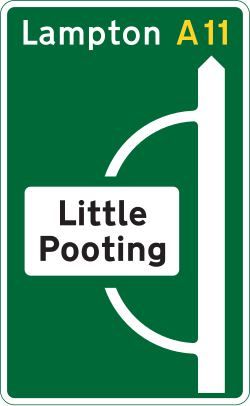
- Map-type signs show the shape of the junction, and are common before roundabouts. A special symbol is used for mini-roundabouts. The width of each road on the map shows its importance.
- Stack-type signs list each exit on a separate part of the sign with its own arrow. They are used at simple junctions and where space is tight.
- Lane signs show which lane to use for each destination. Downward-pointing arrows mean “get in lane”.
- Flag-type signs are placed at the junction itself and point along the road, using chevrons rather than arrows.
- Route confirmatory signs appear after a junction and list destinations and distances, confirming you are on the right road.
Countdown markers
Countdown markers are small rectangular boards with diagonal bars, placed on the approach to an exit. On motorways, each bar represents 100 yards to the exit. The Highway Code notes that green-backed markers may be used on primary routes and white-backed markers with black bars on other routes. At concealed level crossings, white markers with red bars may be used, but these bars do not represent 100-yard intervals.
Information signs




Information signs are all rectangles and most are blue. Common ones include:
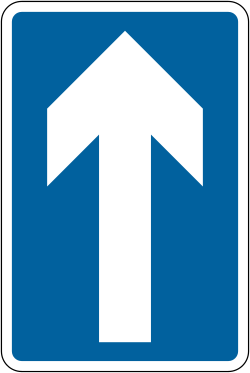
- One-way traffic: a white arrow on a blue rectangle. Compare it with the circular “ahead only” sign, which is an order.
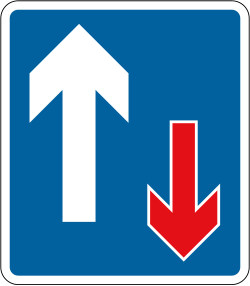
- Traffic has priority over oncoming vehicles: a blue rectangle with a white arrow for your direction and a red arrow for oncoming traffic. The opposite order, give priority to oncoming vehicles, is a red-ring circle.
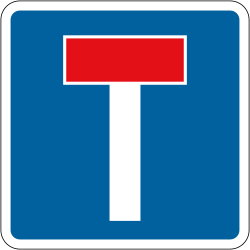
- No through road: a white upright bar with a red bar across the top. There is no way through for vehicles.
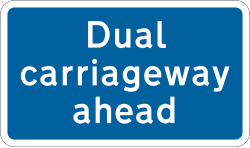
- Dual carriageway ahead and signs showing the loss of a lane, which tell you to plan your position early.
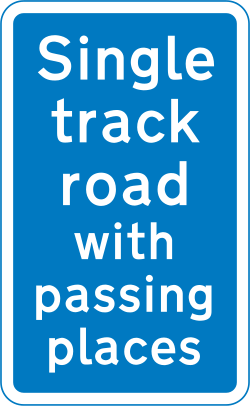
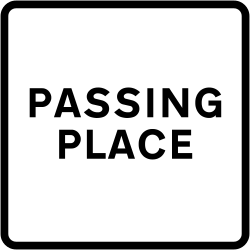
- Narrow road with passing places and passing place signs, used on single-track roads.
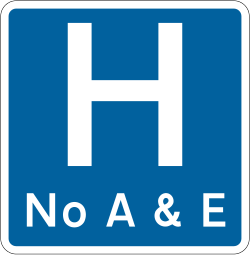
- Hospital signs: red signs mean a hospital with accident and emergency facilities; blue signs mean a hospital without them.
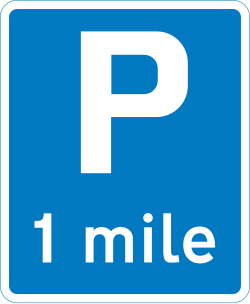
- Parking, controlled parking zone, congestion charging zone and camera enforcement area signs.
- High-occupancy vehicle (HOV) lanes: lanes for vehicles carrying at least the number of people shown. You MUST NOT use them during their times of operation unless the signs say your vehicle is allowed (rule 142).




Tourist signs
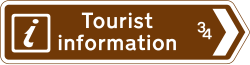
Brown signs point to tourist attractions such as castles, country parks and theme parks. Symbols are often used, and once the full name and symbol have been shown, later signs may show only the symbol. Brown panels can also appear within other direction signs.

Using direction signs on the practical test
During independent driving, the examiner may ask you to follow traffic signs to a destination. GOV.UK says that if you cannot see a sign, for example because it is covered by trees, the examiner will give you directions until you can see the next one, and you will not get a fault for taking a wrong turning. What matters is that you read signs early, choose the correct lane safely and do not make late, sudden changes. Read more in our practical test guide.
Signs learners often confuse
- One-way traffic vs ahead only: the rectangle informs you the road is one-way; the circle orders you to go straight ahead.
- Priority over oncoming vehicles vs give priority: blue rectangle means you have priority; red ring means you give way.
- Blue signs on and off motorways: blue is for direction signs on motorways, but for information signs on other roads.
- Red vs blue hospital signs: red means A&E facilities; blue means no A&E.
- Route numbers with and without brackets: brackets mean you reach that road by following the route, not straight away.
Practice questions
These practice questions are written by Get Driving Test Ready to help you revise. They are not official DVSA questions.
Q1. What colour background do direction signs on primary routes have?
A) Blue
B) Green
C) White
D) Brown
Answer: B. Primary route direction signs have green backgrounds, yellow route numbers and white lettering. (Know Your Traffic Signs (GOV.UK))
Practise this on the road: On your next drive, spot green primary route signs and read the yellow road numbers aloud.
Q2. A brown sign most likely shows the way to what?
A) A car park for lorries
B) A hospital
C) A tourist attraction
D) A motorway
Answer: C. Brown signs and panels show routes to tourist attractions. (Highway Code: traffic signs)
Practise this on the road: Look out for brown signs on a drive and name the attraction each one points to.
Q3. On a green direction sign, what does a blue panel mean?
A) A tourist attraction
B) A road that is closed
C) A local road
D) The motorway starts at the junction ahead
Answer: D. Blue panels indicate that the motorway starts at the junction ahead. (Highway Code: traffic signs)
Practise this on the road: Near a motorway junction, look for blue panels on green direction signs showing where the motorway begins.
Q4. A rectangular blue sign shows a white arrow pointing up and a red arrow pointing down. What does it mean?
A) You have priority over oncoming vehicles
B) Give way to oncoming vehicles
C) One-way traffic
D) No overtaking
Answer: A. This information sign means traffic has priority over oncoming vehicles. The red-ring version with two arrows means you must give priority to oncoming traffic. (Highway Code: traffic signs)
Practise this on the road: On narrow roads or bridges, check which priority sign faces you before you commit to going through.
Image: Wikimedia Commons, OGL v1.0
Q5. Why might a direction sign show a route number in brackets?
A) The road is a toll road
B) The road is for local traffic only
C) The road is reached by following the route shown
D) The road is closed
Answer: C. Route numbers in brackets are roads that will be reached by following the route indicated. (Highway Code: traffic signs)
Practise this on the road: On your next drive, find a direction sign with a route number in brackets and work out how you would reach it.
Q6. On UK road signs, what does a white letter H on a blue background direct you to?
A) A hotel
B) A holiday park
C) A harbour
D) A hospital
Answer: D. A white H on a blue background is the hospital symbol used on UK road signs. The Highway Code also shows a sign for a hospital ahead with Accident and Emergency facilities. (Highway Code: traffic signs)
Practise this on the road: As you drive, point out blue signs with a white H and follow one mentally towards the hospital.
Q7. Before a concealed level crossing you pass white markers with red diagonal bars. What is true about these countdown markers?
A) Each bar is 100 metres
B) The markers are equally spaced, but the bars do not represent 100-yard intervals
C) Each bar is exactly 100 yards
D) They show the number of trains per hour
Answer: B. The Highway Code notes that these markers are erected at equal distances, but the bars do not represent 100-yard intervals. (Highway Code: traffic signs)
Practise this on the road: When approaching a level crossing, watch for red-barred countdown markers and start slowing early.
Q8. During independent driving you cannot see the next traffic sign because it is hidden by trees. What happens?
A) The test ends early
B) You fail for going the wrong way
C) The examiner gives you directions until you can see the next sign
D) You must stop and ask the examiner
Answer: C. GOV.UK explains that the examiner will give you directions until you can see the next sign. (GOV.UK: what happens during the driving test)
Practise this on the road: Practise following signs to a town without a sat nav, and ask your supervisor for help when a sign is hidden.
Next steps
Go back to the road signs hub, then move on to motorway signs, where blue direction signs and countdown markers are used heavily. For mixed revision, try the road and traffic signs topic.