
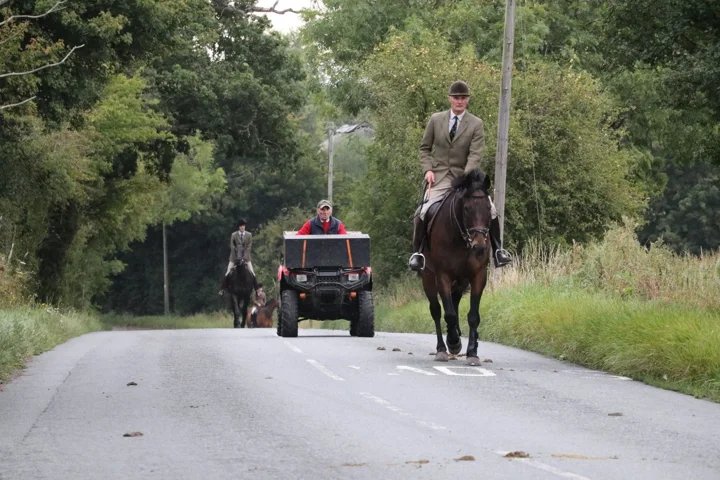
Photo: VINTTRO Ltd / Pexels. Illustrative photograph.
When you meet a horse on the road in Great Britain, the Highway Code tells you to slow to no more than 10 mph, pass wide and slowly, and leave at least 2 metres of space. This guide is for learner and new drivers in England, Scotland and Wales who want to know exactly what Rules 163 and 215 ask, why horses need different treatment from cars and bikes, and what the rules for riders themselves (Rules 47 to 58) mean for you behind the wheel.
Key facts: horses and the Highway Code
- Slow down to a maximum of 10 mph when you see a horse on the road (Rule 215).
- Pass wide and slowly, leaving at least 2 metres where possible (Rules 163 and 215).
- Do not sound your horn or rev your engine near horses.
- Horse riders may ride two abreast, but never more, and in single file on narrow or busy roads and around bends (Rule 53).
- Children under 14 MUST wear a helmet that complies with the regulations when riding on the road (Rule 49).
- Horse riders are in the group the Highway Code says is most at risk, under the hierarchy of road users.
How do you pass a horse safely? The five steps
Rule 215 sets out how to deal with horse riders and horse-drawn vehicles. Put into a sequence you can practise:
- Spot it early. Rule 154 tells drivers on country roads to expect horse riders, pedestrians, cyclists and slow farm vehicles. Scan well ahead, especially on bends and near bridleways.
- Slow to 10 mph or less. Ease off smoothly. Harsh braking or a sudden engine note can startle a horse.
- Watch the rider. If they signal you to slow down or stop, do so. Riders often know when their horse is uneasy.
- Pass wide and slowly when it is safe, giving at least 2 metres. If oncoming traffic means you cannot give that space, wait behind.
- Pull away gently. Do not accelerate hard as soon as you are past. Keep your speed down until you are well clear.
What not to do
- Do not sound your horn or rev your engine.
- Do not pass close, even slowly.
- Do not overtake a horse rider as you approach a junction or roundabout where you are turning left. Rule 167 says stay behind.
- Do not cut across a horse rider going straight ahead when you turn (Rule H3).
What Rule 163 says about distance and speed
Rule 163, the main overtaking rule, gives minimum clearances for people who are more exposed than car drivers. For horses it says to pass at speeds under 10 mph and allow at least 2 metres of space.
| Road user | Rule 163 guidance |
|---|---|
| Horse riders and horse-drawn vehicles | Under 10 mph, at least 2 metres |
| Cyclists | At least 1.5 metres at speeds up to 30 mph, more at higher speeds |
| Pedestrians walking in the road | At least 2 metres, at low speed |
| Motorcyclists | As much room as for a car |
Rule 163 adds that you should give more space in bad weather, including high winds, and at night. If you cannot meet these clearances, you should wait behind and not overtake. Our overtaking cyclists explainer covers the cyclist figures, and overtaking rules covers when you must not overtake at all.
Can you cross double white lines to pass a horse?
Rule 129 says you MUST NOT cross or straddle double white lines where the line nearest you is solid, with some exceptions. One of them: you may cross if necessary, provided the road is clear, to overtake a pedal cycle, horse or road maintenance vehicle travelling at 10 mph or less. You still need to be able to give the full 2 metres and see that the road is clear.
Why horses need different treatment
A horse is a large animal that can react to sudden noise or movement, and the rider is sitting high with no protection apart from a helmet. Rule 214, on animals generally, tells drivers to pass slowly, give plenty of room, be ready to stop, and not use the horn, rev the engine or accelerate quickly near them. The Highway Code places horse riders in the group most at risk in a collision.
Rule 215 adds several points worth remembering. Treat every horse as a potential hazard: horses are flight animals and can move very quickly if startled, however good the rider. Many riders are children, so take extra care. Two riders side by side may be escorting a young or inexperienced horse or rider. Feral or semi-feral ponies, such as those in the New Forest, on Exmoor and on Dartmoor, need the same slow, wide approach as a ridden horse.
Rules for riders that drivers should know (Rules 47 to 58)
Knowing what riders are told to do helps you predict what they will do next.
Position on the road
- Riders keep to the left and keep both hands on the reins unless signalling (Rule 53).
- A led horse is kept on the rider’s left.
- Riders should never ride more than two abreast, and should ride single file on narrow or busy roads and when riding round bends (Rule 53).
- Rule 213 says horse riders may ride in the centre of the lane on narrow roads. Expect this where the road is too narrow for you to overtake safely.
- Riders MUST NOT take a horse onto a footpath or pavement (Rule 54), so they will be in the road where there is no bridleway.
Signals and roundabouts
Riders look behind and give a clear arm signal before moving off or turning (Rule 53). Rule 55 advises riders to avoid roundabouts where possible. If they do use one, they keep to the left and signal right when passing exits they are not taking, then signal left just before they leave. So a horse in the left lane signalling right is usually going round, not leaving. Do not cut across them (Rule 186).
Clothing, helmets and night riding
- Children under 14 MUST wear a helmet that complies with the regulations, securely fastened. A Sikh child wearing a turban is exempt (Rule 49).
- Riders should wear light-coloured or fluorescent clothing in daylight and reflective clothing at night or in poor visibility (Rule 50).
- Riding at night is discouraged. Riders who do ride at night should use reflective bands on the horse and a light showing white to the front and red to the rear on their right arm or leg (Rule 51).
Horse-drawn vehicles
Rule 48 says horse-drawn vehicles should have two red rear reflectors, and if used at night they MUST have a white light at the front and a red light at the rear. On an unlit lane, these may be the only warning you get, so drive at a speed that lets you stop within the distance you can see is clear.
Equestrian crossings
Some roads have equestrian crossings with a separate signal for horse riders. See the pedestrian crossings guide for how they work.
Scenario: a pair of riders on a narrow lane
You round a bend on a 60 mph rural road and see two riders side by side about 100 metres ahead. One of them signals to you to slow down.
- Rule 215 says follow a rider’s signal to slow down or stop. Ease off to 10 mph or less.
- The riders may move into single file to let you pass. Wait until they have done so and you can see well ahead.
- If the lane is too narrow for 2 metres, stay behind until there is a wider stretch or a safe place.
- Pass slowly and wide, then pull away gently.
Our guide to learning to drive on rural roads covers bends, single-track lanes and tractors too, and herded animals and livestock on the road covers sheep, cattle and dogs.
Horses on the theory and driving tests
Horse riders fall under the vulnerable road users theory topic, and questions on passing horses often test the 10 mph and 2 metre figures. On the practical test, passing a horse too fast or too close is the kind of action an examiner can record as a serious or dangerous fault. See driving test faults explained.
Common questions
How fast should you pass a horse in the UK?
The Highway Code for Great Britain says no more than 10 mph, passing wide and slowly with at least 2 metres of space.
Is the 2 metre rule a legal requirement?
Rules 163 and 215 use “should”, so they are advice rather than stand-alone legal duties. But the Highway Code can be used as evidence in court, for example in a careless driving case.
Can horse riders ride two abreast?
Yes, but never more than two, and they should go into single file on narrow or busy roads and around bends.
Why do riders ride in the middle of the lane?
Rule 213 says horse riders may use the centre of the lane on narrow roads. On a road that narrow, you could not give them 2 metres anyway, so wait behind.
Should I beep to let a rider know I am there?
No. The Code says not to sound your horn or rev your engine near horses. Slow down early so the rider has time to hear and see you.
Do riders have to wear hi-vis?
The Code advises it but does not make it law. The only legal requirement in these rules is a helmet for riders under 14, plus lights on horse-drawn vehicles at night.
Back to the main guide: Learning to Drive in Great Britain.
Sources
- Department for Transport, “The Highway Code: Rules about animals (47 to 58)” (gov.uk)
- Department for Transport, “The Highway Code: Road users requiring extra care (204 to 225)” (gov.uk)
- Department for Transport, “The Highway Code: Using the road (159 to 203)” (gov.uk)
- Department for Transport, “The Highway Code: General rules, techniques and advice for all drivers and riders (103 to 158)” (gov.uk)
- Department for Transport, “The Highway Code: Introduction” (gov.uk)