

Photo: Airam Dato-on / Pexels. Illustrative photograph.
Great Britain has six main types of pedestrian crossing: zebra, parallel, pelican, puffin, toucan and equestrian. The one difference drivers most often get wrong is that only pelican crossings have a flashing amber light, which means give way to anyone on the crossing and go only if it is clear. At every crossing you MUST NOT park on the crossing or its zig-zag lines, and you MUST NOT overtake the vehicle nearest the crossing. This guide covers Highway Code Rules 191 to 199 for drivers in England, Scotland and Wales, plus what the pedestrian rules (18 to 30) mean for you behind the wheel.
The six crossings compared
| Crossing | Who uses it | How you spot it | Lights for drivers | What you must do |
|---|---|---|---|---|
| Zebra | Pedestrians | Black and white stripes, flashing beacons | None | MUST give way once a pedestrian has moved onto the crossing; should give way to people waiting |
| Parallel | Pedestrians and cyclists | Zebra stripes with a cycle route alongside | None | MUST give way once a pedestrian or cyclist has moved onto the crossing |
| Pelican | Pedestrians | Push button operated by pedestrians | Red, then flashing amber, then green | MUST stop on red; on flashing amber MUST give way to anyone on the crossing |
| Puffin | Pedestrians | Red and green figures above the control box on the pedestrian’s side | Same sequence as traffic lights, no flashing amber | Treat as traffic lights |
| Toucan | Pedestrians and cyclists together | Push button; pedestrians and cyclists get the green signal together | Same as traffic lights, no flashing amber | Treat as traffic lights; cyclists may ride across |
| Equestrian | Horse riders | Pavement barriers, wider space, horse and rider figures, a higher control panel | Same as traffic lights, no flashing amber | Treat as traffic lights |
A handy way to remember: toucans are for two (people and bikes), puffins have the signals on the pedestrian’s side, and pelicans are the only crossing with a flashing amber light.
Rules for every crossing
- Zig-zag lines (Rule 191): you MUST NOT park on a crossing or in the area covered by the zig-zag lines. Rule 240 repeats this ban on stopping or parking.
- No overtaking (Rule 191): you MUST NOT overtake the moving vehicle nearest the crossing, or the vehicle nearest the crossing that has stopped to let pedestrians cross. A stopped vehicle can hide the very person stepping out in front of it, even if the lane beside it looks empty.
- Keep it clear (Rule 192): in queuing traffic, do not move onto a crossing unless you can clear it completely, and do not block advanced stop lines for cycles.
- Blocked views (Rule 193): take extra care when queuing traffic or badly parked vehicles hide the crossing. People may be crossing between stopped vehicles.
- No pressure (Rule 194): give people plenty of time and do not rev your engine or edge forward.
- After the lights change (Rule 198): give way to anyone still crossing after your signal turns green. This applies at all crossings.

Zebra crossings (Rule 195)
Zebra crossings have black and white stripes and flashing beacons. As you approach:
- Look out for people waiting to cross, and be ready to slow down or stop.
- You should give way to pedestrians waiting to cross.
- You MUST give way when a pedestrian has moved onto the crossing.
- Allow more stopping time on wet or icy roads.
- Do not wave, flash your lights or sound your horn to invite people across. Another vehicle may be coming.
- Watch for people approaching from the side of the crossing.
A zebra crossing with a central island counts as two separate crossings. Once a pedestrian has reached the island, the half on your side may be clear for you to go, but watch for them stepping onto your half.
Parallel crossings
Parallel crossings look like a zebra with a cycle route running beside the stripes. The same rules apply, but for cyclists as well as pedestrians: you should give way to anyone waiting, and you MUST give way once a pedestrian or cyclist has moved onto the crossing. Expect cyclists to arrive faster than walkers.
Pelican crossings and the flashing amber (Rules 196 and 197)
Pelican crossings are signal-controlled crossings where a flashing amber light follows the red “Stop” light.
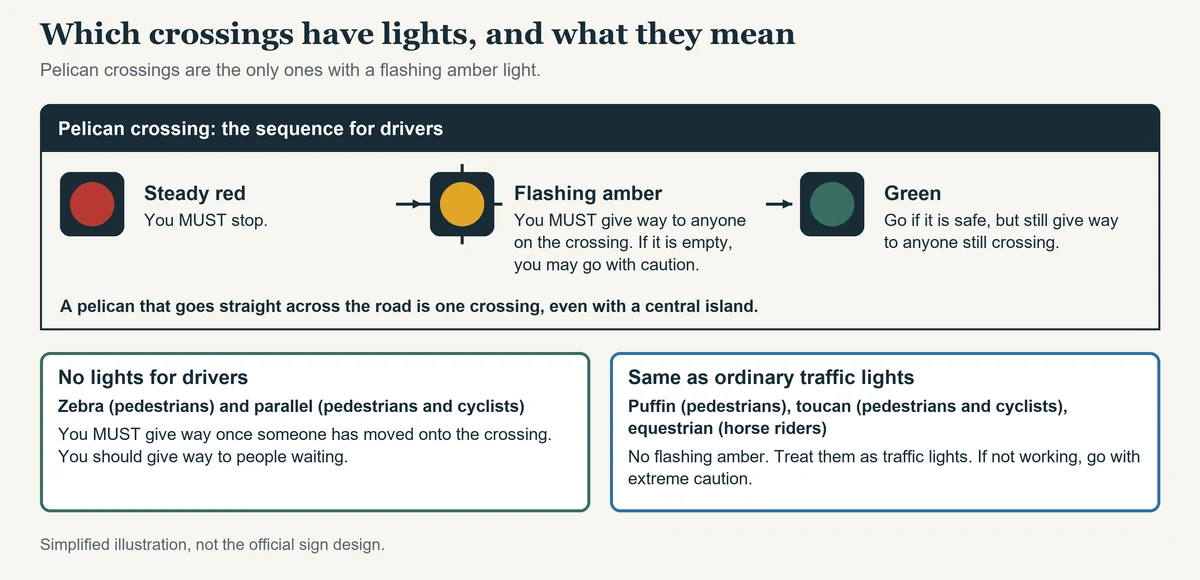
| Light | What it means for you |
|---|---|
| Steady red | You MUST stop |
| Flashing amber | You MUST give way to any pedestrians on the crossing. If nobody is on it, you may go with caution |
| Green | Go if it is safe, but still give way to anyone still crossing (Rule 198) |
A pelican crossing that goes straight across the road is one crossing, even if it has a central island. You MUST wait for pedestrians crossing from the other side of the island. A pedestrian on the far half still has priority over you.
From the pedestrian side, Rule 22 says that when the green figure starts flashing, people should not start to cross, but anyone already crossing should have time to finish.
Puffin, toucan and equestrian crossings (Rule 199)
These work like pelican crossings but have no flashing amber phase. The light sequence for drivers is the same as at ordinary traffic lights. If the crossing is not working, go with extreme caution. Do not enter the crossing unless you can clear it completely, so you do not block pedestrians, cyclists or horse riders.
- Puffin (Rule 23): the red and green figures are above the control box on the pedestrian’s side, and there is no flashing green figure.
- Toucan (Rule 25): pedestrians and cyclists see the green signal together, and cyclists are allowed to ride across.
- Equestrian (Rule 27): for horse riders, with pavement barriers, wider crossing spaces, horse and rider figures, and either two sets of controls (one higher) or just one higher control panel.
Staggered crossings
Rule 28 explains that where the two halves of a pelican or puffin crossing are not in line across a central refuge, they are two separate crossings. Pedestrians press the button again on the island. As a driver, your lights only control your half.
What pedestrians are told, and why it matters to you
Knowing the pedestrian rules helps you predict what people will do:
- Rule 19 tells pedestrians that traffic does not have to stop until someone has moved onto a zebra crossing, and to keep looking in case a driver overtakes a stopped vehicle. That is exactly why overtaking near a crossing is banned.
- Rule 18 tells pedestrians to check that traffic has stopped before they step out, to cross between the studs or over the stripes rather than at the side or on the zig-zag lines, and says they MUST NOT loiter on any crossing. Some still cross at the edges, so watch them.
- Rule 26 says some crossings bleep or speak, and may have a tactile signal, for blind, partially sighted and deafblind people. Someone using these may need more time.
- Rule 29 says pedestrians should only cross where a police officer, traffic warden or school crossing patrol signals them to. See signals by police and crossing patrols.
For more on pedestrians, read Highway Code rules for pedestrians and the hierarchy of road users.
Penalties for crossing offences
Parking on zig-zags, overtaking at a crossing or failing to give way are breaches of the pedestrian crossing regulations. GOV.UK lists three endorsement codes, each carrying 3 penalty points:
| Code | Offence | Points |
|---|---|---|
| PC10 | Undefined contravention of pedestrian crossing regulations | 3 |
| PC20 | Contravention of pedestrian crossing regulations with a moving vehicle | 3 |
| PC30 | Contravention of pedestrian crossing regulations with a stationary vehicle | 3 |
For a new driver, two crossing offences reach 6 points, which means losing your licence within 2 years of passing. See the New Drivers Act.
Common questions
Do I have to stop for someone waiting at a zebra crossing?
Rule 195 says you should give way to pedestrians waiting to cross, and you MUST give way once they have moved onto the crossing.
What does flashing amber mean at a pelican crossing?
You MUST give way to anyone on the crossing. If it is empty, you may go with caution.
Which crossings have no flashing amber?
Puffin, toucan and equestrian crossings. Their lights follow the normal traffic light sequence.
Can I park on zig-zag lines to drop someone off?
No. Rules 191 and 240 say you MUST NOT stop or park on a crossing or in the area marked by the zig-zag lines.
Should I wave pedestrians across?
No. Rule 195 says do not wave, flash your lights or sound your horn to invite people across, because another vehicle may be approaching.
Is a crossing with a central island one crossing or two?
A zebra with an island is two crossings. A pelican that goes straight across is one crossing, even with an island. Staggered pelican or puffin crossings are two.
Related: traffic lights and signals. Back to the main guide: Learning to Drive in Great Britain.
Sources
- Department for Transport, “The Highway Code: Using the road (159 to 203)” (gov.uk)
- Department for Transport, “The Highway Code: Rules for pedestrians (1 to 35)” (gov.uk)
- Department for Transport, “The Highway Code: Waiting and parking (238 to 252)” (gov.uk)
- GOV.UK, “Penalty points (endorsements): Endorsement codes and penalty points” (gov.uk)