
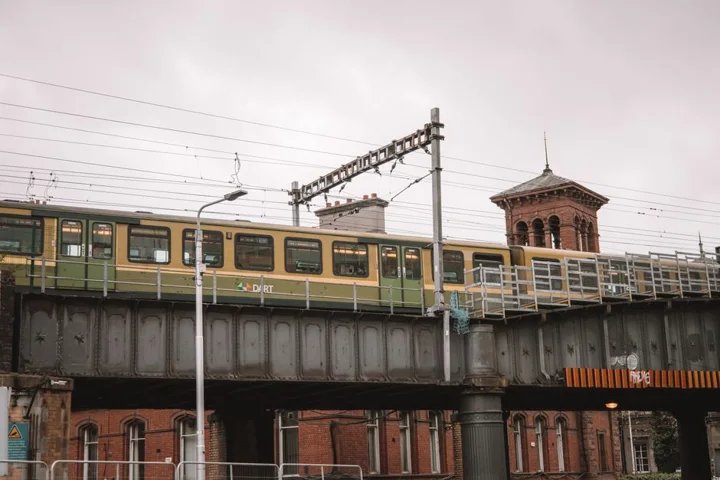
Photo: Joaquin Carfagna / Pexels. Illustrative photograph.
At a railway level crossing in Ireland you must obey the signs and lights, slow down, be ready to stop and never stop on the tracks. At an unattended crossing you stop at least 2 metres from the line, look and listen, then cross quickly. This guide covers the four types of Irish level crossing, what to do if you stall, low railway bridges and road tunnel lane signs, all from the Rules of the Road and current fixed charges.
Key facts
- Never stop on the railway tracks. Don’t enter a yellow box at a level crossing unless you can clear it without stopping.
- Flashing red lights at a level crossing mean stop, exactly like a red traffic light.
- At an unattended crossing, stop at least 2 metres before the railway line, look, listen, then cross quickly.
- You must shut and fasten iron gates after you, even if they were open when you arrived.
- Ignoring the lights or signs at a level crossing: €80 fixed charge and 2 penalty points (5 on conviction).
- If your vehicle hits a railway bridge, you must report it straight away, even if there is no visible damage.
The Rail Cross Code
The Rules of the Road gives one routine to use every time you cross at an unattended crossing:

- Always expect a train.
- Stop, look and listen. Stop at least 2 metres before the railway line. Look right and left for train lights. Listen for a horn or whistle.
- Give way to trains. Let any train pass, then look right and left again.
- Cross quickly once the railway is clear.
The four types of level crossing in Ireland
| Type | What protects it | What you must do |
|---|---|---|
| Unattended, with iron gates | Gates only, which users open and shut themselves. Found on minor roads. | Stop clear of the gates, open both gates, drive forward and stop 2 metres from the line, handbrake on, look and listen, cross, stop well clear on the far side, then shut and fasten both gates. |
| Attended, with gates or barriers worked by railway staff | Railway staff | Slow down and be ready to stop. The crossing is open only when the gates are fully open to the road. |
| Automated, traffic lights only | Road traffic lights, no barriers | Obey the lights. If you are already on the crossing when they change, keep going and clear it quickly. |
| Automated, barriers and flashing red lights | Barriers that lower when a train approaches, plus amber and flashing red lights (sometimes an alarm) | Amber means stop if you safely can. Flashing red means stop. Wait until all lights are out and the barriers are up. Never zigzag round the barriers. |

Extra steps at an unattended gated crossing
The RSA describes these crossings as potentially dangerous and says to use a bridge or a staffed or automated crossing if one is available. Before crossing:
- switch off your phone and music
- open the driver and passenger windows so you can hear
- read the instructions at the crossing
- get a helper to work the gates if you can
Failing to shut and fasten the gates is an offence.
What to do if you stall on a level crossing
If your vehicle stalls or an animal strays onto the line:
- Get everyone well clear of the railway.
- Leave the vehicle or animal where it is.
- Phone the railway controller on the number displayed at the crossing.
- Give the “crossing number” shown on the plate at the crossing. Each crossing has its own number.
When to phone the railway before crossing
At crossings with iron gates or automatic half barriers, or on minor roads protected only by lights, you should phone for permission first if you are taking across:
- a long, low, wide, heavy or slow vehicle
- dangerous goods or an exceptional load
- a crowd of people or a herd of animals
On electrified lines such as the DART, the safe headroom under the overhead wires is 5 metres (16 ft 4 in).
Railway bridges and low bridges
Railway bridges carry an identification plate with a bridge number and Iarnród Éireann’s emergency phone number.
- If you hit a bridge: report it immediately, damage or not. Phone the number on the plate, say what happened and give the bridge number. If you can’t get through, tell a Garda immediately. Failing to report is an offence.
- Height restriction sign: you must not pass unless your vehicle, including any load, is lower than the height shown. The law says a vehicle must not pass the sign if its height equals or exceeds the figure.
- Restricted headroom warning sign: gives advance notice of the height limit, in feet and inches first, then metres.
- Arch bridges: the signed height is only available across part of the arch. “Goalpost” markings show that width.
- Bridges over the railway may have weight, axle, width or axle-count limits. Gross weight, axle weight and width signs mean you cannot go past if your vehicle exceeds the figure.
Most of this matters more for vans, campervans and towing, but learners are tested on the signs. RSA advice: know your height, know your route.
Road tunnel lane signs
Lane control signs hang above each lane at and inside road tunnels. When they are working, amber lights at the top and bottom flash in turn.
| Sign | Meaning |
|---|---|
| Green arrow pointing down | Lane open. You may use it. |
| Red X | Lane closed. Stop. It has the same effect as a stop sign. |
| Green arrow pointing left | Move into the left-hand lane, following the normal rules for changing lanes. |
| Green arrow pointing right | Move into the right-hand lane, following the normal rules for changing lanes. |
| Goods vehicle with axle number | Goods vehicles and large non-passenger vehicles with that number of axles or more must stay in the left-hand lane. This does not apply if the left lane shows a red X, the right lane shows a green arrow, or the left lane is blocked. |
Tunnel speed limits are either a standard sign or a variable message sign: a black square with a red circle and white or yellow numbers. Both are maximums, not targets. Ignoring a lane control sign carries a €60 fixed charge.
For driving through a tunnel (the 50 metre gap, what to do in a breakdown or fire), see motorways and tunnels in Ireland. Each tunnel operator signs its own restrictions on the approach, so read them.
Common questions
Can I stop on a level crossing if traffic ahead is queuing?
No. You must never stop on the tracks. Wait before the crossing until there is room on the far side for your whole vehicle.
What does a flashing amber light at a level crossing mean?
The Rules of the Road says the amber light works like an amber traffic light: stop if you safely can. Flashing red then means stop.
The barriers went up but a light is still flashing. Can I go?
No. Wait until all the lights have gone out and the barriers are fully raised. Another train may be coming.
The gates at an unattended crossing were already open. Do I still close them?
Yes. You must shut and fasten them after you, whatever state you found them in.
How many points for going through a level crossing on red?
Failing to obey traffic lights or signs at a railway level crossing carries a €80 fixed charge and 2 penalty points, or 5 points on conviction in court. See penalty points in Ireland.
Where do I learn the other signs?
See Irish road signs explained, Irish road markings and bus lanes, Luas and light rail.
Back to learning to drive in Ireland.
Sources
- Road Safety Authority, “Rules of the Road”, Section 6 Railway level crossings, Railway bridges and overhead structures, Road tunnel signs (Revision 5, hosted on garda.ie)
- Irish Statute Book, “S.I. No. 182/1997, Road Traffic (Traffic and Parking) Regulations 1997”, articles 31 and 34 (irishstatutebook.ie)
- Irish Statute Book, “S.I. No. 227/2024, Road Traffic Act 2010 (Part 3) (Fixed Charge Offences) Regulations 2024” (irishstatutebook.ie)
- Law Reform Commission, “Road Traffic Act 2002”, First Schedule, revised (revisedacts.lawreform.ie)