
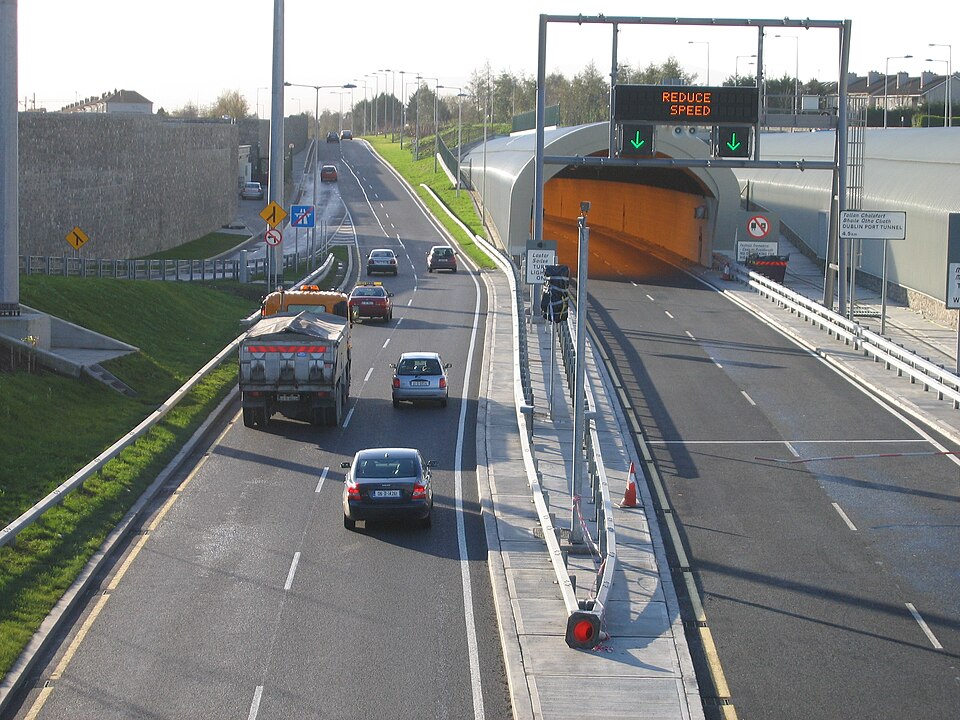
Photo: Sarah777 at en.wikipedia, Public domain, via Wikimedia Commons
Learner permit holders cannot drive on Irish motorways: only people with a full licence for the vehicle category may use them. So your first motorway drive usually comes after you pass the test, often with N plates. This guide covers the 120 km/h limit, joining and leaving, lane use, stopping and the rules for road tunnels, so that first drive is not a surprise.
Key facts
- Motorway limit: 120 km/h unless signs show lower, or your vehicle has a lower limit (80 km/h when towing).
- Banned from motorways: learner drivers, cyclists, pedestrians, animals, vehicles of 50cc or less, vehicles that cannot do at least 50 km/h, invalid carriages and vehicles without inflated tyres.
- No turning, reversing, U-turns, or picking up and setting down passengers.
- Stop only for a breakdown, an emergency, roadworks, a toll plaza, or if a Garda signals you.
- In a tunnel the recommended minimum gap for a car is 50 metres.
Can learner drivers drive on a motorway in Ireland?
No. The “Motorway ahead” sign lists who must not enter, and that includes anyone who does not hold a full driving licence for the category of vehicle they are driving. Dual carriageways that are not motorways are not covered by this ban, so learners can practise higher speeds and lane changes there. Novice drivers on N plates may use motorways. See N plates in Ireland.
Motorway signs to know
| Sign | Meaning |
|---|---|
| Motorway ahead | A motorway entrance is ahead. The road users shown on the sign must not enter. |
| Entry to motorway | You are now on a motorway and motorway rules apply. |
| Countdown markers (3, 2, 1 bars) | 300 m, 200 m and 100 m to the next exit. |
| Motorway ends 1 km / 500 m ahead | Distance to the end of the motorway. |
| Lane gain | An extra lane is joining the motorway. |
See Irish road signs explained.
How to join a motorway
- Use the slip road and acceleration lane to build up speed.
- Signal right early.
- Check mirrors and blind spot for a gap in the left lane.
- Give way to traffic already on the motorway. Do not drive on the hatched markings.
- Match the speed of traffic in the left lane and merge.
- Stay in the left lane until you have settled to the speed before thinking about overtaking.
Lane discipline
| Lane | Use it for |
|---|---|
| Lane 1 (left, next to the hard shoulder) | Normal driving. Keep left unless overtaking. |
| Lane 2 on a 2-lane motorway | Overtaking only, then move back. Also to make room for merging traffic. |
| Lane 2 on a 3-lane motorway | You may stay here while slower traffic is in Lane 1. |
| Lane 3 on a 3-lane motorway | Only when Lanes 1 and 2 are moving in queues and you need to overtake or make room for merging traffic. |
- Overtake on the right. Passing on the left is allowed only in slow-moving queues where your lane is moving faster.
- Signal before every lane change. Moving from Lane 3 to Lane 1 is two separate signals and two manoeuvres.
- Goods vehicles over 3,500 kg, anything towing a trailer or caravan, and buses designed for standing passengers must not use the outside lane except to pass an obstruction.
- Keep at least a two-second gap. Use hazard lights briefly to warn traffic behind if the queue ahead slows sharply.
Leaving the motorway
- Plan ahead using the 2 km and 1 km exit signs, and get into Lane 1 early.
- Signal left by the countdown markers.
- Keep your speed until you are in the deceleration lane, then slow down. Use your speedometer to check you are within the lower limit.
- Watch for lower limits and sharp bends on slip roads.
- Missed your exit? Carry on to the next one. Never cross the ghost island or reverse on the hard shoulder.
Stopping, breaks and breakdowns
You may only stop on a motorway if you break down, there is an emergency, there are roadworks, you are at a toll plaza, or a Garda signals you. The hard shoulder is for emergencies only. Plan rest stops at service areas and lay-bys. Before a long trip, check tyre pressures, oil, coolant and fuel.
If you break down, get onto the hard shoulder, leave by the left-hand doors, and wait behind the crash barrier. Do not put a warning triangle on a motorway. Full steps are in breaking down on an Irish motorway.
If you ever find yourself driving against the traffic, pull onto the hard shoulder, stop, and call 999 or 112. Do not try to turn.
Tolls
Slow down and keep a safe gap approaching a toll plaza. Barrier tolls take cash, card or electronic tags depending on the lane. The M50 uses barrier-free eFlow tolling, so there is no booth: check the payment rules before you use it.
Rules for road tunnels in Ireland
Before you enter
- Check you have enough fuel.
- Take off sunglasses and switch on dipped headlights.
- Tune to the radio frequency shown at the entrance for safety messages.
- Keep at least 50 metres from the vehicle in front (100 metres for vehicles other than cars and motorcycles).
In the tunnel
- Keep in lane. Do not overtake, turn or reverse.
- Do not stop except in an emergency.
- Obey the speed limit, including variable limits shown on electronic signs.
If traffic stops or something goes wrong
| Situation | What to do |
|---|---|
| Told to stop | Keep a safe gap, hazard lights on, engine off, listen to the radio and watch the signs. |
| Breakdown or crash | Engine off, hazard lights on, use the emergency station phone to tell the tunnel operator. |
| Fire in your vehicle | Switch on your hazard lights and drive out of the tunnel if you can. If you cannot, pull over, switch off the engine, leave the vehicle at once and use the nearest emergency exit. Call for help from a safety panel. |
| Fire in another vehicle | If it is behind you, drive out. If it is ahead, engine off, leave the car and walk to the nearest emergency exit. |
More on tunnel and bridge signs in level crossings, low bridges and road tunnels.
Motorway penalties
| Offence | Points on payment | Points on conviction | Fixed charge |
|---|---|---|---|
| Speeding | 3 | 5 | €160 |
| Driving against the flow of traffic | 2 | 4 | €80 |
| Driving on a part that is not the carriageway, such as the hard shoulder | 1 | 3 | €80 |
| Restricted vehicle in the outside lane | 1 | 3 | €80 |
| Stopping or parking on a motorway | None listed | None listed | €40 |
Fixed charges as of November 2026. Novice drivers are banned at 7 points. See penalty points in Ireland.
Common questions
Can I drive on the motorway with N plates?
Yes. The ban covers drivers without a full licence for the category. Once you have a full licence you can use motorways.
Can my instructor take me on the motorway as a learner?
No. The ban is about the licence you hold, not who sits beside you.
Can I drive home on the motorway straight after passing my test?
No. Passing gives you a certificate of competency, not a full licence. Keep to all the learner permit rules, including no motorways and a qualified accompanying driver, until you hold your full licence. See after you pass in Ireland.
Is there a minimum speed on Irish motorways?
Vehicles that cannot reach 50 km/h are banned, and you must not drive in a way that interferes with other motorway traffic. Keep up with the flow within the limit.
Can I use my phone to call for help on the hard shoulder?
Yes, once stopped and safely out of the car. Roadside emergency phones tell the Gardaí your exact location. If you use a mobile, the location markers on posts and on the hard shoulder show the road, direction and distance.
What is the speed limit when towing on a motorway?
80 km/h for any vehicle towing a trailer, caravan or horsebox, and you must stay out of the outside lane.
Related: speed limits in Ireland, after you pass in Ireland, the two second rule and stopping distances, overtaking rules in Ireland. Back to learning to drive in Ireland.
Sources
- Road Safety Authority, “Rules of the Road”, Section 8 Speed limits and Section 11 Motorways and tunnels (Revision 5, hosted on garda.ie)
- Law Reform Commission, “Road Traffic Act 2002”, First Schedule, revised (revisedacts.lawreform.ie)
- Irish Statute Book, “S.I. No. 227/2024, Road Traffic Act 2010 (Part 3) (Fixed Charge Offences) Regulations 2024” (irishstatutebook.ie)
- Dublin Port Tunnel, “Safety Information”, Vehicle Fire (dublintunnel.ie)
- Jack Lynch Tunnel, “Safety Information”, Vehicle Fire (jacklynchtunnel.ie)