

Photo: Tanita Lupa / Pexels. Illustrative photograph.
In Ireland you normally overtake on the right, only when the road ahead is clear enough to pass and get back in without forcing anyone to move. You must never overtake near a junction, a crossing, a bend, a hill or a continuous white line. This guide covers the rules from the Rules of the Road, the penalties, and the line markings that decide whether you can pull out.
Key facts
- Overtake on the right. Overtaking on the left is allowed only in 3 situations.
- You must not break the speed limit, even while overtaking.
- Crossing a continuous white line: 3 penalty points on payment of the fixed charge, 5 on conviction.
- Overtaking where it is prohibited: 3 points on payment, 5 on conviction. Overtaking a cyclist where it is prohibited carries the same points.
- A “LONG VEHICLE” sign means the vehicle is at least 13 metres long.
When must you not overtake in Ireland?
The Rules of the Road says you must not overtake when:
- you are at or near a pelican crossing, a zebra crossing or pedestrian lights
- a traffic sign or road marking prohibits it
- you are approaching a junction
- you are approaching a corner, a bend, a dip, a hump-back bridge or the brow of a hill
- you are on a narrow road
- you are in the left lane of a dual carriageway or motorway and traffic is moving at normal speed
- it would cause danger or inconvenience to another road user at any time
When can you overtake on the left?
- The driver in front has moved out and signalled to turn right, and you are going straight ahead.
- You have signalled that you are turning left.
- Traffic in both lanes is moving slowly and the left lane is moving faster, for example in stop-start traffic.
White lines: can I cross them to overtake?
| Centre line | Can you cross it to overtake? |
|---|---|
| Single or double continuous white line | No. Keep to the left of it, except in an emergency or for access |
| Continuous line on your side, broken on the other | No. Obey the line nearest to you |
| Broken line on your side, continuous on the other | Yes, if it is safe. Obey the line nearest to you |
| Short broken white line | Yes, only if it is safe |
| Longer warning lines | These warn of a hazard ahead, such as a bend, a junction or a continuous line. Think twice |
| Double broken white lines | These warn of a continuous line a short distance ahead. Cross only if it is safe |
| Hatched markings | Do not enter the hatched area |

More in Irish road markings.
How to overtake safely, step by step
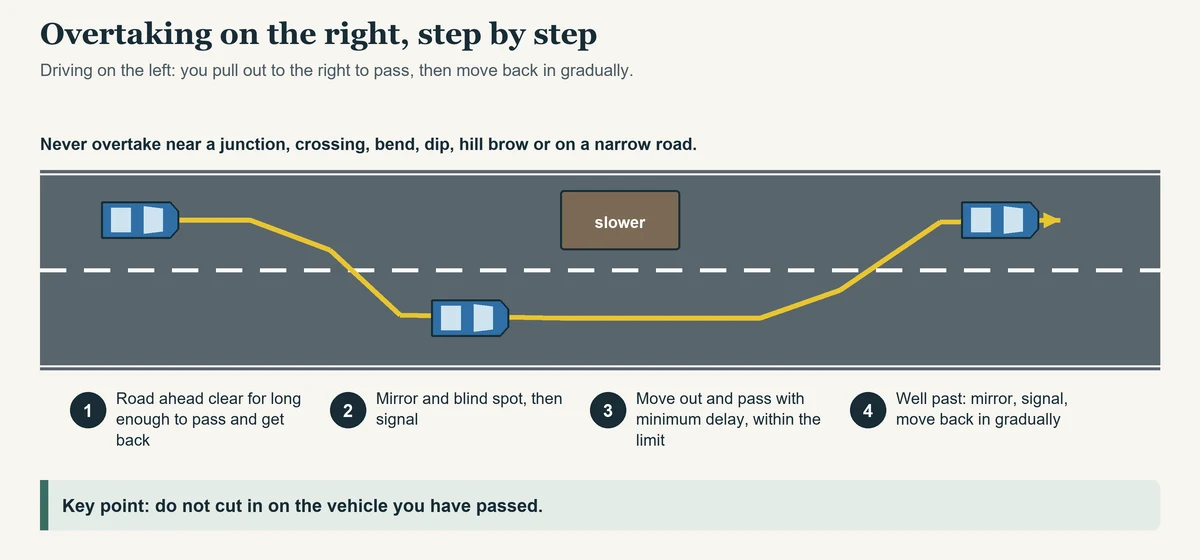
- Make sure the road ahead is clear for long enough to pass and get back to the left without forcing anyone to move.
- Do not follow another overtaking vehicle out. Give way to faster traffic already overtaking you.
- Check your mirror and your blind spot for anything coming up behind.
- Signal in good time, move out when it is safe, and accelerate past with minimum delay. Stay within the speed limit.
- When you are well past, check the mirror, signal and move back in gradually. Do not cut in on the vehicle you have passed.
Leave extra room to pass cyclists, as they may need to move out to avoid uneven road surfaces. See sharing the road with cyclists in Ireland.
Being overtaken
- Keep the same speed, unless that becomes unsafe.
- Keep as far left as is safe.
- Do not accelerate.
- Be ready in case the other vehicle cuts back in suddenly.
On a road with a single broken yellow line, you may pull briefly into the hard shoulder to let a vehicle pass. Only do this if no pedestrians or cyclists are using it and there are no junctions or entrances nearby.
2+1 roads
A 2+1 road has two lanes in one direction and one lane in the other. The two-lane section alternates roughly every 2 km. Overtake only in the two-lane section. Where a central barrier is fitted, you cannot overtake in the one-lane section.
Penalties
| Offence | Points on payment | Points on conviction | Fixed charge |
|---|---|---|---|
| Overtaking in prohibited circumstances | 3 | 5 | €80 |
| Overtaking a cyclist in prohibited circumstances | 3 | 5 | €120 |
| Crossing a continuous white line | 3 | 5 | €80 |
| Entering a hatched area | 1 | 3 | €80 |
Learner and novice drivers are disqualified at 7 points, so two overtaking offences put you close. See penalty points in Ireland.
Common questions
Can a learner overtake in Ireland?
Yes, under the same rules as every other driver.
Can I break the speed limit to overtake?
No. If you cannot pass within the limit, do not pass.
Can I cross a solid white line to pass a tractor or cyclist?
The Rules of the Road allows crossing a continuous line only in an emergency or for access. Wait for a broken line.
Is undertaking on a motorway legal?
Only in the situations above, such as slow-moving queues where the left lane is moving faster. In normal flow you must not overtake from the left lane.
What should I do if someone is tailgating me on a narrow road?
Keep a steady speed and, where there is a broken yellow line and the hard shoulder is clear, pull in briefly to let them pass.
Related: good driving practice in Ireland, speed limits in Ireland, motorways and tunnels, tractors and rural roads. Back to learning to drive in Ireland.
Sources
- Road Safety Authority, “Rules of the Road”, Section 5 Good driving practice and Section 6 Traffic signs and road markings (Revision 5, hosted on garda.ie)
- Law Reform Commission, Road Traffic Act 2002, First Schedule, revised (revisedacts.lawreform.ie)
- Irish Statute Book, “S.I. No. 526 of 2022, Road Traffic Act 2010 (Part 3) (Fixed Charge Offences) Regulations 2022” (irishstatutebook.ie)