

Photo: Adrien Olichon / Pexels. Illustrative photograph.
In Ireland, road markings carry the same legal weight as upright signs, so you must obey them. A double yellow line means no parking at any time. A single yellow line means no parking during the times shown on a nearby plate. You must not enter a yellow box junction unless you can clear it without stopping. This guide covers every common marking in the Rules of the Road, including what each white line lets you do.
Key facts
- Continuous white centre line (single or double): keep to the left of it, except in an emergency or for access.
- Crossing a continuous white line: 3 penalty points on payment of the fixed charge, 5 on conviction.
- Yellow box: do not enter unless your exit is clear. At a road junction you may wait in it to turn right, as long as you do not block traffic with right of way. There is no such exception on railway or tram tracks.
- Do not park within 15 m before or 5 m after a pedestrian crossing or traffic lights, or within 5 m of a junction unless spaces are marked.
- A broken yellow edge line marks a hard shoulder, which is normally for pedestrians and cyclists.
White lines along the centre of the road
| Marking | Meaning |
|---|---|
| Single or double continuous white line | All traffic must keep left of the line, except in an emergency or for access. No parking beside it |
| Short broken white line | Divides opposing lanes. Cross only when safe |
| Longer white warning lines | A hazard is ahead: limited view, a junction, a roundabout, a hill, a crest, a bend or a continuous line |
| Double broken white lines | A continuous line is a short distance ahead. Cross only when safe |
| Broken line beside a continuous line | Obey the line nearest to you |
| Hatched markings (diagonal stripes) | Separate traffic or guide merging and diverging traffic. You must not enter the hatched area |
For using these lines when passing, see overtaking rules in Ireland.
Lines across the road at junctions
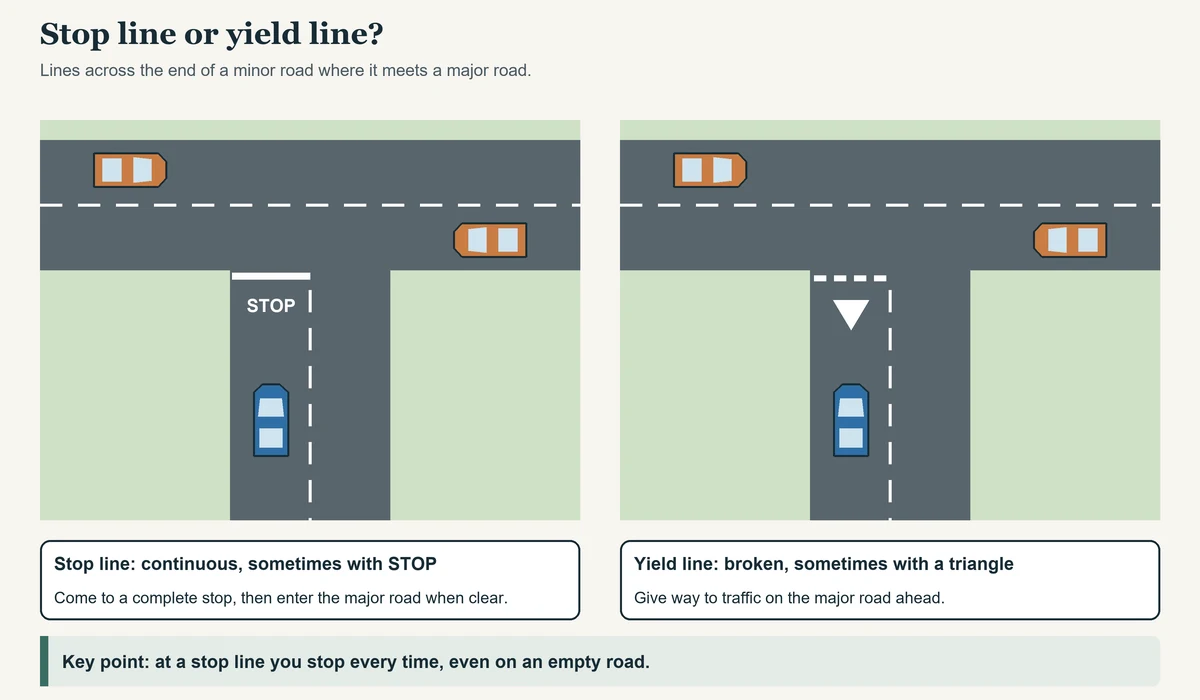
- Stop line (continuous white line, sometimes with STOP): come to a complete stop before entering the major road.
- Yield line (broken white line, sometimes with a white triangle): give way to traffic on the major road ahead.
- Advanced stop line for cyclists: at traffic lights, stop at the first white line you reach and keep out of the cyclist area. Give cyclists time and space to move off on green.
- Right-turn box (white arrow in a white-edged box): position here to turn right at traffic lights. Do not enter it on red. Wait in it until oncoming traffic lets you turn.
- No Entry markings at the wrong end of a one-way street: do not pass.
More on junctions in junctions in Ireland.
Yellow box junctions
A yellow box is a pattern of criss-cross yellow lines at a junction. You must not enter it unless you can leave it without stopping.
Exception: if you are turning right, you may wait inside the box for a gap in oncoming traffic. Do not do this if it would block other traffic that has right of way.
Yellow boxes are also used at railway level crossings and tram crossings. Never enter one there unless you can clear it without stopping, and never stop on the tracks.
Entering a yellow box against the rules is a fixed charge offence (€60 under S.I. No. 526 of 2022).
Yellow lines at the edge of the road
| Marking | Meaning |
|---|---|
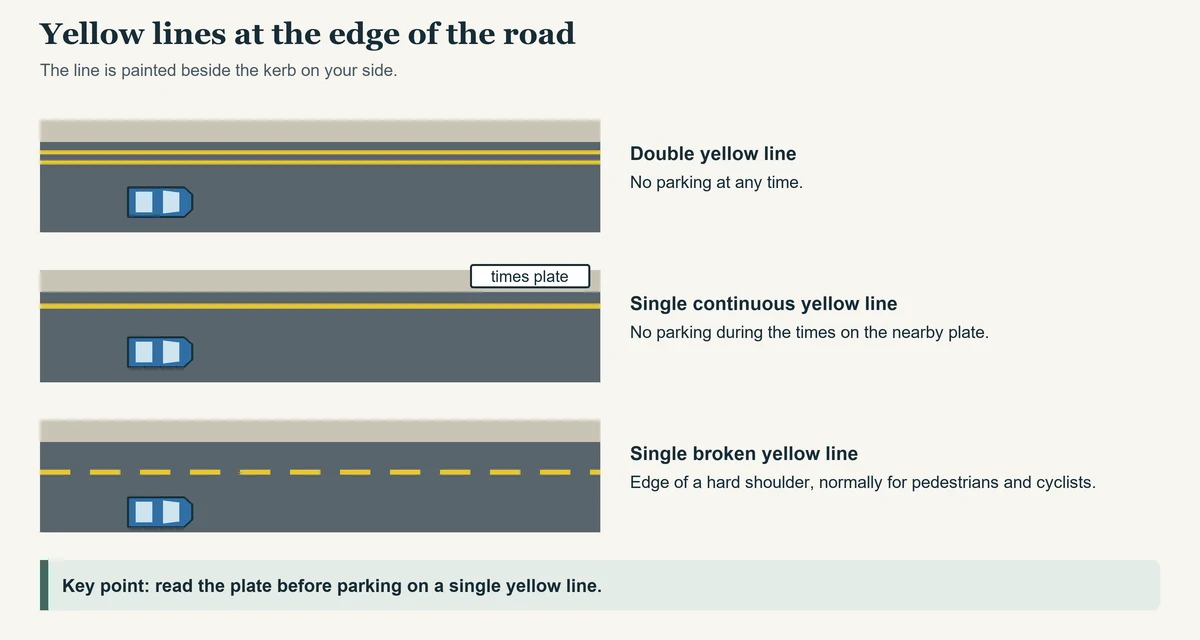
| Double yellow line | No parking at any time |
| Single continuous yellow line | No parking during the times shown on the nearby information plate |
| Single broken yellow line | Edge of a hard shoulder, normally for pedestrians and cyclists. You may pull in briefly to let a vehicle overtake if the shoulder is clear and no junctions or entrances are near |
| Yellow zig-zags with “SCHOOL KEEP CLEAR” | Do not stop or park |
Motorway hard shoulders have different rules. See motorways and tunnels.
Markings for crossings, buses and loading
- Zig-zag lines (white or yellow) on either side of zebra, pelican and pedestrian light crossings: do not park or overtake within them.
- Bus lane: a continuous white line with “Lána Bus” and an upright blue sign. Keep out during the hours on the plate. A contra-flow bus lane is generally for buses only, day and night.
- BUS or TAXIS painted in a marked area: bus stop or taxi rank. Do not stop there.
- LOADING repeated across a bay: goods vehicles loading or unloading, for a maximum of 30 minutes.
- Disabled parking bays: only for vehicles displaying a valid disabled person’s parking permit.
Parking details in parking rules in Ireland. Bus lane rules in bus lanes, Luas trams and light rail.
Penalties for ignoring markings
| Offence | Points on payment | Points on conviction | Fixed charge |
|---|---|---|---|
| Crossing a continuous white line | 3 | 5 | €80 |
| Failure to stop at a stop sign or stop line | 3 | 5 | €80 |
| Failure to yield at a yield sign or yield line | 3 | 5 | €80 |
| Entering a hatched area | 1 | 3 | €80 |
| Not complying with traffic lane markings | 1 | 3 | €60 |
| Entering a yellow box against the rules | not in points schedule | not in points schedule | €60 |
See penalty points in Ireland.
Common questions
Can I park on a single yellow line in Ireland?
Only outside the times shown on the nearby information plate.
Can I stop in a yellow box to turn right?
Yes, while waiting for a gap in oncoming traffic, as long as you are not blocking traffic that has right of way.
Can I cross a solid white line to get into a driveway?
Yes. Crossing for access is allowed, as is crossing in an emergency.
Can I drive in the hard shoulder on a normal road?
Only briefly, to let a vehicle behind overtake, and only if no pedestrians or cyclists are using it and no junctions or entrances are near.
What does a white arrow in a box at traffic lights mean?
It is a right-turn waiting box. Move into it on green and wait there until oncoming traffic clears.
Related: Irish road signs explained, traffic lights and signals, pedestrians and crossings. Back to learning to drive in Ireland.
Sources
- Road Safety Authority, “Rules of the Road”, Section 6 Traffic signs and road markings, Section 9 Junctions and roundabouts and Section 10 Parking (Revision 5, hosted on garda.ie)
- Law Reform Commission, Road Traffic Act 2002, First Schedule, revised (revisedacts.lawreform.ie)
- Irish Statute Book, “S.I. No. 526 of 2022, Road Traffic Act 2010 (Part 3) (Fixed Charge Offences) Regulations 2022” (irishstatutebook.ie)