

Photo: Bob Jenkin / Pexels. Illustrative photograph.
At an Irish junction, traffic going straight ahead on the major road generally has right of way, and at a junction of equal roads you give way to traffic on your right. You must stop fully at a Stop sign, even on an empty road, and slow down and give way at a Yield sign. This guide covers who goes first, how to turn right and left, crossing dual carriageways, and the penalties learners most often pick up.
Key facts
- Stop sign or stop line: you must come to a complete stop, every time.
- Yield sign (Géill Slí) or yield line: slow down and stop only if you need to let traffic pass.
- Right of way is never absolute. The Rules of the Road says you must always proceed with caution.
- Failing to stop at a Stop sign or yield at a Yield sign: €80 and 3 penalty points (5 on conviction), as of November 2026.
Who has right of way at a junction in Ireland?
| Situation | Who goes first |
|---|---|
| Major road meets minor road | Traffic going straight ahead on the major road. Minor road traffic must yield. |
| Roads of equal importance (unmarked crossroads) | Traffic on your right. Let it pass before you move. |
| T junction | Traffic already on the road you are joining. |
| You are turning right | Oncoming traffic going straight through. |
| You are turning right, an oncoming car is turning left into the same road | The car turning left. You wait. |
| Coming out of a private entrance or driveway | Traffic on the public road. |
Who must you always yield to?
- pedestrians already crossing at a junction
- pedestrians on a zebra crossing, and on a pelican crossing while the amber light flashes
- pedestrians and traffic when you move off from a stop sign or parking space
- traffic already turning at the junction
- traffic in another lane when you want to change lanes
Watch for cyclists coming off the end of a cycle track, and for mopeds and motorcycles pulling out of side roads. They are small and easy to miss. The Rules of the Road sums up the duty as: stop, look, listen, and look again.
Turning right at a junction, step by step
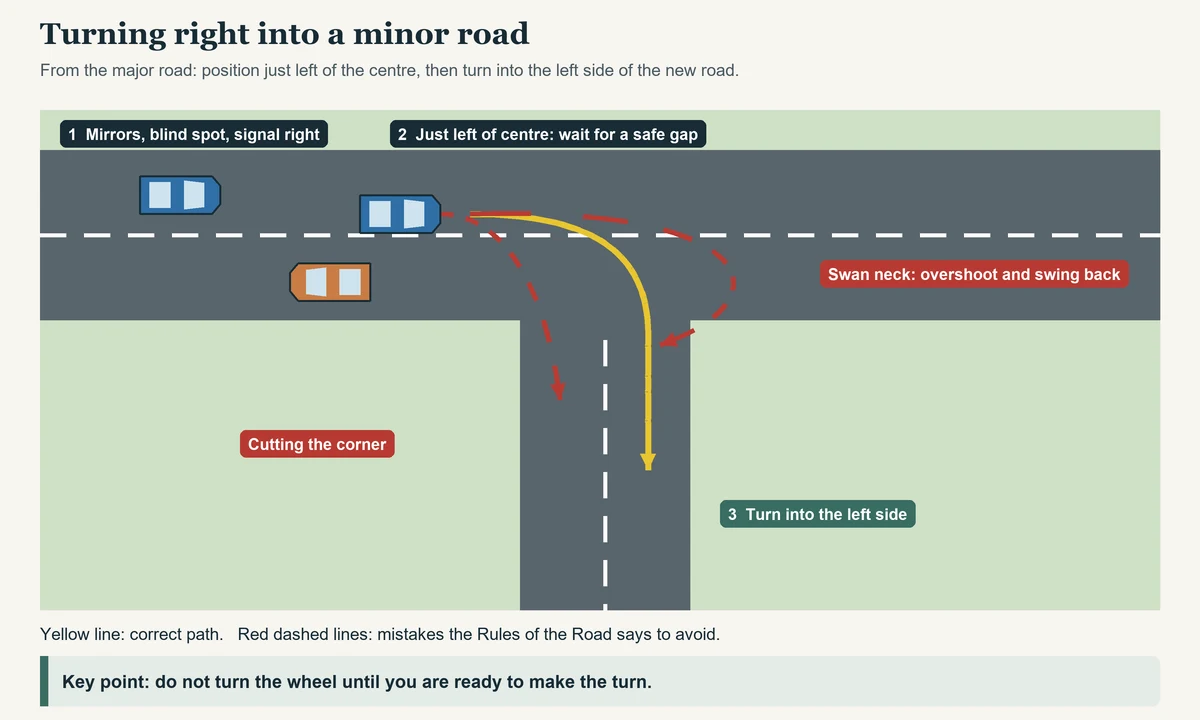
From a major road into a minor road
- Check mirrors and blind spot early. Signal right.
- Move to just left of the centre of the road, or into the right-turn space.
- Do not turn the steering wheel until you are ready to make the turn. Leave room for vehicles to pass on your left where possible.
- When there is a safe gap, turn into the left side of the new road.
- Do not cut the corner, and do not overshoot and swing back (a “swan neck”).
From a minor road onto a major road
- Mirrors, signal right, and position just left of the centre of your road.
- At a Stop or Yield sign, wait at the junction until the road is clear both ways.
- Pull out only into a gap in both directions, entering the left side of the major road.
Two cars turning right at a crossroads
If possible, pass behind each other (“back to back”). This lets both drivers see oncoming traffic. If the layout does not allow it, you may turn nearside to nearside.
Turning right from a one-way street
Move as close to the right-hand side as is safe. Some one-way streets allow two lanes to turn right; follow the markings.
Turning left
- Mirrors, signal left, slow down, and keep close to the left kerb without hitting or mounting it.
- Check your left mirror for cyclists and motorcyclists coming up on your inside. Do not overtake a cyclist just before you turn left.
- Use a left-turn slip lane where there is one.
- A flashing amber left arrow lets you turn only after you give way to pedestrians and to anyone approaching on an adjacent cycle track. A clear road to your right is not enough on its own.
- Give way to pedestrians and cyclists crossing the road you are turning into.
Yellow box junctions
Do not enter a yellow box unless your exit is clear. You may wait in the box to turn right if only oncoming traffic is stopping you, as long as you do not block traffic with right of way. Entering a box wrongly is a €60 fixed charge. More in Irish road markings.
Junctions on dual carriageways
Keep to the left lane. Use the right lane only to overtake or to turn right a short distance ahead.
- Turning left on: keep close to the left, wait for a safe gap, then build up to the speed of traffic in the left lane.
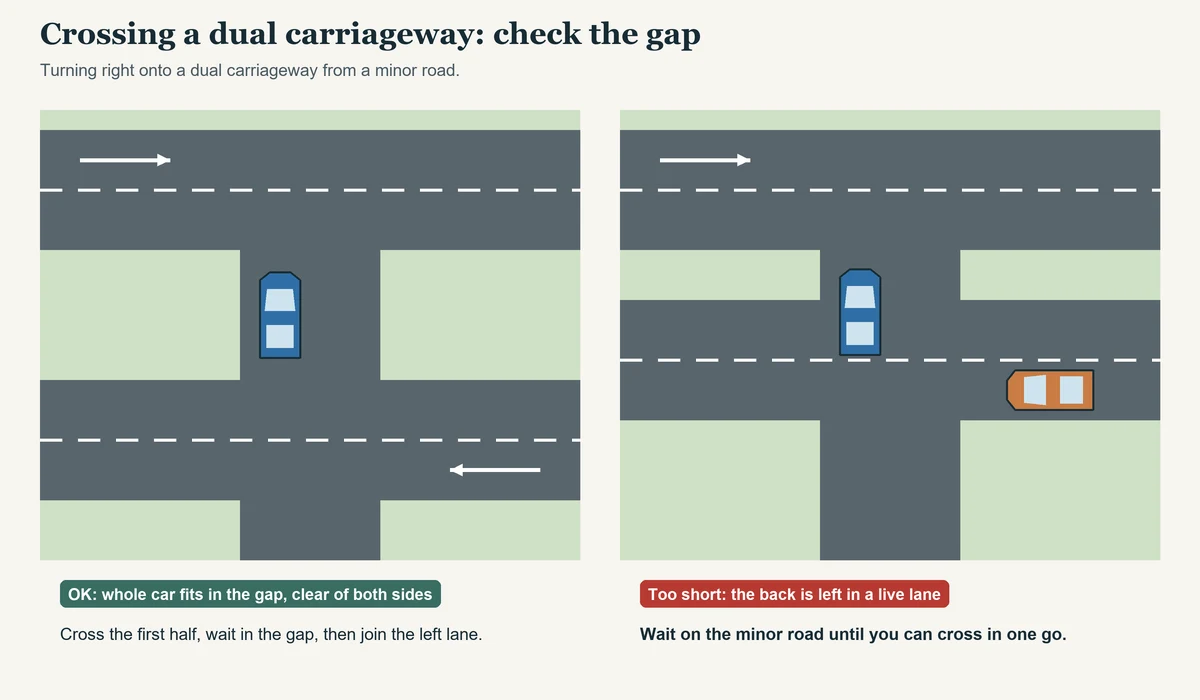
- Crossing or turning right on: first check that the gap in the central reserve can hold your whole vehicle clear of both carriageways. If it can, and it is empty, cross the first half when it is clear and wait in the gap for the second half. If the gap is too short or another vehicle is already in it, wait on the minor road until you can cross without leaving any part of your car in a live lane. Don’t squeeze in beside a waiting vehicle.
- Turning right off: move into the right lane (or the deceleration lane), turn into the central gap, wait, then finish into the left lane of the new road.
Long vehicles and cars towing need far more room to turn. Hang back and let them finish.
Example: you want to turn right onto a dual carriageway. The near lanes are empty, but the central gap is shorter than your car. Pulling out now would leave your back end in a live lane while you wait for the far side, so stay at the minor road until you can make the whole move safely. A driver behind you beeping does not change that.
Junction penalties
| Offence | Points on payment | Points on conviction | Fixed charge |
|---|---|---|---|
| Failing to stop at a Stop sign or stop line | 3 | 5 | €80 |
| Failing to yield at a Yield sign or yield line | 3 | 5 | €80 |
| Failing to yield right of way | 2 | 4 | €80 |
| Breaking the rules for driving at a junction | 1 | 3 | €60 |
| Entering a yellow box wrongly | None listed | None listed | €60 |
Fixed charges as of November 2026. As a learner or novice you are banned at 7 points. See penalty points in Ireland.
Common questions
Do I have to stop at a Stop sign if the road is clear?
Yes. The Rules of the Road says you must stop at the sign or line even if there is no traffic. Rolling through is a 3-point offence.
Who goes first at a crossroads with no signs?
If the roads are of equal importance, traffic on your right has right of way. Approach slowly, because the other driver may not know the rule.
Can I wait in a yellow box to turn right?
Yes, if oncoming traffic is the only thing stopping you and you are not blocking traffic with right of way.
What is a swan neck turn?
Driving past the correct turning point and then swinging back into the side road. The Rules of the Road says not to do it.
Do pedestrians have right of way at a junction?
You must yield to pedestrians already crossing the road you are turning into. The Rules of the Road advises yielding to pedestrians in all cases.
Related: roundabouts in Ireland, Irish road signs explained, traffic lights and signals, sharing the road with cyclists, common reasons for failing the Irish driving test. Back to learning to drive in Ireland.
Sources
- Road Safety Authority, “Rules of the Road”, Section 9 Junctions and roundabouts (Revision 5, hosted on garda.ie)
- Law Reform Commission, “Road Traffic Act 2002”, First Schedule, revised (revisedacts.lawreform.ie)
- Irish Statute Book, “S.I. No. 227/2024, Road Traffic Act 2010 (Part 3) (Fixed Charge Offences) Regulations 2024” (irishstatutebook.ie)
- Law Reform Commission, “S.I. No. 182/1997, Road Traffic (Traffic and Parking) Regulations 1997”, article 30 as substituted by S.I. No. 473/2025, revised (revisedacts.lawreform.ie)