

Photo: Dahlia E. Akhaine / Pexels. Illustrative photograph.
Irish road signs fall into three groups: regulatory signs you must obey, warning signs for hazards ahead, and information signs for directions. Colour and shape tell you which group a sign belongs to before you can read it. Warning signs are yellow diamonds, roadworks signs are orange, and regulatory signs are mostly round with a red border. This guide decodes each group as set out in the RSA’s Rules of the Road. It is what you need for the theory test and for the sign questions on the driving test.
Key facts
- Regulatory signs: usually circular, with a red border and black symbols on white. Mandatory direction signs are blue and white.
- Stop is the only octagonal (eight-sided) sign.
- Warning signs: diamond or rectangular, yellow with a black border and black symbol.
- Roadworks signs: the same shapes, but orange.
- Information signs: blue on motorways, green on national roads, and white with black text on regional and local roads.
- Speed limits are shown in km/h.
Shapes and colours at a glance
| Look | Type | What to do |
|---|---|---|
| Red octagon | Stop | Stop completely at the line, however quiet the road looks |
| Yield sign reading “Yield” or “Géill Slí” | Yield | Give way to traffic on the major road |
| Circle with red border, white background | Prohibition or limit | Must obey (no entry, no right turn, speed limit, parking prohibited) |
| Blue circle, white symbol | Mandatory instruction | Must do (turn left, keep left, straight ahead) |
| Yellow diamond, black border | Warning | Slow down and expect the hazard shown |
| Orange diamond or rectangle | Roadworks | Take extra care and reduce speed |
| Blue rectangle | Motorway information | Motorway rules apply |
| Green rectangle | National road information | Directions and distances |
| White rectangle, black text | Regional and local road information | Directions and distances |

Regulatory signs: what you must obey
Regulatory signs show what the law requires. They include upright signs, road markings and traffic lights. The common upright signs are:
- Speed limit signs: a red circle with the limit in km/h, for example 50, 60, 80, 100 and 120. The rural speed limit sign, a white circle with black diagonal stripes, can be used on rural local roads instead of a 60 km/h number sign. Since 7 February 2025 it means a maximum of 60 km/h, not 80 km/h. It is not a national speed limit sign like the one used in the UK, and on a narrow lane you may need to drive well below 60 km/h. See speed limits in Ireland 2026.
- No entry, no right turn, no left turn, no U-turn and no overtaking.
- Parking signs: parking prohibited, parking permitted, disc parking and clearway. See parking rules in Ireland.
- Size and weight limits: maximum width, height, length, gross weight and axle weight.
- Lane signs: with-flow bus lane, contra-flow bus lane, tram lanes and the start and end of cycle tracks. See bus lanes, Luas trams and light rail.
- School warden stop sign: you must stop.
Stop and Yield
At a Stop sign you must stop completely before entering the major road. At a Yield sign you must give way to traffic on the major road and wait until it is safe. Yield signs can read “Yield”, “Yield Right of Way” or “Géill Slí”. Both carry 3 penalty points on payment of the fixed charge, or 5 on conviction, if ignored. See junctions in Ireland.
Traffic lane control signs
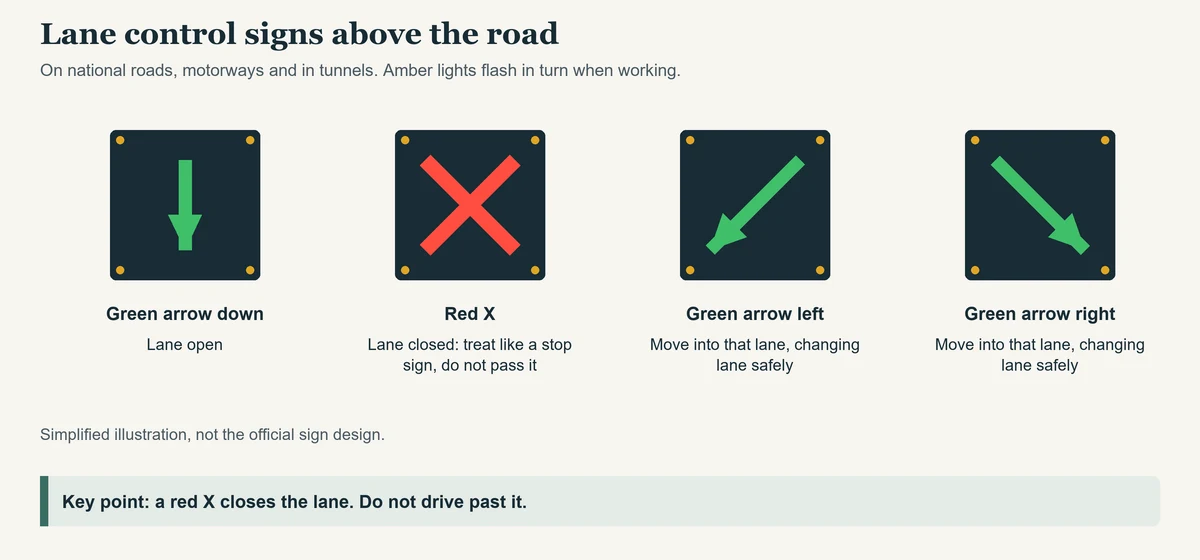
These are found on national roads, motorways and in tunnels. When they are working, amber lights flash in turn at the top and bottom.
- Green arrow pointing down: the lane is open.
- Red X: the lane is closed. Treat it like a stop sign and do not pass it.
- Green arrow pointing left or right: move into that lane, following the normal rules for changing lane safely.
One-way streets
At the entrance you see a blue “straight ahead” sign. At the wrong end you see No Entry road markings, and sometimes an upright No Entry sign. Do not pass them.
Warning signs: hazards ahead
Warning signs are yellow diamonds or rectangles with a black border and a black symbol. The Rules of the Road groups them as:
- Junctions: crossroads, T-junction, Y-junction, side road, staggered crossroads, and junctions with a dual carriageway. A thicker arm shows the more important road.
- Bends and corners: dangerous bend, series of bends, dangerous corner, and chevron boards for a sharp change of direction.
- Road layout: roundabout, mini-roundabout, road narrows, dual carriageway ends, merging traffic, two-way traffic, lane loss, and the start of a climbing or passing lane.
- Road surface and gradient: slippery road, steep ascent or descent, sharp dip, hump-back bridge, and a series of bumps.
- Users and animals: school ahead, children crossing, pedestrian crossing, cyclists, cattle, sheep, deer, and accompanied horses.
- Rail and trams: level crossings with or without gates, barriers or lights, and tram lane crossings. See level crossings, low bridges and tunnels.
- Other hazards: traffic signals ahead, low bridge with height shown, overhead cables, tunnel, crosswinds, falling rocks, and unprotected quay or river.
Roadworks signs and Stop/Go boards
Roadworks signs use the same shapes as warning signs but are orange. At manual traffic control you must stop at the Stop board. Go only when it shows “Go” or “Téigh”. Ignoring them is an offence. More in roadworks signs and traffic calming.
Information and motorway signs
- Advance direction signs are colour coded by road type: blue for motorway, green for national and white for regional or local.
- Motorway countdown signs mark 300 m, 200 m and 100 m to the next exit.
- Motorway ends 500 m ahead, end of motorway, and lane gain, where an extra lane joins.
- Variable message signs show changing electronic information about speed limits, roadworks, new layouts and safety.
See motorways and tunnels in Ireland.
Emergency diversion symbols
When a motorway is closed, traffic can be sent along a signed diversion marked with a symbol: a square, triangle, circle or diamond, either filled in or outlined. Note the symbol at the start of the diversion and follow that same symbol at each junction until the diversion ends. Do not switch to a different symbol because it looks quicker.
Variable speed signs
Electronic signs can show two kinds of speed. A regulatory variable speed limit is a legal limit, and you must keep to it. A cautionary speed is a warning: slow down to a safe speed for the hazard ahead. Read any message shown with it, such as a queue or lane closure warning. A blank sign does not change the normal speed limit for the road.
Traffic calming and slow zones
Town entry signs may come with a speed limit and traffic calming features such as islands, chicanes, build-outs, pinch points and mini-roundabouts. Signs on residential roads warn of ramps, speed cushions or speed tables. A Slow Zone sign marks a 30 km/h area, usually in housing estates.
Common questions
What colour are warning signs in Ireland?
Yellow with a black border and symbol, usually diamond shaped. Roadworks warnings are orange.
Why are Irish speed signs in km/h?
All speed limits in the Republic of Ireland are set in kilometres per hour. Your speedometer’s km/h scale is the one to follow.
What is the difference between a blue and a red circle sign?
A red-bordered circle tells you what you must not do, or sets a limit. A blue circle tells you what you must do.
Are road markings signs too?
Yes. Road markings have the same legal status as upright signs. See Irish road markings.
How many signs come up on the driving test?
Under the RSA’s 2025 procedures, the oral part includes 6 road sign questions. See pre-test checks.
Does the theory test include signs?
Yes. Road signs are part of the Driver Theory Test question bank. See Irish theory test topics.
Back to learning to drive in Ireland.
Sources
- Road Safety Authority, “Rules of the Road”, Section 6 Traffic signs and road markings and Sections 21 to 25 sign catalogues (Revision 5, hosted on garda.ie)
- Road Safety Authority, “Standard procedures and requirements for conducting driving tests 2025” (rsa.ie)
- Law Reform Commission, Road Traffic Act 2002, First Schedule, revised (revisedacts.lawreform.ie)
- Road Safety Authority, “Rules of the Road”, current edition reflecting the law at 1 March 2025, printed pages 118 to 119 (rural speed limit sign), 159 (diversion symbols) and 166 to 167 (variable speed signs) (rsa.ie)
- Road Safety Authority, “Rural speed limit” campaign page (rsa.ie)