
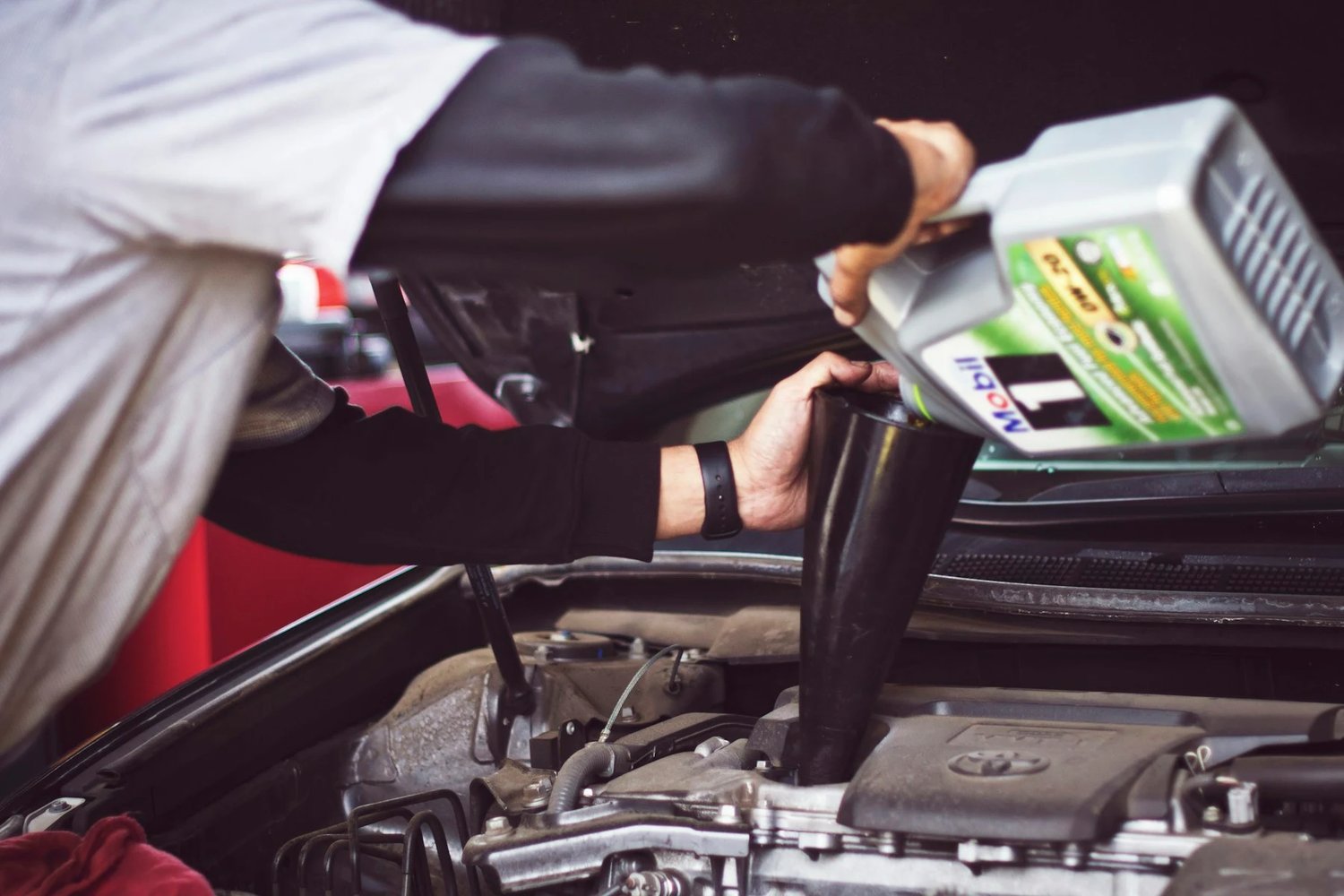
Photo: Tim Mossholder / Unsplash. Illustrative photograph.
Before you drive a metre on the Irish driving test, the RSA driver tester checks your knowledge at the desk and at the car. You answer Rules of the Road questions, identify road signs, show hand signals, and explain how you would check 3 parts of the car picked at random. This checklist covers each part and what costs you a fault.
Key facts
- The oral part has 14 questions under the RSA’s 2025 standard procedures: 6 verbal questions on the Rules of the Road, 6 road signs and 2 hand signals.
- Hand signals are done at the desk.
- If 3 or more questions, including hand signals, are not answered or are answered wrongly, the tester records a Grade 2 fault.
- Technical checks: the tester picks 3 items at random and you explain how you would check each one.
- You open and close the bonnet yourself for oil, coolant or washer fluid. Not being able to lift or secure the bonnet counts as a fault.
Part 1: Rules of the Road questions
The RSA’s procedures list the topics testers draw on for every test category. Expect questions on:
- pedestrian crossings
- traffic lights
- road markings
- right of way
- road signs
- dipping your headlights
If you cannot answer, the tester moves on to the next question. You can ask for a question to be repeated if you did not hear or understand it.
How to prepare
- Learn the meaning of every sign in the Rules of the Road, not just the common ones. See Irish road signs explained.
- Know what each line on the road means: continuous and broken white lines, yellow lines, yield and stop lines, and yellow boxes. See Irish road markings.
- Be able to explain the full traffic light sequence, filter arrows and the flashing amber at a pelican crossing.
- Answer in your own words. A short, correct answer is all that is needed.
Part 2: Hand signals
The 2 hand signal questions come from the signals shown in Section 7 of the Rules of the Road. Learn all 7. They are always given with the right arm.
| Signal | Who it is for | What you do |
|---|---|---|
| I am going to move out or turn right | Traffic behind | Right arm straight out of the window, level |
| I am going to turn left | Traffic behind | Right arm out of the window, moved in an anti-clockwise circle |
| I am going to slow down or stop | Traffic behind | Right arm out of the window, palm down, moved up and down |
| I want to turn right | Garda on point duty or oncoming traffic | Right arm out of the window, pointing to the right |
| I want to turn left | Garda on point duty or oncoming traffic | Right forearm and hand inside the windscreen, fingers pointing left |
| I want to go straight on | Garda on point duty or oncoming traffic | Right hand raised inside the windscreen, palm facing forward |
| I want to slow down or stop | Garda on point duty or oncoming traffic | Right arm out of the window, moved up and down |
Practise in a parked car so the signal is clear and steady. More detail in traffic lights, driver signals and hand signals.
Part 3: Technical checks on the test car
The tester picks 3 of these at random. For each one, explain how you would check it.
| Item | What a good answer covers |
|---|---|
| Tyres | Tread above the legal minimum of 1.6 mm for a car; no cuts, bulges or uneven wear; correct pressure from the handbook, checked when cold |
| Lights | Switch on and walk round, or use a reflection or a helper; both rear brake lights must work for the test to go ahead |
| Reflectors | Present, clean and not broken |
| Indicators | Switch on hazards or each indicator and walk round to check front, rear and side repeaters |
| Engine oil | Open the bonnet, pull the dipstick, wipe, reinsert and read: the level should sit between the minimum and maximum marks |
| Coolant | Check the level against the marks on the coolant tank under the bonnet; only check when the engine is cold |
| Windscreen washer | Open the bonnet, find the washer reservoir and check the level; do not confuse it with the coolant tank |
| Steering | Check for excessive free play in the wheel and that the car does not pull to one side |
| Brakes | Test the footbrake gently as you move off; it should not feel spongy or pull; the handbrake should hold the car |
| Horn | Press it briefly to check it works (where it is lawful to sound it) |
Ask your ADI to show you where everything is under the bonnet of the car you will use on the day. Car layouts differ, and the tester will ask you to open and close the bonnet yourself.
Part 4: Secondary controls
You may also be asked to work controls such as the wipers and washers, demisters, rear window heater, lights, fans and air vents. Know where they are before test day, especially in a borrowed car.
Pre-test check: your 2 minute list
- Recite the 6 obligatory topics and one rule from each.
- Name 10 random signs from the Rules of the Road without looking.
- Do all 7 hand signals in the driver’s seat.
- Open the bonnet and point to the dipstick, coolant tank and washer reservoir.
- Find the demister, rear heater, fog light and hazard switches.
Common questions
How many questions are asked before the Irish driving test?
Under the RSA’s 2025 standard procedures, 14: 6 verbal questions, 6 road signs and 2 hand signals.
How many can I get wrong?
Getting 2 wrong is not recorded as a Grade 2 fault. Three or more wrong or unanswered, including hand signals, means a Grade 2 fault. One Grade 2 fault does not fail you on its own. See how the test is marked.
Do I physically do the hand signals or just describe them?
The RSA’s terms describe the hand signals as conducted at the desk. Be ready to show them with your right arm and say what each one means.
Do I have to open the bonnet?
Yes, if oil, coolant or washer fluid comes up. Being unable to lift or secure the bonnet is itself recorded as a fault, so practise on the test car.
Can I bring an interpreter?
The RSA’s terms refer to interpreters for the hand signals at the desk. Check the current driving test terms and conditions with the RSA before booking.
Related: the Irish driving test explained, test manoeuvres, your car for the test. Back to learning to drive in Ireland.
Sources
- Road Safety Authority, “Standard procedures and requirements for conducting driving tests 2025” (rsa.ie)
- Road Safety Authority, “Standard procedures for conducting driving tests 2017” (rsa.ie)
- Road Safety Authority, “RSA driver tester marking guidelines” (rsa.ie)
- Road Safety Authority, “Driving test terms and conditions” (rsa.ie)
- Road Safety Authority, “Prepare your car, light van and trailer for the driving test” (rsa.ie)
- Road Safety Authority, “Rules of the Road”, Section 7 Traffic lights and signals (Revision 5, hosted on garda.ie)