

Photo: Joaquin Carfagna / Pexels. Illustrative photograph.
The Irish car driving test includes three set manoeuvres: reversing around a corner, a turnabout and a hill start. You will also move off from the kerb several times. This guide explains how the RSA driver tester sets up each one, what they mark, and the mistakes that cost faults.
Key facts
- For a car (category B), you do one reverse around a corner. The tester decides whether it is to the left or the right.
- A turnabout and a hill start are both carried out on every car test.
- The tester marks a manoeuvre only after you finish it. Only one fault can be recorded under each aspect of that manoeuvre.
- Turning the steering wheel while the car is stopped (“dry steering”) is not recorded as a fault in the turnabout.
- If you refuse to attempt the reverse or the turnabout, the test is stopped and you get no result. You have to reapply on MyRoadSafety.
Reverse around a corner
How the tester sets it up
The tester asks you to stop before a junction and shows you the road to reverse into. You reverse around the corner, keeping reasonably close to the kerb, until the tester tells you that is far enough. The tester gets out of the car to watch this manoeuvre.

Step by step
- Pull up on the left, past the side road, at a safe distance from the corner.
- Check all round, including both blind spots, before you start.
- Reverse slowly, using clutch control (or a gentle foot on the brake in an automatic).
- Look mainly out of the rear window, with frequent checks all round, especially as the front of the car swings out into the main road.
- Follow the kerb around the corner, keeping close to it without touching it.
- If a car, cyclist or pedestrian comes, stop and let them pass. Continue only when safe.
- Straighten up and keep reversing in a straight line until the tester says stop.
The rule behind it
The Rules of the Road says you may reverse from a major road into a minor road, far enough to take up the correct position on the left when you rejoin the major road. You must never reverse from a minor road onto a major road.
Turnabout
The tester asks you to pull in on the left, then turn the car around to face the opposite direction. You may go forward and back more than once if you need to.
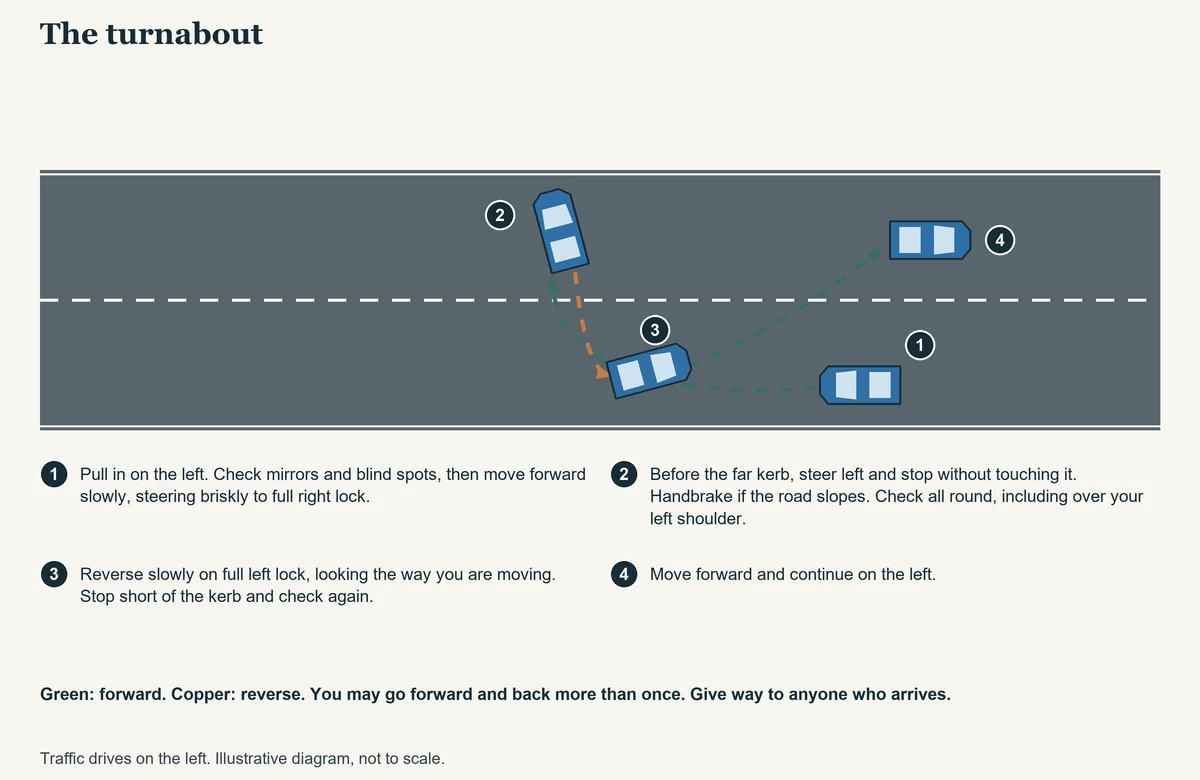
- Check mirrors and blind spots before moving off from the kerb.
- Move forward slowly, steering briskly to full right lock.
- Before you reach the far kerb, steer left and stop without touching it.
- Secure the car with the handbrake if the road slopes. Check all round again, including over your left shoulder.
- Reverse slowly, steering to full left lock, looking in the direction you are moving.
- Stop short of the kerb, check again, then move forward and continue on the left.
Give way to any road user who arrives at any point. Pausing for traffic is good observation, not a fault.
Hill start
A hill start must be carried out on the test. The tester will ask you to pull in and stop on a hill on the left.
- Stop on the left and apply the handbrake.
- Check mirrors, signal if needed and check your right blind spot.
- Find the biting point, add a little more power, then release the handbrake smoothly.
- Move off without rolling back and without stalling.
The marking guidelines allow a handbrake fault where it is not applied on a slope, or not applied when stopped for a while, and only where this has consequences such as the car rolling back or forward.
Moving off
You move off from the kerb many times during the test, and the tester marks progress and observation each time. The Rules of the Road sets out the checks:
- doors, bonnet and boot closed
- seat, head restraint and mirrors adjusted
- everyone’s seat belt fastened
- mirrors and the blind spot over your shoulder
- signal when needed, and give way to traffic and pedestrians
Once the way is clear, move out and get up to the normal safe and legal speed of the traffic. Waiting too long for a gap when the road is clear can be marked as a progress fault. See good driving practice in Ireland.
What gets marked: quick reference
| Manoeuvre | Watch out for |
|---|---|
| Reverse around a corner | Weak observation behind and to the sides, swinging wide, hitting or mounting the kerb, poor speed control, not reacting to other road users |
| Turnabout | Touching the kerb, poor all-round observation before each direction change, not giving way |
| Hill start | Rolling back, stalling, handbrake not applied or not released properly |
| Moving off | Missing the blind spot check, signal not given, undue hesitancy |
Faults are graded 1, 2 or 3. One Grade 3 fault, 4 Grade 2 faults in a single line, or 9 Grade 2 faults in total fails the test. See Irish driving test marking.
Common questions
Is it a left or a right reverse on the Irish car test?
It is the tester’s choice. Practise both until each feels routine.
Can I stop during the reverse?
Yes. Stopping to let a car or pedestrian pass is correct. Faults come from not seeing them, not from waiting.
How many goes do I get at the turnabout?
You may go forward and back more than once. Use as many moves as you need to do it safely.
Is touching the kerb an automatic fail?
No single rule says so. The tester grades the fault by its seriousness. Mounting the kerb or hitting it hard is likely to be marked more severely than a light touch.
Is there parking on the Irish test?
Parking is listed as one of the things assessed on the drive, along with reversing and the turnabout.
What if I refuse to do a manoeuvre?
Refusing the reverse or the turnabout ends the test with no result. You have to reapply.
Related: reversing, U turns and towing, pre-test checks, common reasons for failing, the test explained. Back to learning to drive in Ireland.
Sources
- Road Safety Authority, “Standard procedures and requirements for conducting driving tests 2025” (rsa.ie)
- Road Safety Authority, “RSA driver tester marking guidelines” (rsa.ie)
- Road Safety Authority, “Preparing for your test: driving test eligibility” (rsa.ie)
- Road Safety Authority, “Rules of the Road”, Sections 3 and 5 (Revision 5, hosted on garda.ie)