

Photo: Oleksandr Kobuta / Pexels. Illustrative photograph.
Good driving practice in Ireland starts with the basics the Rules of the Road sets out in Section 5: moving off safely, keeping the right road position on the left, changing lanes without cutting anyone up, and slowing or stopping at the side of the road. These are also the skills the driving test marks most often. Each routine is below as a step-by-step list.
Key facts
- You must drive on the left-hand side of the road in Ireland. Failing to keep left is a €60 fixed charge and 2 penalty points (4 on conviction), as of November 2026.
- When moving off from the kerb you must signal and give way to other traffic and pedestrians.
- When changing lanes you must give way to traffic already in the lane you are moving into.
- Signalling does not give you the right of way.
Moving off: the routine
- Cockpit checks: doors, bonnet and boot closed; seat and head restraint adjusted; mirrors clean and adjusted; every seat belt fastened.
- Mirrors: check the interior and right mirror.
- Signal your intention to move out.
- Blind spot: look over your right shoulder. Traffic, cyclists and pedestrians can be beside the car where the mirrors do not show.
- Give way to traffic and pedestrians, then move out when clear.
- Build speed to the normal safe and legal flow of traffic.
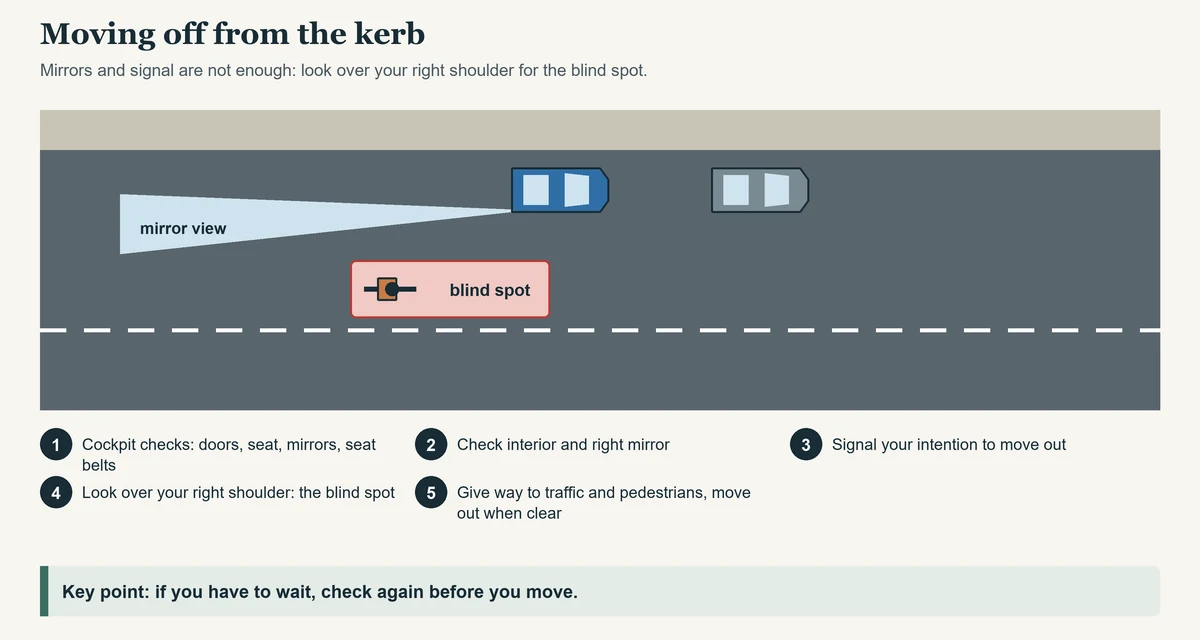
If you have to wait after checking, check again before you move: a cyclist or pedestrian may have come into the space. Missing the blind spot check when moving off is one of the RSA’s most common reasons for failing. See common reasons for failing.
What is the correct road position in Ireland?
Drive far enough to the left that traffic can safely pass or overtake on your right, but not so far left that you drive in a cycle lane or block or endanger cyclists or pedestrians.
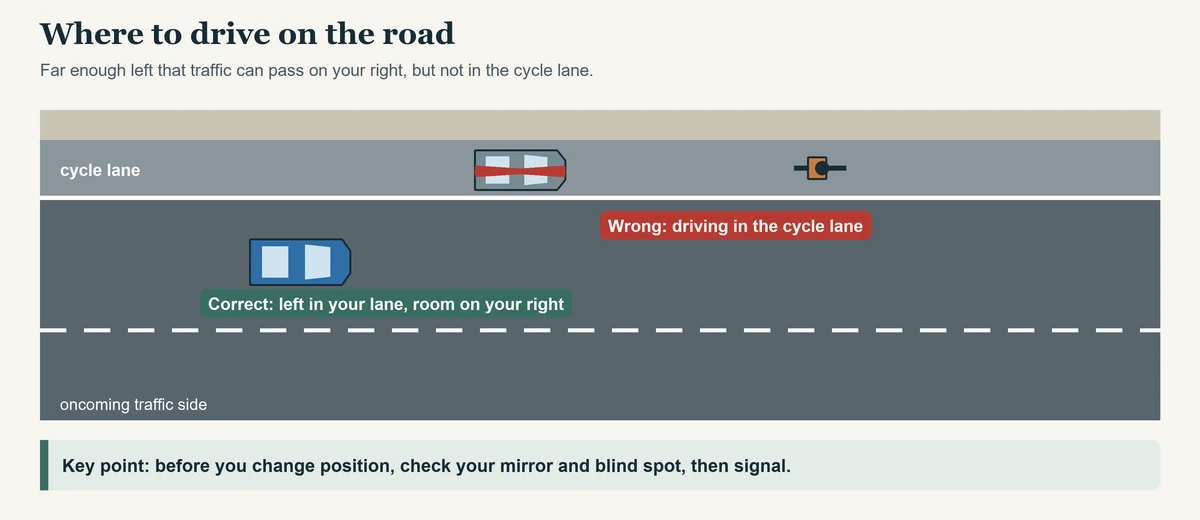
Before you change position, for example to overtake, turn right or pass parked cars, cyclists, horse riders or pedestrians:
- Make sure it is safe.
- Check your mirror for vehicles coming up on your right, and check your blind spot.
- Signal clearly and in good time, then move.
Buses, schools and cyclists
- Let signalling buses back into traffic after they pick up or drop off passengers.
- Near schools and bus stops, watch for pedestrians and children and be ready to stop.
- At an advanced stop line, let cyclists move off ahead of you.
- Turning left, watch for cyclists and mopeds near the kerb. Do not overtake a cyclist just before you turn left.
- The RSA advises leaving at least 1 metre when passing a cyclist where the speed limit is 50 km/h or less, and at least 1.5 metres where it is above 50 km/h. See sharing the road with cyclists.
How to change lanes safely
- Only change lanes for a good reason.
- Check your mirrors in plenty of time.
- At speed, take a quick sideways glance to check for a vehicle that has dropped out of mirror view.
- Signal, then move when it is clear and safe. Give way to traffic already in the lane.
- Approaching a junction, follow lane arrows and signs. They tell you which direction traffic in that lane must take.
Slowing down or stopping at the side of the road
- Check your mirror to make sure you can slow and stop safely.
- Signal that you are pulling in.
- Your brake lights show you are slowing. If you think they may not be seen or are not working, use the slowing-down arm signal (right arm moved up and down outside the window). Get faulty brake lights fixed straight away.
- Use a lay-by if there is one, or stop close to the left-hand edge.
- Do not leave headlights on when stopped. Use sidelights or parking lights if you need lights.
Scenario: pulling out from a parked position on a busy street
You are parked on the left with a car parked ahead. A cyclist is coming up behind. Mirror, signal, blind spot: you see the cyclist, so you wait with the signal on and let them pass. Check again, then move out, leaving room past the parked car before returning to your normal position. Moving out in front of the cyclist would force them to react, which the tester marks as a fault.
Common questions
What does the Rules of the Road say about keeping left?
You must drive on the left-hand side of the road, far enough left for others to pass on your right, but not in a cycle lane.
Do I always have to signal when moving off?
Yes. The Rules of the Road says you must signal and give way when moving off from the kerb. The signal never replaces looking.
Can I overtake on the left?
Only in limited cases, such as when the driver in front is turning right. See overtaking rules in Ireland.
What is a blind spot check?
A look over your shoulder to see the area your mirrors do not cover. Do it before moving off and changing lanes.
Where am I allowed to reverse or make a U turn?
See reversing, U turns and towing in Ireland.
Back to learning to drive in Ireland. Related: junctions, signals and hand signals.
Sources
- Road Safety Authority, “Rules of the Road”, Section 1 (message to overseas drivers) and Section 5 Good driving practice (Revision 5, hosted on garda.ie)
- Road Safety Authority, “Repeating your test” (rsa.ie)
- Irish Statute Book, “S.I. No. 227/2024, Road Traffic Act 2010 (Part 3) (Fixed Charge Offences) Regulations 2024” (irishstatutebook.ie)
- Law Reform Commission, “Road Traffic Act 2002”, First Schedule, revised (revisedacts.lawreform.ie)
- Road Safety Authority, “Cyclists campaign” (rsa.ie)