
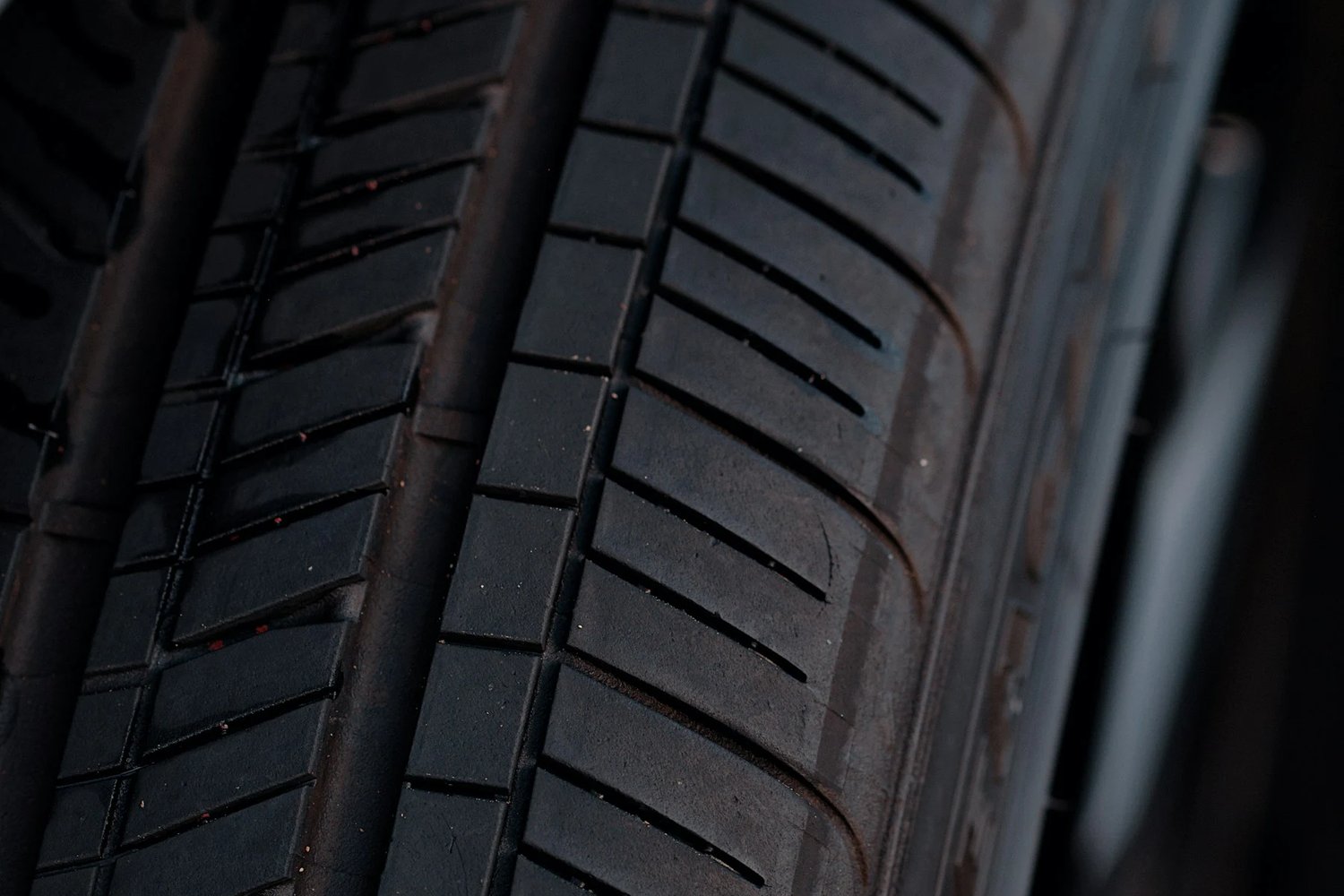
Photo: Leiada Krözjhen / Unsplash. Illustrative photograph.
In Ireland the driver is responsible for making sure the car is roadworthy, and it is an offence to drive an unsafe vehicle on a public road. This checklist follows Section 4 of the Rules of the Road: tyres, lights and reflectors, windscreens, mirrors, roof racks and registration plates. Use it weekly, and the day before your driving test.
Key facts
- Minimum tyre tread: 1.6 mm across the main treads (1 mm for motorcycles and vintage vehicles).
- Defective or worn tyres: €80 fixed charge and 2 penalty points (4 on conviction), as of November 2026.
- Fog lights only in dense fog or falling snow.
- Windscreens on vehicles registered since January 1986 must be laminated glass.
- Registration plates: plain black characters on a plain white reflective background, no italics or shadows.
What must I check regularly?
The Rules of the Road says you must make sure these are checked regularly: steering, brakes, front and rear lamps, indicators, reflectors, rear view mirrors, safety belts, speedometer, tyres, windscreen wipers, horn and silencer.
Tyres
| Check | Standard |
|---|---|
| Tread depth | At least 1.6 mm over the main treads. Replace before you reach it |
| Pressure | Every tyre, including the spare, to the manufacturer’s figure |
| Damage | No cuts, cracks or bulges, which can cause a blow-out |
| Matching | Tyres must be the same on any axle. Do not mix radial and cross ply on one axle |
| Replacements | New, e-marked tyres from a reputable dealer. Avoid second-hand tyres |
| Space saver spare | Only to finish the journey or get to a tyre dealer, under the speed stamped on it |
Not accepted on the driving test: a space saver fitted to the car. See your car for the Irish driving test.
Lights and reflectors
| Front | Rear |
|---|---|
| Two headlights (white or yellow) | Two red tail lights |
| Two white sidelights | Two red brake lights |
| Amber indicators | Two red reflectors |
| Number plate lighting | |
| Amber indicators |
- Reversing lights must be white or yellow.
- Use fog lights only in dense fog or falling snow, and switch them off when it clears.
- You must not fit blue or red flashing lights. Flashing lights other than indicators are for the Gardai, ambulances and other designated vehicles.
- Get professional advice before modifying lights, and tell your insurer: some modifications can invalidate your policy.
- Keep lights, reflectors and number plate lights clean.
Quick check: switch on the lights and hazards and walk round. For brake lights, ask someone to press the pedal, or reverse up to a wall or garage door and look in the mirror.
Windscreens and wipers
- Laminated glass is required on vehicles registered since January 1986, and on any replacement windscreen on older cars.
- Keep wiper blades in good condition and the washer fluid topped up.
- Keep the windscreen and windows clean and free of clutter.
Mirrors
- Your car must give you a view behind and to each side, through mirrors or an approved digital camera system that replaces them. A reversing camera or parking sensor is not a replacement for mirrors. Keep mirrors, camera lenses and screens clean, and learn where their blind spots are.
- Keep them clean, undamaged and correctly positioned.
- You must use them before signalling, moving off, changing lanes, overtaking, slowing, stopping, turning and opening doors.
Roof racks, roof boxes and bike racks
- Fit the rack or box securely.
- The load must not block your view in any direction.
- Never overload it, or load it so it could fall off or make the car unstable.
- Check it is mounted and the load secured before you set off. The same applies to roof and rear bike racks.
Registration plates
- Plain black characters on a plain white reflective background, in one of the legal formats for vehicles registered since 1 January 1991.
- No italics or shadows. Keep them clean and readable.
- You must not interfere with a registration plate.
Other safety responsibilities
The Rules of the Road says the driver must keep the vehicle in good working order and have these checked regularly, not just the items above:
- Brakes and steering: the two systems you rely on most to avoid a crash.
- Horn: it must work.
- Speedometer: you cannot keep to the limit without one that works.
- Silencer (exhaust): part of the regular checks.
- Indicators, safety belts and windscreen wipers: also on the must-check list.
- Loads: anything on a roof rack or in a roof box must be completely secured before you set off, must not block your view, must not overload the rack and must not be able to fall off.
The same section adds two duties to passengers: never leave infants or young children alone in a car, even briefly, and never leave animals alone in a vehicle. It also covers phones. Under section 3 of the Road Traffic Act 2006 you must not hold a mobile phone while driving in a public place, and holding includes supporting it with another part of your body, such as between your ear and shoulder. The law gives a defence if you were calling the emergency services or dealing with a genuine emergency, but that is not general permission to handle a phone. Even hands-free, a call can distract you, so the safest choice is to let calls wait until you have stopped somewhere safe and legal. Holding a phone is a penalty point offence (see penalty points in Ireland). Avoid headphones or loud entertainment systems that stop you hearing sirens or horns. Towing a trailer brings its own rules: see reversing, U-turns and towing in Ireland.
Electric cars and driver assistance
If you practise in an electric car, learn how to charge it and how to use the charging point safely, following the car and charger instructions. If a cable, plug or charger looks damaged, do not use it. Know how the car shows that it is ready to move, and how its controls differ from the car you usually drive.
Find out which driver assistance features your car has, and what their warnings mean, before you set off. A parking alert, lane warning or automatic braking does not replace your own observation, steering and braking. Ask your instructor to explain any unfamiliar controls while you are parked, and keep an observation routine that works when a feature is switched off or not working.
Useful to keep in the car
The RSA suggests a first aid kit, at least one high-vis vest or jacket, at least one red warning triangle, and a torch.
Common questions
What is the legal tyre tread depth in Ireland?
1.6 mm over the main treads for most vehicles. 1 mm for motorcycles and vintage vehicles.
What are the penalties for bald tyres?
€80 fixed charge and 2 penalty points on payment, 4 on conviction (as of November 2026).
Can I drive with one brake light out?
No. Two working red brake lights are required, and the test will not go ahead with a brake light out.
When can I use fog lights?
Only in dense fog or falling snow.
Which technical checks come up on the driving test?
The tester asks you to demonstrate checks on items such as tyres, lights, reflectors, indicators, oil, coolant, washer fluid, steering, brakes and horn. See pre-test checks.
Back to learning to drive in Ireland. Related: tax, insurance and the NCT, seat belts and child car seats, driving at night.
Sources
- Road Safety Authority, “Rules of the Road”, Section 4 Vehicle safety and Section 3 The driving test (Revision 5, hosted on garda.ie)
- Irish Statute Book, “S.I. No. 227/2024, Road Traffic Act 2010 (Part 3) (Fixed Charge Offences) Regulations 2024” (irishstatutebook.ie)
- Law Reform Commission, “Road Traffic Act 2002”, First Schedule, revised (revisedacts.lawreform.ie)
- Law Reform Commission, Revised Acts, Road Traffic Act 2006, section 3 (revisedacts.lawreform.ie)
- Road Safety Authority, “Rules of the Road”, current edition reflecting the law at 1 March 2025, printed pages 40 (electric vehicles and driver assistance) and 44 (mirrors and approved camera systems) (rsa.ie)