

Photo: Jan van der Wolf / Pexels. Illustrative photograph.
Roadworks signs in Ireland are orange, not yellow: diamond or rectangular, with a black border and black symbols or words. When you see them, slow down, obey any Stop/Go board and keep to the roadworks speed limit. This guide explains the roadworks signs, temporary speed limits and the traffic calming features you meet in Irish towns and estates, with fixed charges as of November 2026.
Key facts
- Roadworks signs: orange with a black border. Ordinary warning signs are yellow.
- At a Stop board you must stop. Go only when the board shows “Go” or “Téigh”. Ignoring it is an offence.
- Councils can set a roadworks speed limit as low as 20 km/h for the duration of the works, for up to 12 months per order.
- Don’t park at roadworks.
- Traffic calming: islands, gateways, mini-roundabouts, build-outs, chicanes, pinch points, ramps, speed cushions and speed tables.
- Breaking the mini-roundabout rules: €60 fixed charge and 1 penalty point.
What do roadworks signs look like in Ireland?
They use the same shapes as warning signs, but in orange. That colour tells you the hazard is temporary and that a temporary layout or speed limit may apply. For the other sign families, see Irish road signs explained.
Common roadworks signs
| Sign | What to do |
|---|---|
| Roadworks ahead | Slow down and look for workers, vehicles and a changed layout |
| Temporary traffic signals ahead | Be ready to stop at portable lights |
| Flagman ahead | Someone will control traffic by hand. Follow their signs |
| Queues likely | Expect stopped traffic; leave room to stop |
| Lane closed (nearside, offside, or two lanes of three or four) | Move into the open lane early and merge in turn |
| One-lane or two-lane crossover (out and back) | Traffic is being moved to the other carriageway and back again |
| Move to left / move to right | Follow the lane shift |
| Loose chippings, slippery road, uneven surface | Slow down and keep your distance; chippings can be thrown up |
| Hump or ramp | Temporary ramp across the road |
| Site access on left or right | Works vehicles may pull out |
| Overhead electric cables | Take care with high loads |
| Pedestrians cross to left or right | The footpath is diverted across the road |
Information plates at roadworks
Plates under or beside the main signs show detours (ahead, left, right, end of detour), road closed, hard shoulder closed, use hard shoulder, unfinished road surface, concealed entrance, the type of works, a cautionary speed, and the distance or length the works cover. Barrier boards and chevron boards mark the edge of the works.
Stop/Go boards at roadworks
- When the Stop board faces you, stop. You may only go when the Go (or Téigh) side is shown.
- Where plant or machinery is crossing the road, you must stop at a Stop sign whichever direction you come from.
- The boards can be held by a person or operated mechanically. Both carry the same legal force.

Speed limits at roadworks
Under section 10 of the Road Traffic Act 2004, a council chief executive can apply a special speed limit to a road where works are being carried out. It must be at least 20 km/h, it lasts for the duration of the works, and a single order can last no more than 12 months. Section 10A gives a similar power on national managed roads. The limit is shown on regulatory speed signs (red ring, white background). Breaking it carries the speeding fixed charge: €160 and 3 penalty points. Motorways can also have lower signed limits at roadworks. See speed limits in Ireland.
Driving through roadworks: checklist
- Slow down as soon as you see the first orange sign.
- Get in lane early when a lane is closed.
- Leave a bigger gap; queues form suddenly.
- Watch for workers on foot and vehicles leaving site entrances.
- Read the electronic variable message signs. They give live information about roadworks and changed layouts.
- Don’t park at roadworks.
Traffic calming in Irish towns and villages
Traffic calming slows traffic and manages its flow at junctions. Entering a calmed town or village, you will see an information sign, often with the place name and a speed limit sign. Expect:
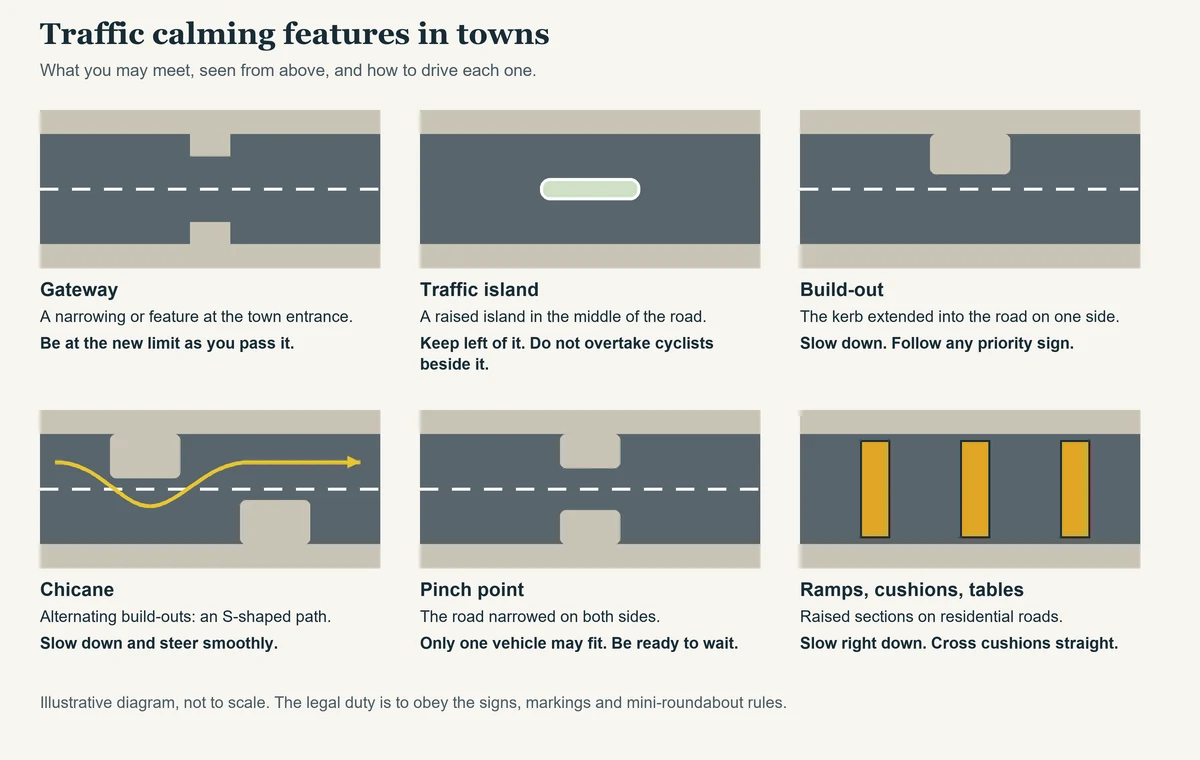
| Feature | What it is | How to drive it |
|---|---|---|
| Gateway | A narrowing or feature at the town entrance | Be at the new limit by the time you pass it |
| Traffic island | A raised island in the middle of the road | Keep left of it; don’t overtake cyclists alongside it |
| Build-out | The kerb extended into the road on one side | Slow down; follow any priority sign telling you to give way to oncoming traffic |
| Chicane | Alternating build-outs forcing an S-shaped path | Slow down and steer smoothly |
| Pinch point | The road narrowed on both sides | Only one vehicle may fit. Be ready to wait |
| Mini-roundabout | A small painted or slightly raised roundabout | Follow the mini-roundabout rules; drive around the central marking |
| Ramps, speed cushions, speed tables | Raised sections, signed on residential roads | Slow right down; cross cushions straight |
The “how to drive it” column is practical guidance; the legal duties are to obey the signs, road markings and the mini-roundabout rules. For mini-roundabouts in detail, see roundabouts in Ireland.
Slow zones in housing estates
A Slow Zone sign marks a 30 km/h area, usually a self-contained estate of local roads. Expect speed bumps and the unexpected: children, parked cars and people stepping out.
Penalties
| Offence | Fixed charge | Points on payment | Points on conviction |
|---|---|---|---|
| Speeding, including through a roadworks limit | €160 | 3 | 5 |
| Breaking the mini-roundabout rules | €60 | 1 | 3 |
| Not complying with mandatory traffic signs | €60 | 2 | 4 |
| Not complying with prohibitory traffic signs | €60 | 1 | 3 |
As of November 2026. See penalty points in Ireland for the full table.
Common questions
What colour are roadworks signs in Ireland?
Orange, with a black border and black symbols or words. Permanent warning signs are yellow.
Is the speed limit at roadworks legally binding?
Yes, when it is shown on a regulatory speed limit sign. Councils set them by order under the Road Traffic Act 2004. A “cautionary speed” plate is advice; still follow it.
What happens if I drive past a Stop board?
It is an offence. You must wait until the board shows Go or Téigh.
Do I have to stop at roadworks lights when nobody is coming?
Yes. Temporary signals are traffic lights. Red means stop.
What is the speed limit in a Slow Zone?
30 km/h.
Will roadworks come up in the theory test?
Sign recognition is part of the theory test and the driving test questions. See Irish theory test topics.
Back to learning to drive in Ireland.
Sources
- Road Safety Authority, “Rules of the Road”, Section 6 and Section 23 Warning signs for roadworks (Revision 5, hosted on garda.ie)
- Law Reform Commission, “Road Traffic Act 2004, Revised”, sections 2, 10 and 10A (revisedacts.lawreform.ie)
- Irish Statute Book, “S.I. No. 227/2024, Road Traffic Act 2010 (Part 3) (Fixed Charge Offences) Regulations 2024”, Schedules 2 and 6 (irishstatutebook.ie)
- Law Reform Commission, “Road Traffic Act 2002, Revised”, First Schedule (revisedacts.lawreform.ie)