

Photo: Mike Bird / Pexels. Illustrative photograph.
Lorries, buses and coaches need more road space than you, and their drivers may not be able to see you in their mirrors. The Highway Code for Great Britain (Rules 164, 187 and 221 to 225) tells you to hang back, give them room to turn and give buses priority when it is safe. This guide covers each situation a learner meets, plus the markings that tell you a vehicle is long or slow.
Key facts
- If you are following a bus or articulated lorry, the driver may not see you in their mirrors (Rule 221).
- Drop back to see past a large vehicle and so its driver can see you (Rules 164 and 222).
- Many large vehicles have speed limiters set to 56 mph (90 km/h), even on motorways (Rule 222).
- Large goods vehicles and long combinations carry rear and side markings: vertical rear markings are required on commercial vehicles or combinations longer than 13 metres.
Blind spots: where the driver cannot see you
Rule 221 says the driver of a bus or articulated lorry may not see you in their mirrors when you follow. Hanging back is the single most useful thing you can do: it lets you see further ahead, plan earlier and stay where the driver can see you.

Rule 222 adds that large vehicles can block your view. Pulling back increases your separation distance and improves your view of the road ahead.
Situations and what to do
| Situation | What to do | Rule |
|---|---|---|
| Following a lorry or bus | Drop back so you can see ahead and the driver can see you | 164, 221, 222 |
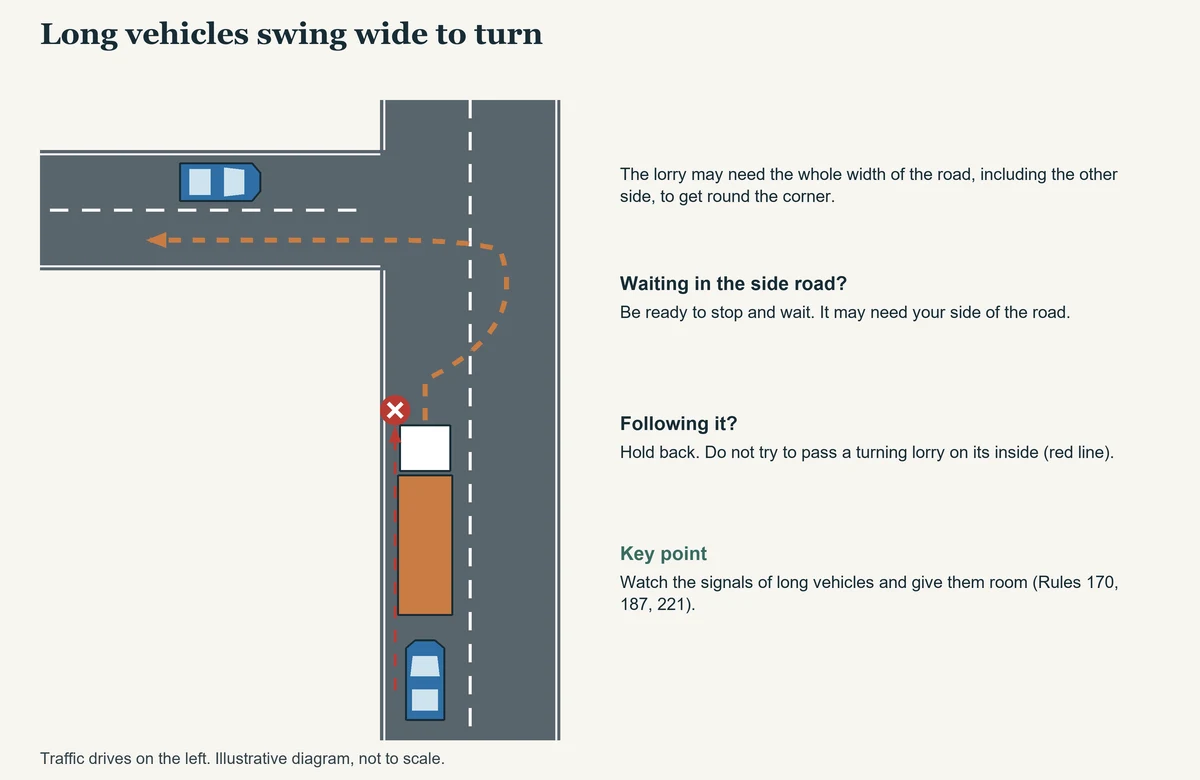
| Lorry turning at a junction | Expect it to need extra road space, including your side of the road. Be ready to stop and wait | 170, 221 |
| Long vehicle at a roundabout | Give it plenty of room. It may take a different course or straddle lanes, so watch its signals | 187 |
| Vehicle approaching from your right and signalling left | Do not assume it will turn. Wait and make sure before you emerge | 170 |
| Bus signalling to pull away from a stop | Give way when it is safe | 223 |
| Bus or tram at a stop | Do not overtake between the kerb and the bus or tram. Watch for passengers crossing | 167, 223 |
| Wanting to overtake a lorry | Make sure there is room to finish. It takes longer to pass. If in doubt, do not overtake | 164 |
| Vehicle ahead overtaking a lorry | Do not assume you can follow it. It may abandon the overtake and pull back in | 164 |
| Vehicle with a flashing amber beacon | Approach with caution: it is slow, stopped or an abnormal load | 225 |
More on overtaking: overtaking rules in the Highway Code.
Why lorries swing wide when turning
A long vehicle may need the whole width of the road to get round a corner. Rule 170 tells you to watch for long vehicles that may need the full road width to turn, and Rule 221 to be ready to stop and wait. Hold back rather than trying to pass a turning lorry on its inside.
Trams and quiet vehicles (Rule 224)
Take care around electric vehicles such as milk floats and trams. Trams move quickly and silently and cannot steer round you. The tram rules are in driving alongside trams.
Slow vehicles with amber beacons (Rule 225)
A flashing amber beacon warns of a slow-moving or stationary vehicle, such as a traffic officer vehicle, salt spreader, snow plough or recovery vehicle, or of an abnormal load. On unrestricted dual carriageways, slow vehicles with a maximum speed of 25 mph (40 km/h) or less, such as tractors, MUST use one. Powered wheelchairs and mobility scooters (top speed 8 mph) MUST use one on a dual carriageway with a limit over 50 mph (Rule 220): see mobility scooters on the road.
Reading the markings on large vehicles
| Marking | Where you see it |
|---|---|
| Rear markings for large goods vehicles | Motor vehicles over 7,500 kg maximum gross weight and trailers over 3,500 kg |
| Vertical rear markings | Required on commercial vehicles or combinations longer than 13 metres; optional between 11 and 13 metres; also on builders’ skips in the road |
| Projection markers (side and end) | Loads or equipment, such as a crane jib, overhanging the front or rear by more than 2 metres |
| Hazard warning plates | Tankers and vehicles carrying dangerous goods |
| School Bus sign | Front or rear window of a bus or coach |
Pictures and meanings: vehicle markings explained.
Common questions
How do I know if a lorry driver can see me?
The Highway Code’s point is that you often cannot be sure. Rule 164 says dropping back should allow the driver to see you in their mirrors, so hang back rather than sitting close behind or alongside.
Do I have to let a bus out?
Rule 223 says give buses, coaches and trams priority when it is safe, especially when they signal to pull away from stops. It is advice, not a MUST rule.
Why are lorries so slow on the motorway?
Large vehicles have lower speed limits than cars, and many have speed limiters set to 56 mph (90 km/h), even on a motorway (Rule 222).
Can I overtake a bus at a bus stop?
Only with great care, watching for people stepping out in front of it (Rule 223). Rule 167 says do not overtake between the kerb and a bus or tram at a stop.
What is a long vehicle marker?
The vertical rear markings shown on commercial vehicles or combinations longer than 13 metres. They warn you the vehicle is long and may need extra room.
Back to the main guide: Learning to Drive in Great Britain. Related: road users requiring extra care, mini and double roundabouts, other types of vehicle topic guide.
Sources
- Department for Transport, “The Highway Code: Road users requiring extra care (204 to 225)” (gov.uk)
- Department for Transport, “The Highway Code: Using the road (159 to 203)” (gov.uk)
- Department for Transport, “The Highway Code: Vehicle markings” (gov.uk)