
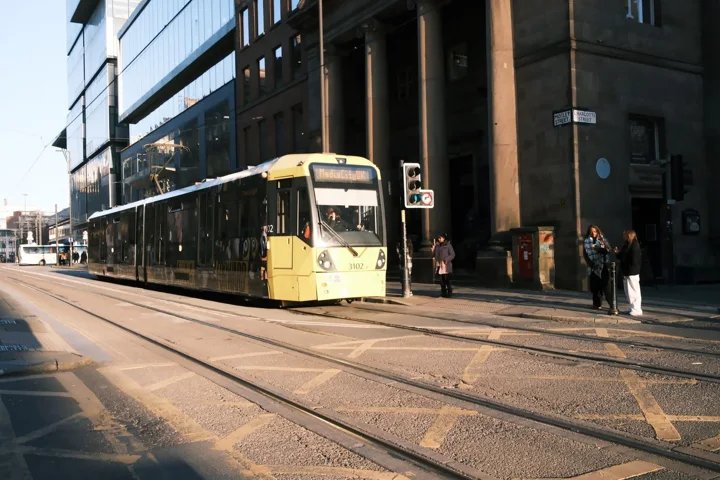
Photo: Max W / Pexels. Illustrative photograph.
Trams cannot steer round you. Highway Code Rules 300 to 307 set out what drivers in Great Britain must do: keep out of tram-only lanes, never block the track, always give way to trams, and cross rails at a right angle. This guide covers those rules, the tram signs and markings to know, and where in Britain you will meet trams.
Where are there trams in Great Britain?
| System | Area |
|---|---|
| Manchester Metrolink | Greater Manchester |
| West Midlands Metro | West Midlands |
| Nottingham Express Transit | Nottingham |
| Sheffield Supertram | Sheffield |
| Blackpool Tramway | Blackpool |
| London Trams | South London (Croydon) |
| Edinburgh Trams | Edinburgh |
The English systems are those listed in the Department for Transport’s light rail and tram statistics. Northern Ireland has no street trams, and its Highway Code has no tramways section.
The rules for drivers (Rules 300 to 307)
| Rule | What it says |
|---|---|
| 300 | You MUST NOT enter a road, lane or route reserved for trams. Avoid driving directly on the rails. |
| 301 | Always give way to trams. Take extra care where the track crosses from one side of the road to the other, and where the road narrows and the rails come close to the kerb. Trams have their own signals and may be allowed to move when you are not. Do not race, overtake or pass them on the inside, unless they are at a stop or stopped by tram signals and there is a designated lane for you to pass. |
| 302 | You MUST NOT park where you would obstruct trams or force others to. Do not stop on the track except in a designated bay with all of your car clear of the tram’s path. |
| 303 | At a tram stop with a platform, follow the signed route. At a stop with no platform, you MUST NOT drive between a stopped tram and the left-hand kerb. If no other route is signed, wait until the tram moves off. |
| 304 | Look out for pedestrians, especially children, running to catch a tram. |
| 305 | Give priority to trams, especially when they signal to pull away, unless it would be unsafe. Watch for people crossing after getting off. |
| 306 | Take extra care near rails, especially when wet. Cross them directly at a right angle. Give cyclists and motorcyclists more room to do the same. |
| 307 | Overhead wires are normally 5.8 metres above the road but can be lower. Lower wires have height clearance plates. Obey them. |
Why trams always get priority
- A tram cannot steer round an obstruction. If you stop on the track, it has to stop.
- Many passengers stand, so a tram emergency stop can injure them. That is why Rule 305 says to give priority, especially when a tram signals to move off.
- Trams are quiet. Look properly, especially at junctions where tracks cross the road.
Tram signs and road markings
- Blue circle with a tram symbol: route for trams only. It may add bus, cycle or “taxi” symbols if those vehicles may also use it.
- No entry except trams: used where the route is unsuitable for other vehicles.
- Red triangle with a tram: trams crossing the road ahead.
- Swept path: the part of the road the tram uses. It may be a different colour or texture, or edged with white lines or yellow dots. Keep it clear.
- Road marking at the start of a tram-only route: do not follow the tram past it.
- Give way sign with a tram plate: at a tram crossing without barriers or lights, you must give way to trams.
- Diamond-shaped signs and white light signals: for tram drivers only. Follow the normal traffic lights for your lane.
See all sign types in the UK road signs guide.
Tram tracks and two wheels
Rule 306 warns that cyclists and motorcyclists can be caught by rails, particularly at shallow angles, on bends and at junctions. Expect a cyclist to swing out to cross the rails at a right angle, and leave them room to do it. More: Highway Code rules for cyclists.
Scenario: turning right across tram tracks
You are waiting to turn right at a junction in Manchester. Tram lines run along the middle of the road you are turning across.
- Wait behind the stop line, not on the rails, until you can clear the track in one go.
- Check both directions for trams as well as for cars. Tram signals can give trams different instructions from your traffic lights.
- Do not stop on the track in a queue. If the exit is not clear, wait.
Common questions
Can I drive in a tram lane?
Not if it is reserved for trams. Rule 300 says you MUST NOT enter a road, lane or route reserved for trams. Some tram routes allow buses, cycles or taxis, and the sign shows this.
Do trams have right of way?
The Highway Code says always give way to trams. At a crossing without barriers or lights, the give way sign with a tram plate makes this a legal requirement.
Can I overtake a tram?
Do not overtake or pass a tram on the inside, unless it is at a stop or stopped by tram signals and has its own lane.
Can I pass a tram at a stop?
At a stop with no platform, you MUST NOT drive between the tram and the left-hand kerb. If no alternative route is signed, wait until it pulls away.
Are tram tracks slippery?
Yes, especially when wet. Take extra care, and cross them at a right angle where you can.
Related: level crossings explained, road junctions and turning right and bus lanes and cycle lanes. Back to the main guide: Learning to Drive in Great Britain.
Sources
- Department for Transport, “The Highway Code: Road works, level crossings and tramways (288 to 307)” (gov.uk)
- Department for Transport, “Know your traffic signs” (gov.uk), section: Tram signs, signals and road markings
- Department for Transport, “Light rail and tram statistics, England: year ending March 2026” (gov.uk)
- Scottish Government, FOI release on Edinburgh Trams operation (gov.scot)