

Photo: Jan Wright / Pexels. Illustrative photograph.
A level crossing is where a road crosses a railway or tramway line. In Great Britain, the rule at every type of crossing is the same: never drive on until the road is clear on the other side, never stop on it, and always stop when red lights flash. This guide explains each type of crossing you will meet as a learner or new driver: full barrier, half barrier, open, and user-operated gates. It also covers the signs on the approach and what to do if you break down on the tracks. It is based on Highway Code Rules 291 to 299 and the Department for Transport’s Know Your Traffic Signs.
Key rules at any level crossing
- Never drive onto a crossing until the road is clear on the other side, and don’t get too close to the car in front (Rule 291).
- Never stop or park on, or near, a crossing.
- You MUST obey flashing red stop lights and stop behind the white line (Rule 293).
- Never reverse onto or over a controlled crossing.
- If a train passes and the red lights keep flashing, wait. Another train is coming.
- Do not enter a yellow box at a crossing if traffic ahead could leave you stopped with any part of your car inside it.
Types of level crossing in Great Britain
| Type | What you see | What you do |
|---|---|---|
| Full barrier (controlled) | Steady amber, then twin flashing red lights, alarm, barriers across the whole road | Stop at the white line. Cross only when the lights go off and the barriers are fully up. |
| Automatic half barrier | Amber lights and alarm, then flashing red lights, then half barriers lower | You MUST stop. Never zig-zag around the barriers: they lower automatically because a train is approaching. |
| Automatic open (no barriers) | Flashing red lights and alarm, St Andrew’s cross sign | A train is approaching whenever the lights show. Stop and wait until they go off. |
| Gates or barriers without traffic lights | Gates or barriers, sometimes worked by an attendant | Stop and wait when the barrier or gate begins to close. Don’t cross until it opens (Rule 295). |
| User-operated, with miniature lights | ‘Stop’ sign, small red and green lights, gates you open yourself | You MUST NOT cross on red. Cross only on green (Rule 296). |
| User-operated, no lights | Gates or barriers, often a railway telephone | Stop, look both ways and listen. If there’s a phone, always ring the signal operator first and again when clear (Rule 297). |
| Open crossing | No gates, barriers, attendant or lights. A ‘Give Way’ sign over a train symbol | Look both ways, listen and make sure no train is coming before you cross (Rule 298). |
How do the lights at a level crossing work?
- Steady amber: means stop, as at normal traffic lights, unless it is unsafe to do so. If you have already crossed the white line when the amber comes on, keep going.
- Twin flashing red: means STOP. This applies to pedestrians too.
- Lights still flashing after a train passes: another train is coming. At automatic half-barrier crossings the barriers stay down and the alarm sound may change.
- Barriers rising: don’t move until the lights go out.

Know Your Traffic Signs says to phone the signal operator if the red lights flash for more than three minutes without a train arriving (except at full-barrier crossings), or if a barrier lowers without the lights flashing.
More on signals: Highway Code light signals.
How to use a user-operated gated crossing
These crossings have gates or barriers but no attendant. With miniature red and green lights, which are worked by an approaching train:
- Stop. You must stop even if the gates have been left open.
- Check the light. Red means a train is coming: don’t cross.
- On green, open the gates or barriers on both sides.
- Check the green light is still on, then cross quickly.
- Close the gates or barriers once you are clear.
If there are no lights, follow the same steps, but stop, look both ways and listen before crossing. If there is a railway telephone, use it before you cross and again when you are clear.
Signs on the approach to a level crossing
- Warning triangle (gate or barrier): level crossing with a gate or barrier ahead.
- Warning triangle (no gate or barrier): level crossing without a gate or barrier ahead.
- Plate showing lights: advance warning of light signals at the crossing.
- Countdown markers: three, two and one sloping bars on the approach. They divide the distance from the warning sign to the stop line into three equal parts. Each bar is not necessarily 100 yards.
- St Andrew’s cross: used at crossings with no gates or barriers.
- Overhead cable sign with a safe height: electrified lines ahead. Bells may hang over the road to warn vehicles that are too tall.
- Yellow box markings: part of the road that must be kept clear.
- Name and phone number board: for contacting the railway operator at crossings without a dedicated phone.
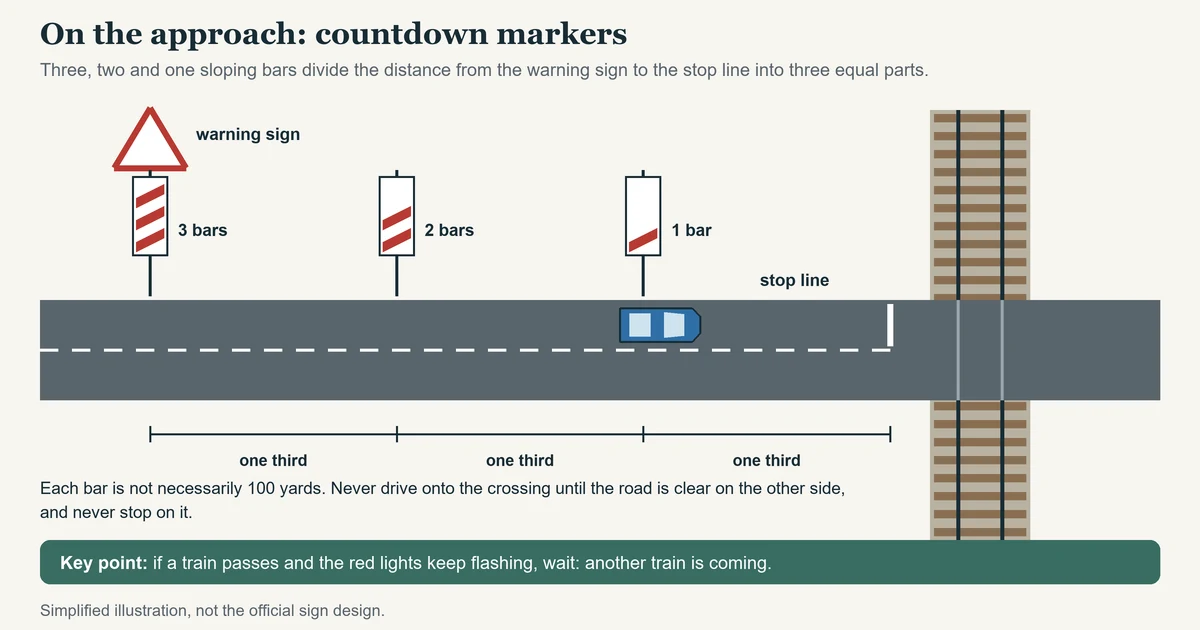
See UK warning signs for the sign shapes.
Overhead electric lines and railway telephones
- It is dangerous to touch overhead electric lines. You MUST obey safe-height signs. Don’t go on if your vehicle touches a height barrier or bells. The usual clearance is 5 metres (16 feet 6 inches), but it may be lower (Rule 292).
- Drivers of large or slow vehicles, long low vehicles that could ground, or anyone herding animals MUST obey signs telling them to phone for permission before crossing. They must phone again when clear if asked to (Rule 294).
What to do if you break down on a level crossing
Rule 299:
- Get everyone out of the car and clear of the crossing immediately.
- Use the railway telephone, if there is one, to tell the signal operator. Follow their instructions.
- Move the car clear only if there is time before a train arrives.
- If the alarm sounds or the amber light comes on, leave the car and get clear at once.
Full breakdown routine: what to do if your car breaks down.
Level crossings with trams
Where a tramway crosses the road with no barriers, gates or traffic lights, drivers must give way to trams. Sometimes only a ‘Give Way’ sign and a tram plate are used. See driving alongside trams.
Common questions
Can I go if the barriers are up but the lights are still flashing?
No. Wait until the lights go out, even after the barriers rise. Lights that keep flashing after a train has passed mean another train is coming.
Is it ever OK to drive around half barriers?
Never. They come down automatically because a train is approaching.
What if the amber light comes on as I reach the crossing?
Stop at the white line unless stopping would be unsafe. If you have already crossed the white line, keep going.
Traffic is queuing over the crossing. Should I follow?
No. Only drive on when the road is clear on the other side, and keep out of the yellow box if you could end up stopped in it.
Do learners get level crossings on the driving test?
Test routes are not published. If your route has a crossing, the examiner will expect you to follow these rules. Level crossings also come up in the theory test under rules of the road.
What does an open crossing look like?
It has no gates, barriers, attendant or lights, just a ‘Give Way’ sign. You must look both ways and listen for trains yourself.
Related: road works and contraflows (Rules 288 to 290) and learning to drive on rural roads. Back to the main guide: Learning to Drive in Great Britain.
Sources
- Department for Transport, “The Highway Code: Road works, level crossings and tramways (288 to 307)” (gov.uk)
- Department for Transport, “Know Your Traffic Signs: Level crossing signs and signals” (gov.uk)
- Department for Transport, “Know Your Traffic Signs: Tram signs, signals and road markings” (gov.uk)