

Photo: Taiki Ishikawa / Unsplash. Illustrative photograph.
The Highway Code for Great Britain sets out how to use indicators, arm signals, flashing headlights and the horn in Rules 103 to 112. In short: signal in good time, only when it helps someone, and never to give orders or show anger. You MUST NOT sound your horn while stationary, or in a built-up area between 11.30 pm and 7.00 am, unless another road user poses a danger.
Key facts
- Signal before changing course or direction, stopping or moving off, and cancel the signal afterwards (Rule 103).
- A signal does not give you priority (Rule 103).
- Flash your headlights only to let other road users know you are there (Rule 110).
- Never treat someone else’s flashed headlights as an invitation to go (Rule 111).
- Horn: never while stationary, and not in a built-up area from 11.30 pm to 7.00 am, unless another road user poses a danger (Rule 112).
How to signal correctly (Rules 103 and 104)
- Check first. Look in your mirrors and make sure your signal will not mislead anyone.
- Time it. Signal in good time, but not too early. An early left signal can make others think you are turning into an earlier side road or stopping.
- Use the right signal. Indicators for changes of course, brake lights for slowing, and an arm signal to reinforce an indicator if needed.
- Cancel it. A signal left on after a turn misleads other road users.
- Read other people’s signals with care. Rule 104 warns that another vehicle’s indicator may not have been cancelled. Wait until they actually start to turn.
What each signal means
These are the meanings given in the Highway Code section “Signals to other road users”.
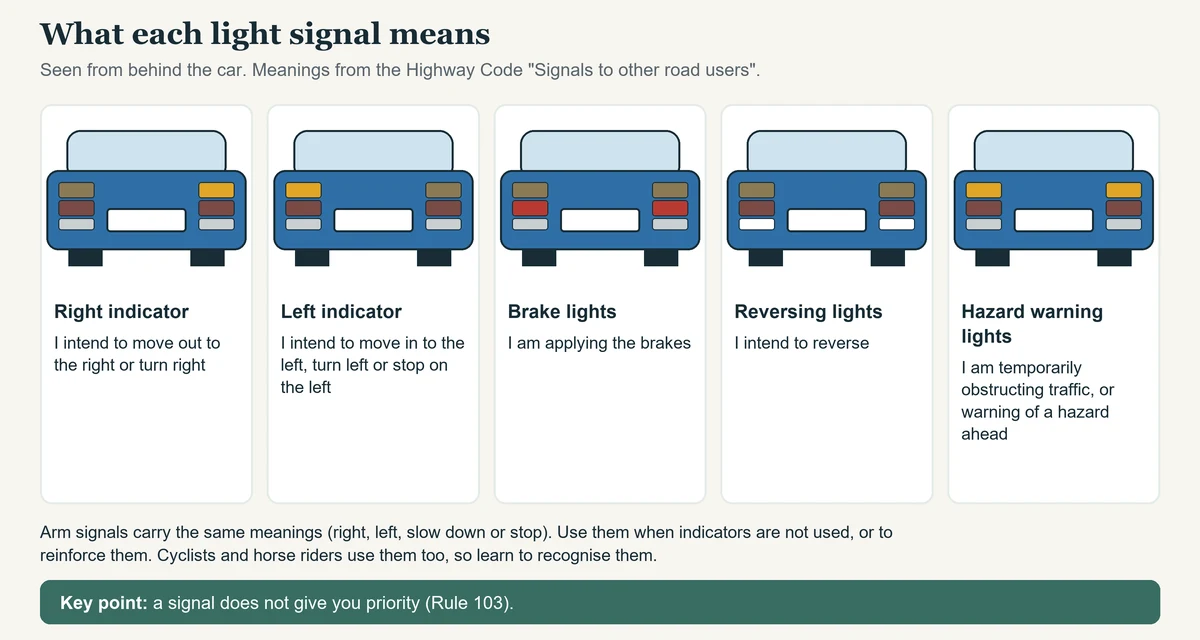
| Signal | Meaning |
|---|---|
| Right indicator | I intend to move out to the right or turn right |
| Left indicator | I intend to move in to the left or turn left or stop on the left |
| Brake lights | I am applying the brakes |
| Reversing lights | I intend to reverse |
| Hazard warning lights | I am temporarily obstructing traffic, or warning of a hazard or obstruction ahead (Rule 116) |
| Arm signal, right | I intend to move out to the right or turn right |
| Arm signal, left | I intend to move in to the left or turn left |
| Arm signal, slow or stop | I intend to slow down or stop |
When would you use an arm signal?
The Highway Code says arm signals are for when indicators are not used, or to reinforce your indicators and brake lights. Cyclists and horse riders also use them, so you need to recognise them even if you never give one. The theory test can ask what each one means.
Flashing headlights (Rules 110 and 111)
- Flash your headlights only to let other road users know you are there.
- Do not flash them to send any other message, or to intimidate.
- If someone flashes at you, do not assume it means “go”. Use your own judgement and proceed carefully. They may be flashing at someone else, or by mistake.
Rule 195 adds that at a zebra crossing you should not wave, flash your lights or sound your horn to invite pedestrians across.
When can you use the horn? (Rule 112)
| Situation | Allowed? |
|---|---|
| While moving, to warn others you are there | Yes |
| Aggressively, to show annoyance | No, never |
| While stationary on the road | MUST NOT, unless another road user poses a danger |
| Moving in a built-up area, 11.30 pm to 7.00 am | MUST NOT, unless another road user poses a danger |

Rule 214 also says do not sound your horn near animals, and Rule 215 repeats this for horses. See passing horses safely.
Signals you MUST obey (Rules 105 to 109)
- Signals from police officers, traffic officers, traffic wardens and school crossing patrol signs.
- Police stopping you: pull over and stop as soon as it is safe, then switch off the engine.
- DVSA officers and traffic officers using flashing amber lights: you MUST obey their signals.
- All traffic light signals and traffic signs giving orders, including temporary ones.
Detail: signals by police, traffic officers and crossing patrols and Highway Code light signals.
What the examiner looks for
DVSA marks signals on whether they were needed, correct and well timed. Faults it gives as examples:
- signalling and then not turning
- signalling right at a roundabout when going ahead
- signalling too late to be useful
- checking mirrors after or at the same time as signalling, rather than before
The fix is the mirrors, signal, manoeuvre routine: see mirror, signal, manoeuvre explained. For roundabout signals, see roundabouts and the Highway Code.
Common questions
Do I always have to signal on the driving test?
DVSA assesses whether each signal was necessary, correct and well timed, so think about who it is for. Checking your mirrors before any change of speed or direction is always expected. If in doubt, ask your instructor how examiners treat signalling on your local routes.
Is it illegal to flash your headlights to let someone out?
The Highway Code says flash your headlights only to let others know you are there, and not to convey any other message. Doing it to invite someone out goes against Rule 110 and could mislead another road user.
What time can you not use your horn in the UK?
In Great Britain, from 11.30 pm to 7.00 am when driving in a built-up area, unless another road user poses a danger. You must not use it while stationary at any time, with the same exception.
Does signalling give me right of way?
No. Rule 103 says a signal does not give you priority.
Do I need to know arm signals for the theory test?
You should recognise them: they are in the Highway Code and cyclists and horse riders use them.
Back to the main guide: Learning to Drive in Great Britain. Related: using your car lights.
Sources
- Department for Transport, “The Highway Code: General rules, techniques and advice for all drivers and riders (103 to 158)” (gov.uk)
- Department for Transport, “The Highway Code: Signals to other road users” (gov.uk)
- Department for Transport, “The Highway Code: Using the road (159 to 203)” (gov.uk)
- Department for Transport, “The Highway Code: Road users requiring extra care (204 to 225)” (gov.uk)
- DVSA, “Understanding your driving test result: Car driving test” (gov.uk)