

Photo: Dave Fox Cars / Unsplash. Illustrative photograph.
Clutch control is how you move a manual car smoothly at low speed: finding the biting point, holding it, and feeding the clutch up while you keep looking at the road, not your feet. This guide is for learners in the UK and Ireland in manual cars. It explains what the clutch does, how to find the biting point, how to creep slowly for manoeuvres, and the clutch habits examiners mark as faults.
Key facts
- DVSA’s Ready to Pass skills list asks learners to use the foot controls (accelerator, brake, clutch) smoothly and progressively, and to adapt quickly when driving a different vehicle.
- On the GB driving test, examiners can mark “clutch: uncontrolled use” and coasting “with clutch pedal depressed” as faults.
- The biting point is in a different place in every car. Learn it by feel in the car you drive.
- Automatic cars have no clutch pedal. If you pass in one, you can only drive automatics (see learning to drive an automatic).
What does the clutch actually do?
The clutch connects the engine to the wheels.
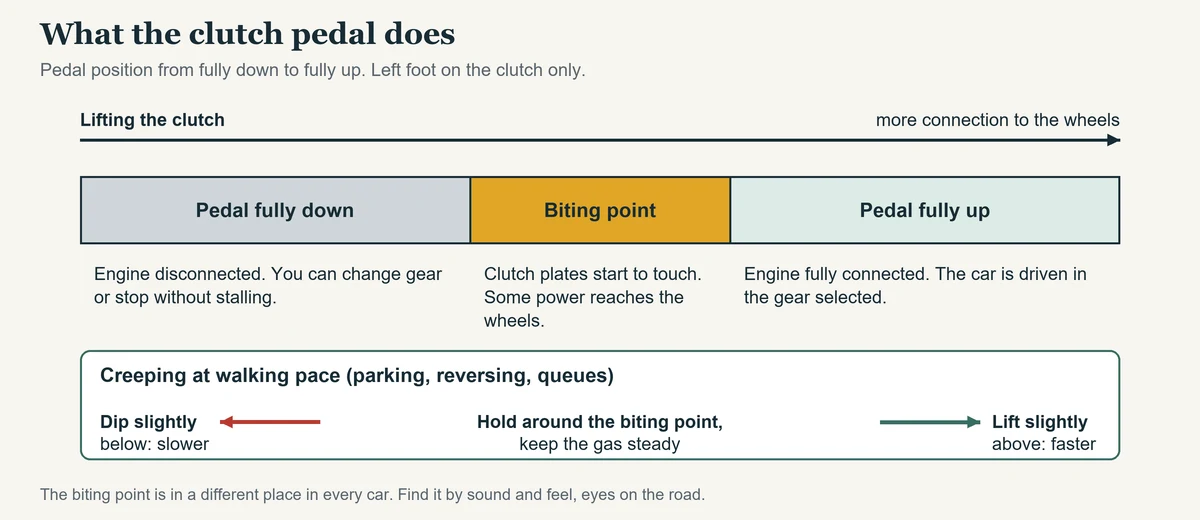
- Pedal fully down: engine disconnected. You can change gear or stop without stalling.
- Pedal fully up: engine fully connected. The car is driven by the engine in whatever gear you have selected.
- In between (the biting point): the clutch plates start to touch and some power reaches the wheels. This is the zone where clutch control happens.
Use your left foot for the clutch only. The right foot works the accelerator and the footbrake.
How to find the biting point
Do this first with your instructor in a quiet, flat place.
- Footbrake or handbrake on. Clutch fully down. Select first gear.
- Press the accelerator slightly and hold it steady. Your instructor will tell you how much your car needs.
- Lift the clutch very slowly until you hear the engine note drop slightly and feel the car want to move. On some cars the front of the bonnet rises a little. That is the biting point.
- Hold your foot still. Do not lift further yet.
- Press the clutch back down and repeat until you can find it without looking.
The signals are sound and feel: engine note, a slight vibration, the car pulling against the brake. Your eyes should be free for the mirrors and the road.
Moving off with clutch control
Once you can find the biting point, moving off is the same routine every time. Highway Code rule 159 says before moving off you should use all mirrors, look round for blind spots, signal if necessary, look round again, and move off only when it is safe.
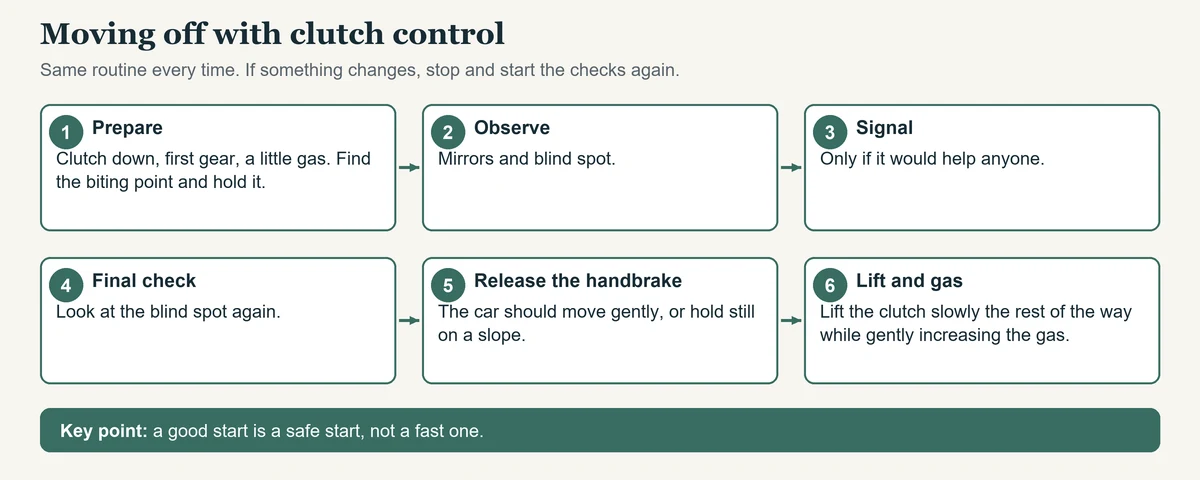
- Prepare: clutch down, first gear, a little gas, find the biting point and hold it.
- Observe: mirrors and blind spot.
- Signal if it would help anyone.
- Final check of the blind spot.
- Release the handbrake. The car should move gently, or hold still on a slope.
- Lift the clutch slowly the rest of the way while gently increasing the gas.
If something changes during these steps, a cyclist appears or a car pulls out, stop and start the checks again. A good start is a safe start, not a fast one. On a slope, see hill starts explained.
Creeping slowly for manoeuvres and queues
Parking, reversing and crawling traffic all need the car to move at walking pace or slower. In a manual, you do that by holding the clutch around the biting point:
- Lift slightly above the biting point to move a little faster.
- Dip slightly below it to slow down.
- Cover the footbrake, or use it gently, if the road slopes.
- Keep the gas steady rather than pumping it.
Holding the clutch at the biting point for short spells is normal. Holding it there for long periods, or using the clutch to hold the car on a hill instead of the brakes, wears the clutch and is uncontrolled. For test manoeuvres, see driving test manoeuvres explained.
Stopping and changing gear
- Stopping: brake first. Press the clutch down just before the car stops, so the engine does not stall. Pressing it too early means you are coasting.
- Changing gear: clutch down fully and promptly, change gear, then lift the clutch smoothly. Do not ride the clutch between changes.
- Turning: keep the clutch up and the car in gear through the turn. Holding the clutch down round a corner removes engine braking and steering feel.
Highway Code rule 122 explains why holding the clutch down while moving is coasting: engine braking is lost, speed builds downhill, the footbrake works harder, steering response is affected and it may be harder to select a gear when you need one. See coasting and downhill control.
Common clutch problems and fixes
| Problem | Likely cause | What to practise |
|---|---|---|
| Car jerks forward, then stalls | Clutch lifted too fast past the biting point | Hold at the biting point for a second, then lift slowly |
| Engine revs loudly but car barely moves | Too much gas, clutch held too low | Less gas; lift the clutch a little more |
| Car rolls back on a slope | Handbrake released before the biting point was found | Find the biting point first, then release |
| Jerky gear changes | Clutch dropped quickly after the change | Lift smoothly through the biting point |
| Stalls when stopping | Clutch pressed too late | Clutch down just before the car stops |
| Looking down at the pedals | Not yet confident by feel | Stationary drills: find the biting point with eyes forward |
| Foot resting on the clutch while driving | Habit | Rest your left foot flat on the floor away from the pedal |
Stalls happen to every learner. What matters is a calm restart and fresh observations: see stalling and how to recover.
A practice plan
- Stationary: find and hold the biting point, eyes forward, ten times.
- Flat, quiet road: move off and stop repeatedly, with full observations each time.
- Slow control: creep at walking pace in a quiet car park or road, steering gently.
- Gentle slopes: uphill and downhill starts with your instructor.
- Traffic: queues, junctions and roundabouts where you must move off promptly.
- A different car: if you practise privately as well as with an instructor, expect the biting point to be somewhere else. Spend a few minutes finding it before you drive.
In Great Britain, private practice needs a supervisor who meets the rules and insurance that covers you. See supervising a learner driver. In Ireland, see accompanying a learner driver in Ireland.
Common questions
How long does it take to learn clutch control?
It varies. Many learners get the basic biting point in the first lesson or two, but smooth slow control in traffic and on hills takes longer. There is no official number of hours.
Is it bad to hold the car at the biting point?
For a few seconds while you get ready to move, it is normal. For longer, use the handbrake or footbrake to hold the car and save the clutch.
Should I press the clutch when braking?
Not straight away. Brake first and press the clutch just before the car stops, or when the engine would otherwise labour at low speed. Your instructor will show you for your car.
Why does the biting point feel different in my parents’ car?
Every clutch is different and they change with wear. Find the new biting point while stationary before you move.
Does clutch control matter on the Irish driving test?
Yes. The RSA test assesses your control of the car, including moving off, the hill start and the reverse manoeuvre. See Irish driving test manoeuvres.
Can I avoid the clutch by learning in an automatic?
Yes, but in both GB and Ireland passing in an automatic restricts your licence to automatics. See automatic or manual and Ireland’s code 78.
Related: your first driving lesson, vehicle handling. Guides: learning to drive in Great Britain and learning to drive in Ireland.
Sources
- DVSA, “Control and positioning” (readytopass.campaign.gov.uk)
- DVSA, “Carrying out driving tests: examiner guidance, 1. Car driving test” (gov.uk)
- Department for Transport, “The Highway Code: General rules, techniques and advice for all drivers and riders (103 to 158)” (gov.uk)
- Department for Transport, “The Highway Code: Using the road (159 to 203)” (gov.uk)
- GOV.UK, “Driving test: cars, using your own car” (gov.uk)