
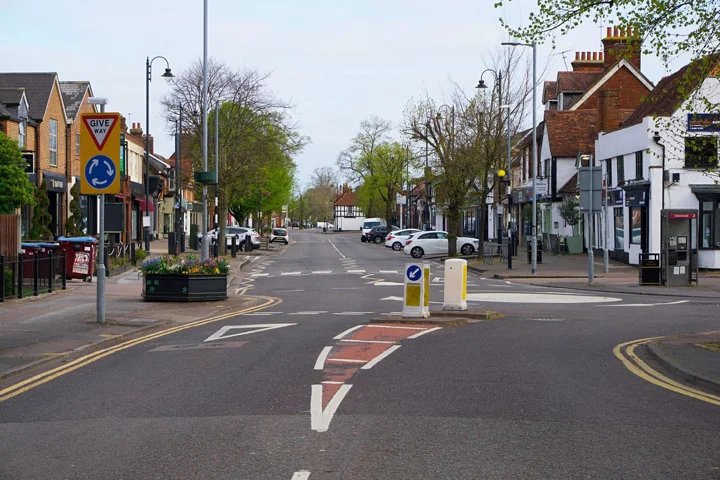
Photo: Mike Bird / Pexels. Illustrative photograph.
On the car driving test in Great Britain, you drive independently for 20 to 35 minutes, following a sat nav, traffic signs or both. Since 24 November 2025, examiners can run independent driving for the whole test. Taking a wrong turn is not a fault in itself. This guide explains how the independent section works, how the sat nav is set up and what the examiner is really marking.
Key facts
- Length: 20 to 35 minutes of independent driving, within about 35 minutes of driving in total (GOV.UK).
- From 24 November 2025: examiners may use independent driving for the full test or mix it with directed driving (DVSA).
- Method: sat nav, traffic signs, or both. The examiner tells you which.
- Sat nav: the examiner provides and sets it up. You cannot use your own. DVSA uses the TomTom Start 52.
- Wrong turn: not a fault. The examiner helps you get back on route.
- Emergency stop: about 1 in 7 tests since 24 November 2025 (previously 1 in 3).
How the independent driving section works
- The examiner asks you to pull up on the left.
- They brief you clearly on the method: follow the sat nav, follow signs to a place, or both.
- If it is a sat nav route, the examiner’s device is preloaded with the test routes. Just follow its directions.
- You drive, making your own decisions on lanes, speed and positioning.
- When the section ends, the examiner goes back to turn-by-turn directions, or keeps you independent for the rest of the test.
Test routes are not published, so you cannot learn them in advance.
Sat nav or traffic signs: what to expect
| Sat nav | Traffic signs | |
|---|---|---|
| What you do | Follow directions from the examiner’s sat nav | Follow direction signs to a named place |
| How often | After the December 2017 changes, DVSA reported sat nav was used in 4 out of 5 tests | The other 1 in 5 at that time. Current GOV.UK pages give no split. |
| If you cannot see | If unsure, ask the examiner. Examiners should not leave you in doubt about the route. | If a sign is hidden, the examiner gives directions until you can see the next one |
Practising with a sat nav
- Practise with the sat nav mounted, set up before you move, and never hand-held. Use it the way the law allows: see mobile phones and sat navs.
- Listen to the voice and glance at the screen only briefly. Your eyes belong on the road and mirrors.
- Treat the sat nav as advice. If it says “turn left” but the turn is a no entry, follow the signs.
- Practise following signs to towns and places too, including on roundabouts and multi-lane approaches.
What happens if you go the wrong way?
DVSA examiner guidance is clear: going off route, or needing reminders of where to go, is not a fault in itself. The examiner helps you get back on route.
What can be marked is unsafe driving while you go wrong, for example:
- swerving across lanes at the last moment to make the turn
- stopping or braking hard without need
- missing or ignoring a road sign, such as a no entry or a lane arrow
- cutting across another vehicle’s path
If you realise you are in the wrong lane, carry on safely in that lane and let the sat nav or examiner reroute you. A missed exit costs nothing; an unsafe lane change can fail you. Fault types: driving, serious and dangerous faults.
What the examiner is looking for
Independent driving tests whether you can make decisions on your own. Examiners record faults under the normal headings, such as response to signs and signals and awareness and planning. They want to see you:
- read signs early and plan your lane
- keep to the speed limit and drive at a suitable speed while working out the route
- use mirrors, signal correctly and change lanes safely
- keep your attention on the road rather than the screen
You will also be asked to pull up at the side of the road, pull out from behind a parked vehicle and do a hill start. These can happen during the independent section.
Common questions
How long is independent driving on the test?
GOV.UK says 20 to 35 minutes. Since 24 November 2025, DVSA examiners can use independent driving for the full test.
Can I use my own sat nav on the test?
No. The examiner provides the sat nav and sets it up.
Is going the wrong way a fail?
No. A wrong turn is not a fault. Only unsafe driving while correcting it, or ignoring signs, would be marked.
Can I ask the examiner where to go?
If you are unsure, ask. DVSA examiner guidance says candidates must not be left in doubt about the route.
What if I forget which place I was following signs to?
Ask the examiner to remind you. Needing reminders is not a fault in itself.
Will the test include a motorway?
No. The test includes various roads and traffic conditions, but not motorways.
Related: driving test manoeuvres, top reasons people fail, what to bring on test day and the practical test guide. Back to the main guide: Learning to Drive in Great Britain.
Sources
- GOV.UK, “Driving test: cars: What happens during the test” (gov.uk)
- DVSA, “Carrying out driving tests: examiner guidance: 1. Car driving test” (gov.uk)
- DVSA, “Making adjustments to the driving test” (despatch.blog.gov.uk)
- DVSA, “Driving test changes in 2017: impact summary” (gov.uk)