
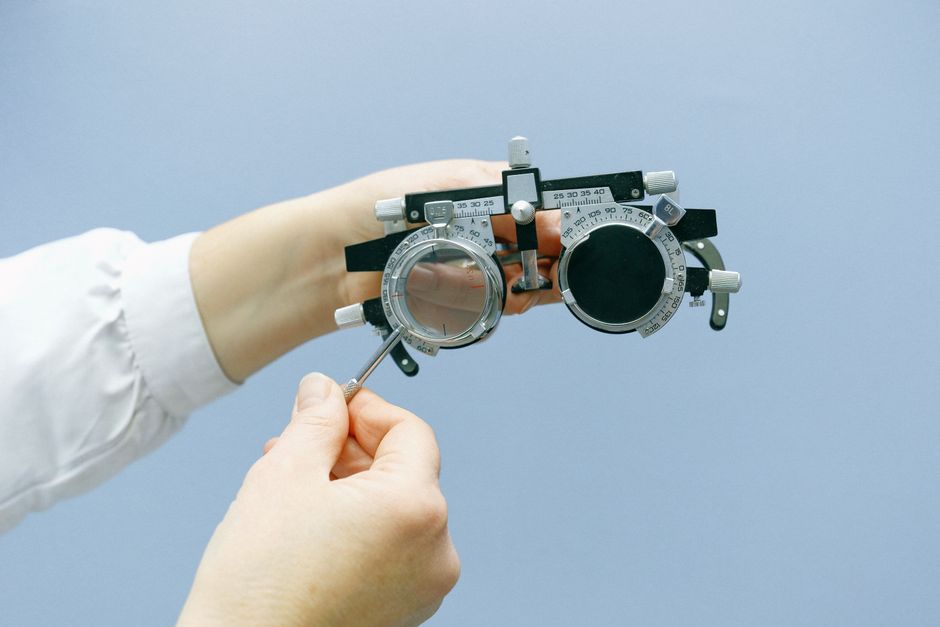
Photo: Anna Shvets, Pexels
To hold a car licence in Canada under the national CCMTA standard, you need visual acuity of at least 20/50 (6/15) with both eyes open and examined together, and a visual field of at least 120 continuous degrees along the horizontal, plus 15 continuous degrees above and below fixation. Glasses or contact lenses can be used to reach the standard. Telescopic (bioptic) lenses cannot, except in Ontario. You can drive with sight in one eye, and colour vision only matters in that you must be able to tell traffic lights apart.
This page explains the licensing standard, not eye health. Your optometrist or ophthalmologist is the person to ask about your own eyes.
The standard for a non-commercial licence
| What is measured | National standard |
|---|---|
| Visual acuity | At least 20/50 (6/15), both eyes open and examined together |
| Visual field | At least 120 continuous degrees along the horizontal meridian, and 15 continuous degrees above and below fixation |
| One eye (monocular vision) | Allowed if you meet the acuity and field standards and enough time has passed to adjust |
| Colour vision | You can tell the different traffic lights apart |
| Double vision | Within the central 40 degrees, it must be corrected (for example with prism lenses) so you no longer have it |
| Telescopic and low-vision aids | Cannot be used to meet the standard |
What happens if your acuity is close to the line?
British Columbia publishes how it applies the standard:
- Corrected acuity of 20/60 to 20/70 may lead to an on-road assessment.
- Worse than 20/70 may lead to an offer of a functional driving evaluation.
- Drivers at 20/40 or better are usually reassessed every two years; at 20/50 or worse, usually every year.
Provinces apply their own procedures. Nova Scotia’s current Class 5 to 8 standards use 20/50 (6/15) acuity with both eyes open and examined together, plus a field of 120 continuous degrees horizontally and 15 above and below fixation. Its October 2026 update supersedes the older handbook’s 20/40 figure. Ask RMV how it assesses your circumstances.
Driving with sight in one eye
If you have lost vision in one eye, you lose stereoscopic depth perception. The standard allows you to drive once you meet the acuity and field standards and enough time has passed to relearn how to judge distance. BC says this is typically 1 to 3 months, and it generally does not ask non-commercial drivers for more information.
Colour blindness
Colour blindness does not stop you getting a car licence. The only requirement is being able to tell traffic lights apart. BC generally asks for no further information.
Glasses and contact lenses: the restriction code
If you need correction to meet the standard, your licence carries a condition. In BC, code 21 means “corrective lenses required” (it also covers prism lenses), and code 51 means you must patch one eye while driving, used for some double-vision cases. Other provinces use their own codes. You must wear your correction every time you drive, including at the vision screen.
Bioptic telescopes
The national standard says low vision and telescopic lens aids “cannot be used to meet the vision standard”. BC notes that limited research suggests drivers using telescopic lenses have higher crash rates. Ontario is the exception: it has allowed telescopic lenses for a Class G licence since October 2020, with conditions. See Ontario vision standard, vision waiver and telescopic (bioptic) lenses.
Cataract, glaucoma and progressive conditions
- There is no separate licensing rule for cataract or glaucoma. What matters is whether you still meet the acuity and field standards.
- For progressive field conditions such as glaucoma or retinitis pigmentosa, BC reassesses with a field test, typically every 1 to 3 years.
- In Ontario, optometrists must report acuity below 20/50 or a field below the standard, which leads to a licence suspension. See Does your doctor have to report you?
Is the standard changing?
The CCMTA is reviewing the vision part of its standards. Until a new version is adopted and your province applies it, the figures above remain the reference. Check with your licensing office before your vision screen.
Where your vision is checked
Every province screens vision before issuing a learner’s licence. The details for each province are in Vision test for your learner’s licence in every Canadian province and territory. Quebec’s process is covered in SAAQ medical and vision reports.
Want to practise the eyesight check? Our sister site Driving Eyesight Test has a free Canada letter chart on drivingeyesighttest.com. It is a practice screen only, not an eye test.
Back to the hub: Driving with a medical condition or disability in Canada.
Sources
- Government of British Columbia, “Chapter 22: Vision”, RoadSafetyBC medical standards (gov.bc.ca)
- Government of Ontario, “Reporting a driver for medical review” (ontario.ca)
- Government of Nova Scotia, “Health professionals”, current vision standards following the Traffic Safety Act commencement (novascotia.ca)