Category: Newfoundland and Labrador

  • Newfoundland and Labrador written test study guide: rules, signs

    Newfoundland and Labrador written test study guide: rules, signs

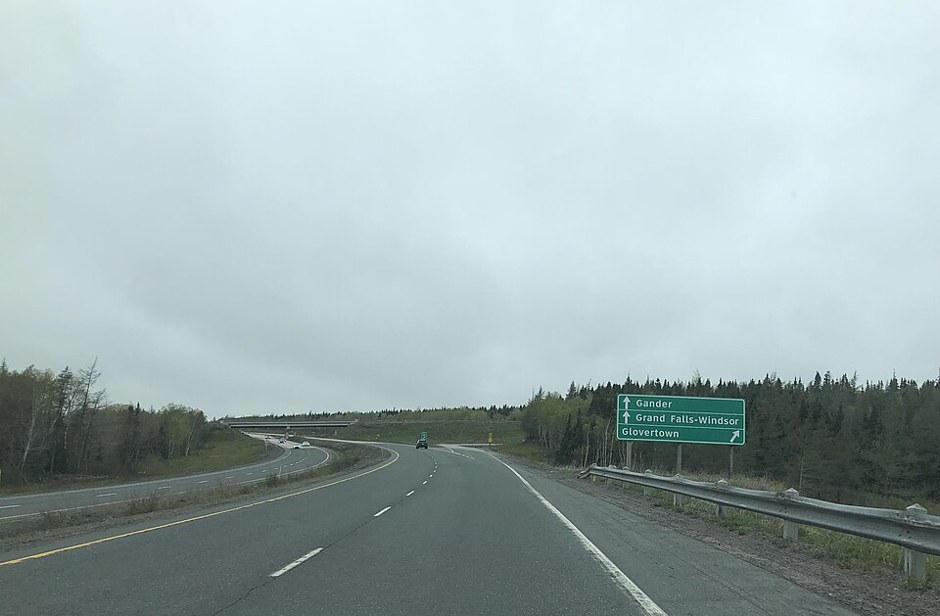
    Photo: Ycleymans, CC BY-SA 4.0, via Wikimedia Commons

    The Newfoundland and Labrador written test asks about the rules of the road, safe driving practices and road sign recognition, and you need 85% to pass. This study guide covers the handbook topics that test those three areas: sign shapes and colours, the signs specific to Newfoundland and Labrador (moose and weather warnings), right-of-way, default speed limits, passing, school buses, parking distances and move-over rules. It is for anyone preparing for the Class 5 Level I (learner) test.

    Key facts

    • Pass mark: 85% on the written test (Motor Registration Division).
    • With no speed sign: 100 km/h on paved parts of the Trans-Canada Highway, 80 km/h on other paved highways, 60 km/h on gravel roads, 50 km/h through communities and unmarked school zones.
    • Uncontrolled intersection: yield to traffic on your right.
    • School bus with flashing lights or stop sign: stop in both directions. Passing it costs 6 demerit points.
    • Move over: slow to at least 30 km/h below the limit (no more than 30 km/h in zones of 60 km/h or less). Failing to do so costs 4 demerit points.
    • Fines are doubled in construction zones.
    • Railway crossing with signals or a flag person warning of a train: stop no less than 5 metres from the nearest rail.

    What is in the Newfoundland and Labrador written test?

    The Motor Registration Division says the written test covers rules of the road, safe driving practices and road sign recognition. Ask about the number of questions when you book. Study from the province’s Driver’s Handbook (formerly the Road User Guide), available free from gov.nl.ca. The chapters that matter most for the learner test are:

    1. Licensing and Registration: graduated licensing levels, the Class 5I rules, ID.
    2. Road Safety: impaired and distracted driving, fatigue, emergencies, animals on the road.
    3. Traffic Signs and Pavement Markings: the signs section of the test.
    4. Rules of the Road: right-of-way, turns, roundabouts, passing, signals, parking, speed, school buses, emergency vehicles.

    The Motorcycle Safety and Commercial Drivers chapters are not needed for a Class 5 learner test. For the format, retakes and what to bring, see Newfoundland and Labrador written test.

    Sign shapes and colours

    Learn the shapes first. The handbook says several of them are used for only one sign, so you can name the sign even if snow covers the words.

    Shape or colour Meaning in the NL handbook
    Octagon (red, white letters) Stop. Come to a full stop at the stop line or crosswalk. No other sign has this shape.
    Inverted triangle (white, wide red border) Yield. Slow down, be ready to stop, give the right-of-way.
    Crossbuck (X shape) Railway crossing. Be ready to stop.
    Pentagon (blue or fluorescent yellow) School zone. Slow down and watch for children.
    Diamond (yellow, black symbols) Warning of a hazard ahead.
    Vertical rectangle or square (white) Regulations that must be obeyed: speed, parking, turns, passing.
    Horizontal rectangle (green, white letters) Directions and distances to communities and routes.
    Brown rectangle Tourist information: rest areas, parks, historic sites, chalets.
    Orange (diamond, square or rectangle) Road construction and maintenance.

    Two symbols appear on regulatory signs. A green circle means the action shown is allowed or required. A red circle with a diagonal stroke means it is not permitted.

    Watch the school sign colour

    Many Canadian handbooks show only the fluorescent yellow-green school pentagon. The Newfoundland and Labrador handbook describes a blue pentagon with white figures of students, and says the sign may also be fluorescent yellow. Both mean a school zone.

    Newfoundland and Labrador signs to know

    Regulatory signs

    • Speed limit, and “change in speed ahead”.
    • Keep right except to pass.
    • Shared centre left-turn lane, and two-way left turns.
    • No U-turn, no left turn, do not enter, one-way.
    • Accessible parking: the space is painted blue in whole or part and is only for a permit holder or someone accompanying one.
    • Passing lane 2 km ahead. Oncoming vehicles may also have the right to use a passing lane first. If several are coming toward you, expect one to use it and yield to them.

    Warning signs

    • Moose crossing: moose cross this stretch regularly. Slow down and drive with caution. See moose on Newfoundland roads.
    • Pavement ends, gravel road ahead.
    • Roundabout ahead (may show a recommended speed).
    • Steep hill: you may need a lower gear and engine braking.
    • Right lane ends; two lanes merge with traffic entering from the right.
    • Divided highway begins, and divided highway ends (two-way traffic, keep right).
    • Slow-moving vehicle triangle: required on the back of the vehicle when it is driven on a highway.

    Weather and hazard signs

    Hazardous conditions signs give advisories, closures or detours because of bad weather. They may be black on yellow, sometimes with flashing yellow lights, or digital signs with yellow or orange text on black. The handbook’s examples are wind warnings in the Wreckhouse area and closure of the highway from Holyrood to St. John’s in winter weather. Obey them strictly.

    Construction signs

    Orange signs with black letters or symbols mark construction and maintenance. Speeds are reduced to protect workers and fines for speeding are doubled. Construction signs still apply when no workers or equipment are visible, because the road itself may be the hazard. Unless the signs at the start of the zone show a lower limit, the Highway Traffic Act sets a maximum of 60 km/h in a construction zone; where the signs show a different maximum, that posted figure applies. When a flag person holds up a STOP sign or flag, stop before the work area and stay stopped until that person waves you on, even if the car ahead has moved. Expect cars ahead to stop suddenly. Zipper merge signs tell you to use both lanes up to the merge point, then take turns.

    The handbook describes two merge methods for lane closures. An early merge, where you leave the closed lane well before it ends, suits light traffic at higher speeds. A late (zipper) merge suits heavy, slow traffic: stay in your lane to the marked merge point, then alternate.

    Traffic lights and pavement markings

    Signal What you do
    Solid green Go straight or turn right. Turn left only after yielding to pedestrians and oncoming traffic.
    Solid amber Stop if you can do so safely; otherwise go through with caution. If you are turning right, the Act lets you continue the turn with caution after yielding to pedestrians and vehicles in the intersection, unless a sign prohibits it. This does not apply to going straight.
    Solid red Stop. Right turn allowed after a complete stop and yielding, unless a sign prohibits it. A left turn on red is allowed only from a one-way street into another one-way street, after the same full stop and yielding.
    Green with green arrow Go in the direction of the arrow, or straight ahead or right unless a sign forbids it. When the arrow goes off, follow the solid green rule.
    Red with green arrow Go only in the direction of the arrow, after yielding. When the arrow goes off, wait for green.
    Flashing amber Slow down and proceed with caution.
    Flashing red Come to a complete stop; go only when safe.
    Lights not working Treat as a four-way stop.
    • A police officer’s directions override the lights, even if you are waved through a red.
    • Yellow lines separate traffic going in opposite directions; white lines separate traffic going the same way.
    • A solid line on your left: do not pass. A broken yellow line on your left: you may pass if the way is clear.
    • You may cross a solid line with caution only to turn left into, or come out of, a private road or driveway. That does not let you overtake across it.
    • Painted islands (two solid yellow lines around diagonal yellow lines): never drive over them or use them to pass.
    • No stop line or crosswalk at an intersection: stop as close to the corner as possible, then yield.
    • If the road beyond the intersection is blocked, stop before entering and wait.

    Right-of-way rules in Newfoundland and Labrador

    • No lights, signs or officer: yield to any vehicle already in the intersection. If two vehicles enter at about the same time, the driver on the left yields to the one on the right.
    • Turning left: yield to oncoming vehicles.
    • Entering a main highway from a side road or driveway: yield to traffic and pedestrians.
    • Passing lane merging back: traffic in the through lane has the right-of-way.
    • Four-way stop: first to stop goes first. Two arrive together: the vehicle on the right goes first. If you are behind a car at the stop sign, you must make your own complete stop once it has moved on.
    • Crosswalk with no working signals: yield to a pedestrian crossing in it, whichever direction you are coming from. A pedestrian crossing outside a crosswalk must yield to vehicles, but you must still take care to avoid them.
    • Signal changes while someone is crossing: a pedestrian who started crossing before the amber or DON’T WALK signal has the right-of-way to finish.
    • Emergency vehicles with lights and siren: pull as far right as possible, stop clear of the intersection, and stay stopped until it passes. You do not have to stop if it is on the other roadway of a highway with separate roadways.
    • A pedestrian who extends a white cane intends to cross: give them the right-of-way. Some people walk with a guide dog in a rigid harness. Hybrid cars are almost silent when slowing or stopping, so take extra care.
    • Never pass a vehicle stopped at a stop sign, traffic light or crosswalk.

    Turning lanes

    For a right turn, approach and turn as close as practicable to the right curb or edge. For a left turn from one two-way road into another, keep just right of the centre line as you approach and as you leave. Where two or more lanes are marked for the same turn, start in one of them and finish in the matching lane of the road you enter; do not drift into the other turning car’s lane.

    Changing lanes, U-turns and backing

    • Changing lanes: keep at least a two-second gap behind the car ahead, and make sure the new lane is clear for about two seconds ahead and two behind. Check your mirrors, signal, look over your shoulder, then move without delay. Do not change lanes at an intersection.
    • Shared left-turn lane (solid and broken yellow lines on each side): use it only to turn left, in either direction. You may cross the solid yellow line to enter it, but do not use it to pass or as a driving lane, and do not travel in it for more than 100 metres.
    • U-turns are not allowed at an intersection, near the top of a hill, on a curve, where a sign forbids them or where you would interfere with traffic. Where one is allowed, stop at the far right, signal left, check front, rear and your blind spot, and turn in one swing.
    • Turning around on a narrow road: the handbook prefers a two-point turn, backing into a side road and then leaving it to the left. For a three-point turn, signal right, pull to the far right, turn sharply left across the road and stop at the edge, back up with the wheel turned right, then drive off the way you came.
    • Backing: check behind the vehicle from outside before you get in, because children and small objects are hard to see. Turn and look out the rear window, go slowly, and stop to check again before crossing a sidewalk or crosswalk. Back into the nearest lane going the way you want to go.

    Entering and leaving a divided highway

    Signal and use the acceleration lane to match the speed of traffic. Drivers already on the highway may move left to let you in, but the handbook calls that a courtesy: it is your job to merge only when there is a safe gap. If you miss your exit, do not stop or back up on the highway. Carry on and take the next exit.

    Leaving by the deceleration lane: signal right, move into the lane, then slow to the limit posted on the ramp. At a cloverleaf, all turns are right turns. In a weave zone, where one lane serves both the entrance and the exit, vehicles exiting have the right-of-way over vehicles entering. An added lane sign means the entering road gets its own new lane, so keep going without merging; a merge sign means two roads become one lane, so entering drivers must find a gap.

    Roundabouts

    Traffic goes counterclockwise. Entering traffic yields to everyone in the roundabout. In a two-lane roundabout, use the left lane if you are going at least halfway round (second exit or later) and the right lane for the first exit. Do not change lanes inside. Never stop inside a roundabout for an emergency vehicle: take your exit, clear the splitter island, then pull right. Signal right before you leave the roundabout; for the second exit or farther, the handbook also has you signal left as you approach. If you cannot exit safely, stay in your lane and go around again. Give large vehicles plenty of room, as they may need more than one lane.

    Speed limits in Newfoundland and Labrador

    Road (when no speed sign is posted) Limit
    Paved portions of the Trans-Canada Highway 100 km/h
    Other paved highways 80 km/h
    Gravel roads 60 km/h
    Through communities or settlements 50 km/h
    Unmarked school zones 50 km/h

    Marked school zones are usually 30 to 50 km/h. Under the Highway Traffic Act, the 50 km/h school zone limit applies between the two posted school zone signs from 7 a.m. to 5 p.m. on days when school is regularly held, and a lower posted limit still applies. Speeding in a school zone carries 6 demerit points. The posted limit is the maximum for ideal conditions: in fog or at night, drive at a speed that lets you stop within what you can see.

    Passing, signals and following distance

    When you may not pass

    • When weather limits your view
    • On a curve, a blind hill or near the top of a hill
    • At an intersection or railway crossing
    • Within 30 metres of a crosswalk
    • On a narrow bridge
    • With a solid line on your left, or where a sign prohibits it

    Passing cyclists and pedestrians

    Leave at least 1 metre when you pass a cyclist or a pedestrian where the speed limit is 60 km/h or less, and at least 1.5 metres where it is above 60 km/h. The speed limit sets the distance, not the speed you slow to. If you cannot leave that gap safely, stay behind until you can. The handbook lists penalties of $100 to $400, 2 to 14 days in prison and 2 demerit points. Around cyclists, slow down, keep a safe following distance and avoid using the horn. Yield to an oncoming cyclist when turning left and to a cyclist on your right when turning right.

    Dooring: before you or a passenger opens a door, do a shoulder check. Reaching across with the hand farthest from the door turns your body and makes you look back.

    You may pass on the right only when the driver ahead is turning left, on roads with two or more lanes each way, and on one-way streets, and never by driving off the roadway. Never go over the limit to pass. Move back in once you can see both headlights of the passed vehicle in your rear-view mirror. If you are being passed, do not speed up.

    When you must signal

    Before you stop or suddenly slow down, turn, change lanes, pass, leave the roadway, or pull out from a parked position. Use hand signals if your lights fail.

    Following distance

    The handbook gives two methods: at least one vehicle length for every 15 km/h (double it on slippery roads), or the three-second rule, counted from a fixed point. Three seconds lets you react at highway speed but is not enough to stop, so add more in poor conditions.

    School buses, emergency vehicles and moving over

    • School bus loading or unloading (flashing lights and/or stop sign): you must stop in both directions and stay stopped until the bus moves, the driver signals you on, or the lights and sign are off. On multi-lane undivided highways, all traffic in all lanes stops. On a divided highway with a physical median, only traffic behind the bus must stop; a painted line is not a median. You may also pass without stopping on a controlled-access highway where the bus is in a loading zone and pedestrians are not allowed to cross the road.
    • Move over: applies to police, fire, ambulance, search and rescue, tow trucks and roadside assistance, enforcement vehicles and public utility or service vehicles, and to vehicles of volunteer firefighters or medical responders answering an emergency, when stopped with lights flashing or other warning signs or equipment in use. Slow to at least 30 km/h below the posted limit, or to no more than 30 km/h where the limit is 60 km/h or less. Change lanes to leave a full lane free when it is safe. If you cannot change lanes, stay in your lane and leave as much room as you can. If the stopped vehicle is in your lane, change lanes when safe, yielding to other traffic, or stop and wait until you can pass safely.

    For how these rules compare across provinces, see school bus stopping rules across Canada.

    Parking distances to memorize

    Do not park within Distance
    A stop sign or other traffic control signal 10 m
    A crosswalk 6 m
    The point opposite a fire hydrant 1 m
    A bus stop 20 m
    A railway crossing 15 m
    A fire station entrance 7 m
    The entrance to a public building (school, church) 6 m

    If you must stop on a highway, use the right shoulder and make sure the vehicle can be seen from 60 metres in either direction. Parking on a hill: facing uphill with a curb, turn wheels toward the centre of the street; uphill with no curb, or any downhill, turn them toward the edge. Never block a sidewalk, intersection, traffic lane, driveway or emergency exit, double-park, or park on a bridge or in a tunnel. When parallel parked, your wheels should be within 30 cm of the curb. Before pulling out, check traffic and signal.

    More numbers from the handbook

    • Headlights on from half an hour before sunset to half an hour after sunrise, and whenever you cannot see people and vehicles clearly at 150 metres.
    • Dim high beams within 150 metres of an oncoming vehicle, or of one you are following or passing.
    • No daytime running lights on your vehicle: use low beams at all times.
    • Fog: slow down, use low beams and follow the lane markings. In zero visibility, move as far off the road as you can, stop, turn on hazard and dome lights and turn off your headlights until it clears.
    • Tires: at least 1.5 mm of tread. No metal studs from May 1 to October 31.
    • Windows: no aftermarket tint on the windshield or front side windows, and no sign or object that blocks your view. Clear all ice and snow before you drive.
    • Collisions: if you damage a traffic control device, parking meter or other public property, report it to police immediately. Stay at the scene if police are called, exchange names, contact and insurance details, and do not discuss fault.
    • Railway crossing with a signal device, lowered gate or flag person warning of a train, a train close by that you can see or hear, or a stop sign at the crossing: stop no less than 5 metres from the nearest rail. Never drive through, around or under a gate while it is down or moving.

    How to reach 85%

    1. Do the signs first. Shapes and colours are quick marks. Cover the descriptions in the handbook and name each sign aloud.
    2. Make a numbers card. Default speeds, parking distances, move-over speeds, 150 m headlight distances, 5 m at railways, 30 m from a crosswalk for passing, and the demerit values above.
    3. Learn your own GDL rules. Questions on learner conditions are easy marks: see Newfoundland and Labrador novice rules.
    4. Read the Rules of the Road chapter twice, the second time asking “what would a question about this paragraph look like?”
    5. Test yourself with the questions below, then go back to the handbook for any you got wrong.

    Quick self-test (unofficial practice)

    These original questions are not from the official test. They check the same handbook knowledge.

    1. There is no speed sign on a paved highway that is not the Trans-Canada. What is the limit?

      A) 60 km/h B) 80 km/h C) 90 km/h D) 100 km/h

      Answer: B. The handbook sets 80 km/h on paved highways other than the Trans-Canada (Rules of the Road: Speed).

    2. You and another car reach a four-way stop at the same moment. The other car is on your right. Who goes first?

      A) You B) The other car C) Whoever is turning left D) Whoever is bigger

      Answer: B. When two arrive together, the vehicle on the right goes first (Rules of the Road: Four-way stop).

    3. How close to a crosswalk may you pass another vehicle?

      A) No closer than 10 m B) No closer than 15 m C) No closer than 30 m D) Any distance if it is clear

      Answer: C. Passing is not permitted within 30 metres of a crosswalk (Rules of the Road: Safe passing).

    4. A police car is stopped on the shoulder with lights flashing in a 100 km/h zone. What is the most you may drive past it?

      A) 30 km/h B) 50 km/h C) 70 km/h D) 90 km/h

      Answer: C. Slow to at least 30 km/h below the posted limit (Rules of the Road: Slow down and move over).

    5. A blue pentagon sign with white figures of students means:

      A) Playground B) Pedestrian corridor C) School zone D) Tourist information

      Answer: C. The pentagon warns of a school zone (Traffic Signs: school ahead sign).

    6. What is the minimum distance you may park from a railway crossing?

      A) 5 m B) 10 m C) 15 m D) 30 m

      Answer: C. No parking within 15 metres of a railway crossing (Rules of the Road: Parking).

    Common questions

    How many questions are on the Newfoundland and Labrador written test?

    Ask about the number of questions at the office when you book. The pass mark is 85%, and the three topic areas are rules of the road, safe driving practices and road signs.

    Is the Road User Guide the same as the Driver’s Handbook?

    Yes. The Driver’s Handbook replaced the Road User Guide name. Download the current version from gov.nl.ca rather than an old copy from another site, which may be out of date.

    Is the handbook available in French?

    The province has announced a French version alongside the English one. Check the Motor Registration Division page for the current files.

    What is the speed limit on a gravel road with no sign?

    60 km/h.

    Do I have to stop for a school bus on the other side of a divided highway?

    No. The Highway Traffic Act says you need not stop for a school bus on a different roadway of a highway with separate roadways. RCMP in Newfoundland and Labrador explain this as a divided highway with a physical median, where only traffic behind the bus must stop. On an undivided road, including one with several lanes, all traffic in all lanes stops.

    Can I turn right on a red light in Newfoundland and Labrador?

    Yes, after a complete stop and after yielding to pedestrians and other traffic, unless a sign prohibits it.

    Related: learning to drive in Newfoundland and Labrador (full guide), the written test, novice rules, demerit points for novice drivers, moose on Newfoundland roads.

    Sources

    • Government of Newfoundland and Labrador, Motor Registration Division, “Graduated Driver Licencing Program” (gov.nl.ca)
    • Government of Newfoundland and Labrador, Motor Registration Division, “Driver’s Handbook” (formerly Road User Guide), chapters Traffic Signs and Pavement Markings, Rules of the Road and Road Safety (gov.nl.ca)
    • Government of Newfoundland and Labrador, “Public Advisory: Road User’s Guide Now Available in French”, 2025 (gov.nl.ca)
    • House of Assembly Newfoundland and Labrador, “Highway Traffic Act”, RSNL 1990 c H-3 (assembly.nl.ca)
    • Royal Canadian Mounted Police, “Forteau RCMP tickets driver who failed to stop for school bus”, 15 April 2026 (rcmp.ca)
  • Moose on Newfoundland Roads: What New Drivers Must Know

    Moose on Newfoundland Roads: What New Drivers Must Know

    Photo: shankar s., CC BY 2.0, via Wikimedia Commons

    Moose are the wildlife hazard that sets Newfoundland and Labrador apart. The Driver’s Handbook estimates about 110,000 moose in the province, and the provincial Moose Management Plan records 422 to 641 moose-vehicle collisions a year over the decade to 2021. This guide covers what Newfoundland and Labrador’s handbook and government advisories tell new drivers: when and why moose are on the road, what to do when one appears, and the local tools that help. For general wildlife advice across Canada, see moose, deer and caribou on Canadian roads.

    Key facts

    • About 110,000 moose in the province (handbook estimate).
    • Over 50 per cent of moose collisions happen between dusk and dawn in summer and fall.
    • Moose-vehicle collisions are about 6 per cent of all reported collisions in the province (Moose Management Plan 2022 to 2026).
    • Report moose sightings near roads: 1-855-89MOOSE (66673).
    • Moose crossing warning signs mark high-risk areas.

    How common are moose collisions in Newfoundland and Labrador?

    From the Moose Management Plan 2022 to 2026 (Table 1):

    Year Moose-vehicle collisions Injuries Fatalities
    2012 608 142 0
    2013 641 102 1
    2014 566 125 2
    2015 565 123 1
    2016 529 122 2
    2017 542 130 1
    2018 490 84 0
    2019 439 75 0
    2020 474 84 2
    2021 (incomplete data) 438 69 1

    The plan links the collision rate closely to traffic volumes, and also to moose densities and vehicle speeds.

    Why moose come onto Newfoundland roads

    The handbook gives three reasons:

    • Salt. They eat road salt that collects on roadside vegetation and in roadside pools.
    • Food. The first green growth of the season usually appears at the road edge.
    • Flies. Wind-swept roadways give them relief from flies.

    A May 2024 provincial advisory added a seasonal factor: in spring, many yearlings leave their mothers, putting more moose near roads.

    When the risk is highest

    • Time of day: dusk to dawn. More than half of collisions happen then.
    • Season: summer and fall, with extra risk in late spring as yearlings disperse.
    • Place: stretches with moose crossing warning signs. The handbook’s moose sign means moose cross that section of road regularly: slow down and drive with caution.

    How to avoid a moose collision: the Newfoundland and Labrador checklist

    • Slow down, especially at night, so you have time to react.
    • Scan the road and both shoulders as far ahead as you can.
    • Use high beams when safe; dim them for oncoming traffic and when overtaking.
    • Keep headlights working, clean and properly aimed, and the windshield clean.
    • Watch for moose warning signs, radio reports of sightings, and other drivers flashing their high beams at you.
    • Stay focused. Do not become distracted.
    • Everyone wears a seatbelt.

    Why speed matters so much

    The handbook uses a moose to explain stopping distance. At 60 km/h in good conditions, an alert driver travels about 12 m while reacting and another 20 m braking. Double your speed and your reaction distance doubles too, before braking distance is added. At highway speed at night, a moose at the edge of your headlights may already be inside your stopping distance.

    What to do when a moose is on the road

    Situation What the handbook says
    An animal is on the road ahead Brake slowly, sound your horn and flash your headlights. Do not swerve. Try to pass smoothly behind the animal.
    A moose suddenly appears in front of you Brake hard and choose an escape route away from oncoming traffic.

    Animals can be hypnotized by headlight glare, so a moose may stand still in your lane. The handbook calls moose large and unpredictable; a collision can cause serious vehicle damage, injury or death.

    If you hit a moose

    1. Stop safely, turn on hazard lights and use warning triangles if you have them.
    2. Call police or emergency services if needed, and give an accurate location and the condition of anyone injured.
    3. You must report the collision to police if anyone is injured or killed, or if damage is $2,000 or more.
    4. Record the time, location and weather, and notify your insurance company as soon as possible.

    What the province is doing

    • About 17 km of moose fencing on the west coast near Stephenville (2024 release).
    • A May 2026 announcement of $6 million for new fencing and brush clearing: 4 km from the Foxtrap weigh scales to Round Pond on the Avalon Peninsula, and 6.5 km from Glide Lake Road along the Trans-Canada Highway to Little Harbour.
    • Ongoing brush clearing to improve sightlines, and funding for a moose sightings hotline.

    Fencing reduces collisions where installed, the province says, but most roads are not fenced. Drive as if a moose could be anywhere.

    Common questions

    When are moose most active on Newfoundland roads?

    Between dusk and dawn, in summer and fall. Over half of moose collisions happen in those conditions.

    Should I swerve to miss a moose?

    The handbook says do not swerve when an animal is on the road ahead: brake, sound the horn, flash your lights. If one suddenly appears in front of you, brake hard and choose an escape route away from oncoming traffic.

    How do I report a moose near the highway?

    Call 1-855-89MOOSE (66673).

    Are moose questions on the Newfoundland written test?

    The test is based on the handbook, which covers animals on the road and the moose crossing sign. Learn both. See the written test guide.

    Can a learner drive at night to practise moose awareness?

    Not between midnight and 5 a.m. at Level I. Practise at dusk with your supervisor instead. See novice rules.

    Start the full licensing path at learning to drive in Newfoundland and Labrador, and read winter driving for new drivers before your first winter.

    Sources

    • Government of Newfoundland and Labrador, “Driver’s Handbook” (gov.nl.ca)
    • Government of Newfoundland and Labrador, “Newfoundland and Labrador Moose Management Plan 2022 to 2026” (gov.nl.ca)
    • Government of Newfoundland and Labrador, Fisheries, Forestry and Agriculture, “Public Advisory: Drivers Encouraged to be Aware of Moose When Travelling Provincial Roadways”, 16 May 2024 (gov.nl.ca)
    • Government of Newfoundland and Labrador, Transportation and Infrastructure, “Provincial Government Advances Safety Measures to Improve Moose Sightings on Provincial Roads Network”, 10 June 2024 (gov.nl.ca)
    • Government of Newfoundland and Labrador, Transportation and Infrastructure, “Provincial Government Investing $6 Million to Improve Road Safety and Reduce Moose-Vehicle Collisions”, 29 May 2026 (gov.nl.ca)
  • Newfoundland Demerit Points for Novice Drivers: the 6-Point Limit

    Newfoundland Demerit Points for Novice Drivers: the 6-Point Limit

    Photo: Ycleymans, CC BY-SA 4.0, via Wikimedia Commons

    Novice drivers in Newfoundland and Labrador (Class 5I and 5II) get a warning letter at 3 demerit points and a licence suspension at 6 points within one year, half the 12-point limit for fully licensed drivers. A suspension also sends you back to the start of your GDL level. This explainer covers the limits, the point values for common offences, and how a points reduction course can remove up to 4 points.

    Key facts

    • Novice limit: 6 points within one year. Warning letter at 3.
    • Full licence limit: 12 points within two years (warnings at 6 and 9).
    • Points come off your record automatically two years after the conviction date.
    • Points reduction course: removes up to 4 points, once every five years, if you have not yet hit the suspension level.
    • Points from offences anywhere in Canada are added to your Newfoundland and Labrador record.

    Novice vs full licence demerit limits

    Novice (Class 5I, 5II, 6I, 6II) Full licence
    Warning letter 3 points 6 points, then 9 points
    Suspension 6 points within 1 year 12 points within 2 years
    After suspension Restart your GDL level Reinstatement

    How many points for common offences in Newfoundland and Labrador?

    Point values are set in the Schedule of the Highway Traffic Demerit Point System Regulations. A selection:

    Offence Points
    Speeding 11 to 20 km/h over 2
    Speeding 21 to 30 km/h over 3
    Speeding 31 to 50 km/h over 4
    Speeding 51 km/h or more over 6 (plus a 7-day licence suspension)
    Holding or using a hand-held phone or device 4
    Driving without due care and attention 4
    Passing a stopped school bus 6
    Racing 6 (plus a 7-day licence suspension)
    Stunting 6 (plus a 7-day licence suspension)
    Contravening a novice or accompanying driver restriction 3
    Not displaying the novice driver sign 3
    Not leaving the required 1 m or 1.5 m when passing a cyclist or pedestrian (handbook) 2
    Failure to stop at a stop sign 2
    Following too closely 2
    Driver not wearing a seatbelt 2

    Check the full, current Schedule on the House of Assembly legislation site before relying on any single value.

    Worked example

    A Level II driver is caught using a hand-held phone (4 points), then three months later is ticketed for 15 km/h over (2 points). That is 6 points within a year: licence suspended, and the driver must restart Level II. One ticket for passing a school bus or going 51 km/h over reaches 6 on its own.

    Suspension lengths for novice drivers

    The Motor Registration GDL page lists novice suspensions for demerit points as:

    Suspension Length
    1st 2 months
    2nd 4 months
    3rd 6 months

    The general demerit page and the regulations give 2 months for a first suspension and 4 months for later ones, with the regulations setting these as minimum periods. Confirm the period that applies to you with the Driver Records Section.

    Driving while suspended adds a further 4 months the first time and 9 months for later offences within five years.

    Getting your licence back after a novice suspension

    1. Serve the full suspension. Motor Registration cannot return a licence early under any circumstances.
    2. Complete a Responsible Drivers Workshop (the suspended driver’s course). You can do it during the suspension or just before reinstatement.
    3. Apply to the Registrar for reinstatement and pay the reinstatement fee ($200 under the fees policy dated 21 December 2023).
    4. Restart the level of licence you held. Time already served at that level does not count: the Driver Regulations say the reinstated licence is reissued as if you were starting that level for the first time, so your new end date runs from the reissue date.

    The Registrar may set additional requirements. If you already passed a test or an approved course, the Registrar can choose not to make you repeat it before reinstatement, but that is a discretion, not a right.

    Points reduction course

    • Who: a novice driver with some points but fewer than 6 (or a full licence holder under 12).
    • When: take it when you receive your warning letter.
    • Effect: up to 4 points removed.
    • Limit: once every five years.
    • Where: some approved driving schools are certified to deliver it. Contact the school directly.
    • Cost: paid by the driver.

    Check your points

    You can check your accumulated demerit points online through MyGovNL. Convictions and suspensions stay on your driving record for 10 years and appear on your driver’s abstract, even after the points themselves expire.

    Common questions

    How many demerit points can a novice driver have in Newfoundland?

    Six within one year triggers a suspension. You get a warning letter at 3.

    Do points from another province count?

    Yes. Convictions in any other Canadian jurisdiction add the appropriate points to your record.

    Can I get a ticket without being stopped?

    Yes. Motor Registration notes you can get a ticket, and points, without being stopped by a police officer.

    Do my novice points carry over to my full licence?

    Yes. The regulations carry points earned as a novice forward onto your record as a non-novice driver.

    Does impaired driving give demerit points?

    Novice drivers over 0% BAC face an immediate roadside suspension instead. See novice rules and impaired driving in Canada.

    Back to learning to drive in Newfoundland and Labrador. Related: school bus stopping rules across Canada.

    Sources

    • Government of Newfoundland and Labrador, Motor Registration Division, “Graduated Driver Licencing Program” (gov.nl.ca)
    • Government of Newfoundland and Labrador, Motor Registration Division, “Demerit Point System” (gov.nl.ca)
    • House of Assembly Newfoundland and Labrador, “Highway Traffic Demerit Point System Regulations”, CNLR 753/96 (assembly.nl.ca)
    • House of Assembly Newfoundland and Labrador, “Highway Traffic Driver Regulations, 1999”, NLR 110/98 (assembly.nl.ca)
    • Government of Newfoundland and Labrador, “Driver’s Handbook” (gov.nl.ca)
    • Government of Newfoundland and Labrador, Motor Registration Division, “Approved Driving Schools” (gov.nl.ca)
    • Department of Digital Government and Service NL, Motor Registration fees policy, 21 December 2023 (gov.nl.ca)
  • Newfoundland Road Test and the Driver Education Credit

    Newfoundland Road Test and the Driver Education Credit

    Photo: Ycleymans, CC BY-SA 4.0, via Wikimedia Commons

    In Newfoundland and Labrador you can book the Class 5 road test after 12 months as a Level I learner, or after 8 months if you complete an approved driver education program. The test takes about 30 minutes, costs $78 under the current fees policy, and must be paid at least 24 hours ahead. This guide covers booking, what to bring, what the examiner checks and how the driver education credit works.

    Key facts

    • Eligible after 12 months at Class 5I, or 8 months with approved driver education (a 4-month credit).
    • Fee: $78 for Class 5 (Motor Registration fees policy dated 21 December 2023; check the current figure before booking).
    • Pay at least 24 hours before your appointment, online at MyGovNL or at a Motor Registration office or Government Service Centre.
    • Length: about 30 minutes, including a vehicle check and a parking test.
    • A passed road test result is valid for 12 months.

    How the driver education credit works

    If you successfully complete an approved Driver Education Program, the minimum time at Level I drops from 12 months to 8. The handbook recommends enrolling once you become a Level I driver. The course must be with a school approved by Government Services to deliver the Graduated Driver Licencing Program; Motor Registration publishes the list of approved schools and their areas on gov.nl.ca. Only the schools in its Table A are approved to deliver the program; Table B lists commercial driver training schools, and a few extra paid lessons are not the same as completing the approved course.

    Without driver education With approved driver education
    Earliest road test after getting Class 5I 12 months 8 months
    Earliest full Class 5 (12 months at Level II) 24 months 20 months
    Proof needed at the road test None Proof of completion of the approved course

    Driver education has another benefit at Level I: the handbook allows a parent or guardian to be present when you are enrolled in a driver education program and driving with a licensed instructor. Course fees are set by the schools; contact them directly.

    How to book the Newfoundland and Labrador road test

    1. Wait until you meet the 12 month (or 8 month) minimum.
    2. Book an appointment online through the Motor Registration appointment system, before your Class 5I licence expires.
    3. Pay the road test fee at least 24 hours in advance. Delays in processing your receipt can get the appointment cancelled.
    4. Arrive 15 minutes early.

    What to bring on test day

    • Receipt showing you paid for the road test
    • Valid Class 5I driver’s licence
    • Valid insurance policy
    • Valid registration certificate for the test vehicle (Motor Registration’s road test page accepts a copy). It must be for the car you are testing in, so bring the right one if you borrow a vehicle.
    • Your NOVICE DRIVER sign, displayed on the test vehicle
    • Proof of completion of an approved driver training course, if you are using the 8 month route

    You supply the vehicle. Its mechanical condition is checked before the drive, so test the lights, signals, horn and brakes the day before. The handbook lists what is checked: licence plate, lights, horn, rear-view mirror, wipers, muffler, brakes, tires, windshield, window glass and steering. No test is given in an unsafe vehicle.

    What the examiner checks

    The test covers the examiner’s pre-test instructions, a vehicle inspection, a parking test, the on-road drive and a summary of your results. You must show you can drive safely without supervision while interacting with other road users, and you will be asked to identify and operate the vehicle’s controls. The examiner assesses:

    • handling: steering, braking and speed control
    • choosing the proper lane for turns
    • observing and obeying speed zones
    • right of way at intersections and during lane changes
    • intersections with and without signs and signals
    • parking

    The parking test

    You can set up pylons to practise using the handbook’s dimensions: a parallel space about 7.3 m long and 1.98 m wide, and an angle space about 2.74 m wide and 4.5 m deep. Signal during every parking move. The examiner may ask you to do angle parking from the left or the right, so practise both.

    • Parallel: find a gap about one and a half times your car length. Stop beside the front car with your back bumpers lined up. Reverse slowly, wheel sharply right, to about 45 degrees to the curb. When your front bumper clears the car ahead, turn sharply left and keep backing. Finish with equal space front and rear, within 30 cm of the curb.
    • 90-degree space: back in, then drive out.
    • 60-degree space: drive in, then back out.

    Common reasons for failing

    The handbook lists these:

    • going over the maximum number of points for errors
    • exceeding the speed limit or driving too fast for conditions
    • not stopping completely at a stop sign, or before turning right on a red light
    • failing to yield at an intersection or during a lane change
    • obstructing traffic by driving too slowly or stopping unnecessarily
    • any unsafe behaviour that makes the examiner stop the test

    Practice checklist for the last month

    • Full stops behind the line at every stop sign, and before every right turn on red.
    • Shoulder check on every lane change and before pulling away from the curb.
    • Know the speed limit on every road you drive, and watch for changes.
    • Practise parking until it is routine.
    • Drive at the speed of traffic where safe; hesitation counts too.

    After you pass

    A clerk processes your passed road test receipt and you pay the licence fee. Your licence is not issued until this step is done. You become a Class 5II novice for 12 months. Read the Level II rules.

    Common questions

    How long is the road test in Newfoundland?

    About 30 minutes, including instructions, the vehicle check, parking and the drive.

    Can I take the road test after 8 months?

    Only if you have completed an approved driver education program and bring proof of completion.

    What happens if I fail?

    The test ends with a summary of your results. You will need to book and pay for another test; check the waiting period with your local Motor Registration office.

    Can I use a rental or a friend’s car?

    You need valid insurance and a valid registration certificate for the vehicle, and it must pass the mechanical check. Make sure the insurance covers you driving it.

    What if I pass but do not get my licence straight away?

    A passed road test result is valid for 12 months, so complete the licence step within that time.

    Back to the full path: learning to drive in Newfoundland and Labrador. Also useful: the written test and winter driving for new drivers.

    Sources

    • Government of Newfoundland and Labrador, Motor Registration Division, “Licence Application Process” (gov.nl.ca)
    • Government of Newfoundland and Labrador, Motor Registration Division, “Graduated Driver Licencing Program” (gov.nl.ca)
    • Government of Newfoundland and Labrador, Motor Registration Division, “Approved Driving Schools” (gov.nl.ca)
    • Government of Newfoundland and Labrador, Motor Registration Division, “Road Tests” (gov.nl.ca)
    • Government of Newfoundland and Labrador, “Driver’s Handbook” (gov.nl.ca)
    • Department of Digital Government and Service NL, Motor Registration fees policy, 21 December 2023 (gov.nl.ca)
  • Newfoundland Novice Rules: Passengers, Curfew, NOVICE DRIVER Sign

    Newfoundland Novice Rules: Passengers, Curfew, NOVICE DRIVER Sign

    Photo: Ycleymans, CC BY-SA 4.0, via Wikimedia Commons

    Novice driver rules in Newfoundland and Labrador come in two levels. Level I learners (Class 5I) need a supervisor with 4 years’ Class 5 experience, carry no other passengers, may not drive from midnight to 5 a.m., and must display a NOVICE DRIVER sign. Level II drivers (Class 5II) drive alone but have a midnight to 5 a.m. limit and a seatbelt passenger cap. Both levels require 0% blood alcohol. This page sets out each rule for learners and the parents supervising them.

    Level I and Level II rules side by side

    Rule Level I (Class 5I learner) Level II (Class 5II novice)
    Minimum time 12 months (8 with approved driver education) 12 months
    Supervising driver Always. At least 4 years as a Class 5 driver, in the front seat beside you Only between midnight and 5 a.m.
    Your BAC 0% 0%
    Supervisor’s BAC 0% 0% (when one is required)
    Passengers None except the accompanying driver No more than the number of seatbelts
    Midnight to 5 a.m. No driving at all Only with a 4-year licensed driver, or with a work exemption
    NOVICE DRIVER sign Required Not required (the sign is for learners only)
    Commercial upgrade Not eligible Only after holding a valid Class 05 for at least one year

    Who can supervise a Level I learner?

    The accompanying driver must:

    • hold, and have held for at least 4 years, a full Class 5 licence or the equivalent licence from another province or country (time on a learner or novice licence does not count toward the 4 years)
    • have 0% blood alcohol content, not just be under the legal limit
    • sit in the front seat, beside the learner

    A parent who drinks one beer at dinner cannot supervise that evening.

    No passengers: what it really means

    At Level I the only other person in the vehicle can be your accompanying driver. No friends, no siblings in the back. The one exception in the handbook: a parent or guardian may be present if you are enrolled in a driver education program and are with a licensed instructor. The Driver Regulations allow one or more parents or guardians in the car during a lesson with an authorized driving instructor; it does not cover informal practice with family.

    At Level II you can carry passengers, but only as many as there are seatbelts. As the driver, you are responsible for making sure passengers under 16 are properly restrained.

    The midnight to 5 a.m. curfew

    • Level I: you may not drive between midnight and 5 a.m., even with a supervisor.
    • Level II: you may drive in those hours only with an accompanying driver who has at least 4 years’ experience and 0% BAC.
    • Work exemption (Level II): you can drive alone in those hours for work. Keep confirmation of your work schedule, signed by your employer, in the vehicle and show it to a police officer on request.

    The NOVICE DRIVER sign rules

    • Lettering at least 5 cm high.
    • Black lettering on a white background.
    • Displayed in a conspicuous place on the rear of the vehicle.
    • Acceptable spots in the handbook: the lower left corner of the rear window directly behind the driver (recommended, as it blocks the least vision), the trunk, or the rear bumper.
    • Display it only when a learner is driving. Take it down when a fully licensed driver takes the wheel.

    Not displaying the sign is a demerit point offence: 3 points under the Highway Traffic Demerit Point System Regulations.

    Making your own sign

    The rules set the wording, size and colours, not a product. A sign printed or lettered with NOVICE DRIVER in black capitals at least 5 cm tall on white meets the stated specification. Check it is readable from behind and does not block your rear view.

    Zero alcohol for novices

    If a novice driver (Level I or II) is over 0% BAC, police suspend the licence immediately at the roadside.

    Offence Suspension
    1st 2 months
    2nd 4 months
    3rd 6 months

    You must also complete an Alcohol Education Program, apply to the Registrar for reinstatement, and restart your level from the beginning. The Registrar may also require an alcohol dependency evaluation or treatment. Criminal Code penalties can apply on top: see impaired driving in Canada for new drivers.

    Zero does not end with Level II. The handbook and the Highway Traffic Act keep drivers under 22 at zero blood alcohol even after they leave the novice levels. Drivers 22 or older on a full licence face a roadside suspension at 50 mg or more: 7 days for a first time, 14 days for a second and two months for a third within 24 months. At 80 mg or more, the vehicle is impounded, the licence is suspended for 7 days, and a further 90-day suspension follows. A Criminal Code impaired conviction means 12 months for a first offence, plus at least 12 months on an ignition interlock.

    Police can also use a saliva test strip to check for THC, methamphetamine and MDMA. Refusing to give a sample is an offence under both provincial and federal law.

    Breaking a GDL restriction

    Contravening a restriction on a novice or accompanying driver carries 3 demerit points under the Highway Traffic Demerit Point System Regulations. With a novice limit of 6 points in one year, two restriction tickets can mean a suspension and a restart. Details: demerit points for novice drivers.

    Common questions

    Can a learner in Newfoundland drive with friends in the car?

    No. At Level I the only permitted passenger is the accompanying driver.

    Can my older brother supervise me?

    Only if he has at least 4 years’ experience as a full Class 5 driver, has 0% BAC and sits in the front seat.

    What time can a Level II driver drive alone?

    Any time except midnight to 5 a.m., unless you have a work exemption.

    Do I need a novice sign at Level II?

    The handbook says the sign should be displayed only when the vehicle is driven by a driver with a learner’s permit, so no.

    Can I drink a small amount as a Level II driver?

    No. Novice drivers at both levels must have 0% BAC.

    Does the curfew apply to adult learners?

    Yes. The program and its restrictions apply to all new drivers regardless of age.

    For the full licensing path, start at learning to drive in Newfoundland and Labrador. To compare curfews in other provinces, see Canadian graduated licensing compared.

    Sources

    • Government of Newfoundland and Labrador, Motor Registration Division, “Graduated Driver Licencing Program” (gov.nl.ca)
    • Government of Newfoundland and Labrador, “Driver’s Handbook” (gov.nl.ca)
    • House of Assembly Newfoundland and Labrador, “Highway Traffic Demerit Point System Regulations”, CNLR 753/96 (assembly.nl.ca)
    • House of Assembly Newfoundland and Labrador, “Highway Traffic Driver Regulations, 1999”, NLR 110/98 (assembly.nl.ca)
  • Newfoundland and Labrador Written Test: the 85% Pass Mark

    Newfoundland and Labrador Written Test: the 85% Pass Mark

    Photo: Ycleymans, CC BY-SA 4.0, via Wikimedia Commons

    The Newfoundland and Labrador learner’s written test is a multiple choice test on rules of the road, safe driving practices and road sign recognition, and you need 85 per cent to pass. You can take the Class 5 test online through MyGovNL, then visit a Motor Registration office for your vision test and photo before you can drive. This page is for anyone 16 or older about to take the Class 5 Level I test in Newfoundland and Labrador.

    Key facts

    • Pass mark: 85 per cent.
    • Format: multiple choice.
    • Topics: rules of the road, safe driving practices, road sign recognition, based on the Driver’s Handbook and the Highway Traffic Act and Regulations.
    • Where: online in English through MyGovNL, or at a Motor Registration office.
    • Passed result valid for six months.
    • Minimum age 16; under 19 needs parent or guardian consent.

    What does 85 per cent mean in practice?

    You can miss very few questions. Check the current question count with Motor Registration if you want to know exactly how many you can get wrong. Prepare to know the whole handbook, not just most of it.

    How to take the test online through MyGovNL

    1. Register for a MyGovNL account. Use a photo ID issued by Motor Registration, or if you do not have one, sign up with your email and MCP card.
    2. Take the Class 5 Level I test online (English only).
    3. If you pass, book an appointment at a Motor Registration office or Government Service Centre.
    4. At the appointment your result is validated, you take a vision test, you are photographed, your identity documents are checked and you pay the learner’s permit fee.

    Your learner’s permit is not valid until you complete step 4, so do not drive before then.

    Taking the test in French, Ukrainian or with help

    • French and Ukrainian versions of the Class 5 written test are offered at all Motor Registration office locations. Book an appointment online.
    • If you need help with reading or writing during the test, contact the office in advance and schedule an appointment.
    • Interpreters for other languages must be approved by the Registrar, and you pay any interpreter costs.

    What the test covers

    Handbook chapter What to know cold
    Licensing and Registration GDL Level I and II rules: 4-year supervisor, no passengers, midnight to 5 a.m. ban, NOVICE DRIVER sign, 0% BAC
    Road Safety Stopping distance, distracted and impaired driving, demerit points, collisions, animals on the road
    Traffic Signs and Pavement Markings Sign shapes and colours, warning signs (including the moose crossing sign), lane markings
    Rules of the Road Right of way, intersections, roundabouts, turns, speed, school buses, emergency vehicles

    The handbook also has motorcycle and commercial chapters, which are not needed for the Class 5 test.

    Sign shapes worth memorizing

    • Octagon: stop.
    • Inverted triangle: yield right of way.
    • Pentagon: school zone or school crossing.
    • Crossbuck: railway crossing.
    • Vertical rectangle or square: regulation.
    • Horizontal rectangle: directions and distances.

    Numbers that come up

    • Learner supervisor: at least 4 years as a Class 5 driver.
    • NOVICE DRIVER sign lettering: at least 5 cm, black on white.
    • Novice demerit limit: 6 points in one year; warning letter at 3.
    • Full licence demerit limit: 12 points in two years.
    • Speeding 51 km/h or more over the limit: 7-day licence suspension.
    • Report a collision to police if anyone is injured or killed, or damage is $2,000 or more.
    • At 60 km/h an alert driver travels about 12 m while reacting and another 20 m braking.

    A study plan that works

    1. Read the four Class 5 chapters of the handbook once, start to finish.
    2. Reread the GDL pages and the sign chapter. These are pure memory and easy marks.
    3. Write down every number from the handbook (distances, points, times, BAC) on one sheet.
    4. Get someone to quiz you on scenarios: who goes first at a four-way stop, what to do when a school bus has its lights flashing.
    5. Book the test only when you would score well above 85 per cent.

    After you pass

    You become a Class 5I (Level I) learner. The licence is valid for two years. You need at least 12 months at this level (8 with approved driver education) before the road test. Read the Level I and Level II rules before your first drive, and see the full path in learning to drive in Newfoundland and Labrador. Two handbook topics worth extra study: demerit points for novice drivers and moose on Newfoundland roads. When you are ready for the next step, see the road test guide.

    Common questions

    What is the pass mark for the Newfoundland learner’s test?

    85 per cent.

    Can I do the Newfoundland written test online?

    Yes, the Class 5 Level I test is available online in English through MyGovNL. You still need an in-person appointment for the vision test, photo and ID check.

    How long is a passed written test valid?

    Six months. Complete the vision test and permit appointment within that time.

    How much does the written test cost?

    The fees policy lists $60 for a Class 5I licence, paid at the appointment. A separate written test fee is not shown on the Motor Registration pages; check the current figure with Motor Registration before booking.

    What if I fail?

    Check the waiting period between attempts with Motor Registration. Contact your local Motor Registration office for retest rules.

    Do I need a parent with me?

    If you are under 19 and applying for the first time, a parent or legal guardian must sign consent on the application, and the handbook says they must come with you to the Motor Registration office. The signature is not needed if you can show you are married or self-supporting.

    Sources

    • Government of Newfoundland and Labrador, Motor Registration Division, “Licence Application Process” (gov.nl.ca)
    • Government of Newfoundland and Labrador, Motor Registration Division, “Graduated Driver Licencing Program” (gov.nl.ca)
    • Government of Newfoundland and Labrador, “Driver’s Handbook” (gov.nl.ca)
    • Government of Newfoundland and Labrador, Motor Registration Division, “Demerit Point System” (gov.nl.ca)
    • Department of Digital Government and Service NL, Motor Registration fees policy, 21 December 2023 (gov.nl.ca)
  • How to Get a Driver’s Licence in Newfoundland and Labrador

    How to Get a Driver’s Licence in Newfoundland and Labrador

    Photo: Ycleymans, CC BY-SA 4.0, via Wikimedia Commons

    To get a driver’s licence in Newfoundland and Labrador, every new driver, at any age, goes through the Graduated Driver Licensing Program: pass a written and vision test for a Class 5 Level I (learner) licence at 16 or older, hold it at least 12 months (8 with an approved driver education course), pass a road test, then spend 12 months at Level II before a full Class 5. This guide is for new drivers and parents in Newfoundland and Labrador and sets out each step, the rules at each level, and what it costs.

    Key facts

    • Minimum age: 16. Under 19 needs a parent or guardian’s consent.
    • Written test pass mark: 85 per cent. You can take the Class 5 test online through MyGovNL.
    • Level I (Class 5I): at least 12 months, cut to 8 with an approved driver education program.
    • Level II (Class 5II): 12 months.
    • Zero blood alcohol at both levels.
    • Fees (Motor Registration fees policy dated 21 December 2023, the policy linked from gov.nl.ca as of November 2026): Class 5I licence $60, Class 5 road test $78.

    The Newfoundland and Labrador GDL path at a glance

    Stage How you get there Minimum time Main restrictions
    Level I: Class 5I (learner) Age 16+, written test, vision test 12 months (8 with approved driver education) Supervisor with 4+ years as a Class 5 driver, no other passengers, no driving midnight to 5 a.m., NOVICE DRIVER sign, 0% BAC
    Level II: Class 5II (novice) Pass the road test 12 months Midnight to 5 a.m. only with a 4-year licensed driver (work exemption), passengers limited to seatbelts, 0% BAC
    Full Class 5 12 months at Level II None Standard rules

    The program has applied to all new drivers regardless of age, and covers both Class 5 (passenger vehicles and light trucks) and Class 6 (motorcycle). You are a “novice” for the whole of Level I and Level II.

    Step 1: Study the Driver’s Handbook

    Motor Registration Division publishes the Newfoundland and Labrador Driver’s Handbook as a free PDF on gov.nl.ca. The written test is based on it and on the Highway Traffic Act and Regulations. Focus on the licensing chapter, road safety, traffic signs and pavement markings, and rules of the road.

    Step 2: Pass the written test

    • Multiple choice questions on rules of the road, safe driving practices and road sign recognition.
    • Pass mark: 85 per cent.
    • Take it online in English through MyGovNL, or at a Motor Registration office. French and Ukrainian versions are offered at offices by appointment.
    • A passed result is valid for six months.

    Full details: Newfoundland and Labrador written test.

    Step 3: Vision test, photo and ID check

    After passing the written test, book an appointment at a Motor Registration office. You may not drive until you have attended it. At the appointment:

    1. Your written test result is validated.
    2. You take a vision test.
    3. You are photographed.
    4. Your original identity documents are checked: proof of age, identity and, if applicable, legal presence in Canada. Photocopies are not accepted unless certified.
    5. If you are under 19, a parent or legal guardian signs consent on the application. They can withdraw consent in writing until you turn 19, and your driving privileges are then suspended.
    6. You pay the Class 5I fee and leave with a temporary permit. The card arrives by mail.

    What ID to bring

    Motor Registration needs at least two documents that together prove your full legal name, date of birth, legal presence in Canada and a photo. Examples from the handbook include a government-issued birth certificate or Canadian passport plus a secondary document such as a Social Insurance card, MCP card or a Newfoundland and Labrador school photo ID. A driver’s licence or ID card from another Canadian jurisdiction is not accepted on its own as proof of identity. You also need proof of address showing your full name, such as a utility bill no older than two months, a bank statement, or a residential lease signed by both landlord and tenant. If you have no document to prove your photo or address, a Guarantor Declaration is used instead: for a minor, a parent or guardian signs it; adults complete one too. Check the full list on the Motor Registration “Identification Documentation” page before you go.

    Step 4: Drive as a Level I learner

    The Class 5I licence is valid for two years. While you hold it you must:

    • Drive only with an accompanying driver who has at least 4 years’ experience as a Class 5 driver, sitting in the front seat beside you, with 0% BAC.
    • Have 0% BAC yourself.
    • Carry no other passengers.
    • Not drive between midnight and 5 a.m.
    • Display a NOVICE DRIVER sign on the rear of the vehicle.

    Every rule explained, with the sign specification: Newfoundland and Labrador novice rules.

    Step 5: Consider an approved driver education course

    Completing an approved driver education program at a school approved by Motor Registration cuts the Level I wait from 12 months to 8. Motor Registration lists the approved schools by area on gov.nl.ca: the schools in its Table A are the ones approved to deliver the graduated licensing program, while Table B lists commercial driver training schools. Check that your course is a Table A program and ask how completion is documented. See road test and driver education credit.

    Step 6: Pass the road test

    • Book once you have 12 months at Level I (8 with driver education).
    • Pay the fee ($78 for Class 5 as of the current fees policy) at least 24 hours before the test.
    • Bring the payment receipt, your valid Class 5I licence, valid insurance and the vehicle’s registration.
    • The test takes about 30 minutes and includes a vehicle check, a parking test and an on-road drive.

    After passing, a clerk processes your licence and you pay the licence fee. A passed road test result is valid for 12 months.

    Step 7: Level II, then a full licence

    As a Class 5II novice you can drive alone, but for 12 months you must keep 0% BAC, carry no more passengers than there are seatbelts, and drive between midnight and 5 a.m. only with an accompanying driver who has 4 years’ experience and 0% BAC (unless you have a work exemption). After 12 months at Level II you move to a full Class 5. A Class 5II driver cannot upgrade to a commercial class until they have held a valid Class 05 licence for at least one year.

    What happens if you break novice rules

    • Any alcohol (over 0% BAC): immediate roadside suspension.
    • Demerit points: a warning letter at 3 points; suspension at 6 points within one year.
    • After any suspension you must apply to the Registrar for reinstatement and restart the level you were on.

    See demerit points for novice drivers.

    Costs to get a Newfoundland and Labrador licence

    Item Fee
    Class 5I learner licence (valid 2 years) $60
    Class 5 road test $78
    Class 5 or 5II licence (valid 5 years) $125 ($115 if renewed online)
    Licence reinstatement after suspension $200

    Figures are from the Motor Registration fees policy dated 21 December 2023. Check the current figure with Motor Registration before booking. There is no refund on a Class 5I licence.

    Moving to Newfoundland and Labrador with a licence

    • From another Canadian province or territory: use your licence for the first 90 days, then exchange it. A Class 5 is accepted without testing.
    • From the United States: exchange without written, vision or road tests if you are 17, your licence is valid (or expired no more than five years) and you have the required ID.
    • From a country with an agreement: the handbook lists Class 5 exchange for Germany, Austria, Switzerland, the United Kingdom, the Republic of Korea, Ukraine and Denmark, and Class 5 and 6 exchange for France, the Isle of Man, Northern Ireland, Ireland, Japan, Taiwan and Belgium. Exchanges are done at a Motor Registration office. Confirm the current list before you apply.
    • From a country without a reciprocal agreement: you may get partial GDL exemption and go straight to written, vision and road tests.
    • Time you spent licensed in another province, territory or country can be credited against the Level I or Level II minimum, but only at the Registrar’s discretion. Have your driving record assessed before you plan your test dates.

    More: exchanging a foreign or out of province licence in Canada.

    Keeping your licence and vehicle legal

    • Registration and insurance: every vehicle must be registered and insured, and both documents stay in the vehicle for police to see. A registered owner convicted of driving without insurance is suspended for three months, pays a $200 reinstatement fee and any fines, and the vehicle may be impounded. Registration runs for 12 months and can be renewed online.
    • Buying or selling privately: tell Motor Registration within 10 days. A motor vehicle inspection certificate is also required.
    • Moving or changing your name: tell Motor Registration within 10 days.
    • Lost, stolen or unreadable licence: replace it right away ($25 in the handbook). Report a stolen one to police first.
    • Renewal: licences last five years and expire on your birthday. If yours has been expired under five years, you can renew without tests. Over five years, you take written, vision and road tests. At 10 years or more, you go through graduated licensing again.
    • Glasses or contacts: if you need them to drive, your licence carries restriction code 1.
    • Health: you must disclose any condition that could affect your driving, and medical professionals must report concerns to the Registrar. Class 5 drivers file medical reports at 75, at 80 and every two years after that.

    Driving hazards specific to Newfoundland and Labrador

    Moose are the big one. The handbook estimates the province is home to about 110,000 moose. Read moose on Newfoundland roads, plus the national guides on winter driving and impaired driving.

    Common questions

    How long does it take to get a full licence in Newfoundland and Labrador?

    At least 24 months: 12 at Level I and 12 at Level II. With approved driver education it is at least 20 months (8 plus 12).

    Can I get my learner’s licence at 15?

    No. You must be at least 16.

    Do adults have to go through graduated licensing?

    Yes. The program applies to all new drivers regardless of age.

    Can I drive straight after passing the online test?

    No. You must attend the in-person appointment for the vision test, photo and ID check first.

    What happens if my learner’s licence expires?

    You can renew it at a Motor Registration office. If it has been expired for more than 12 months, you must retake the written test.

    How does Newfoundland and Labrador compare with other provinces?

    See Canadian graduated licensing compared and learning to drive in Canada.

    Sources

    • Government of Newfoundland and Labrador, Motor Registration Division, “Graduated Driver Licencing Program” (gov.nl.ca)
    • Government of Newfoundland and Labrador, Motor Registration Division, “Licence Application Process” (gov.nl.ca)
    • Government of Newfoundland and Labrador, Motor Registration Division, “Identification Documentation” (gov.nl.ca)
    • Government of Newfoundland and Labrador, Motor Registration Division, “Approved Driving Schools” (gov.nl.ca)
    • Government of Newfoundland and Labrador, “Driver’s Handbook” (gov.nl.ca)
    • Department of Digital Government and Service NL, Motor Registration fees policy, 21 December 2023 (gov.nl.ca)
    • House of Assembly Newfoundland and Labrador, “Highway Traffic Driver Regulations, 1999”, NLR 110/98 (assembly.nl.ca)