
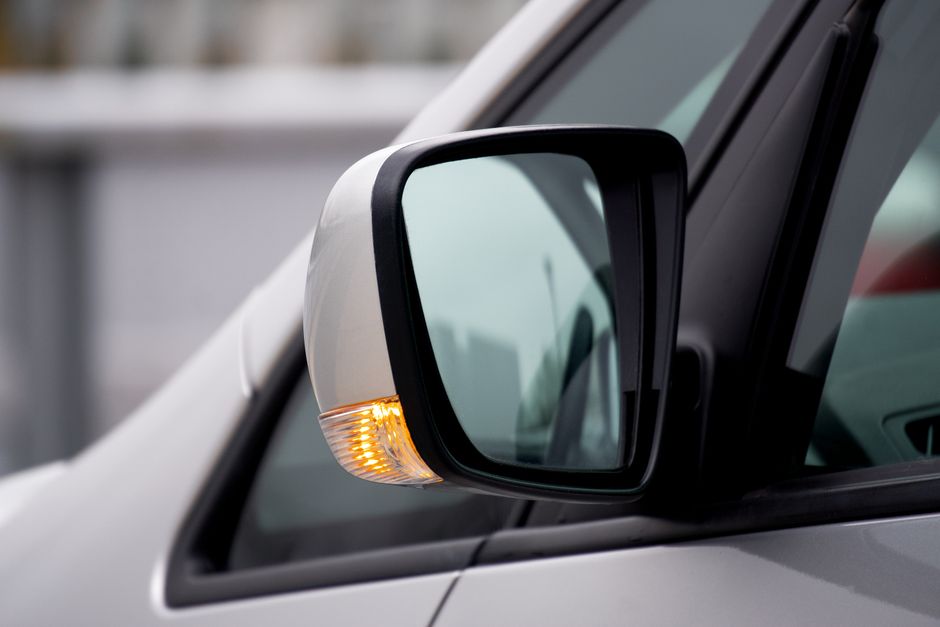
Photo: Mike Bird, Pexels
There are three driving hand signals in the US, all given with your left arm out of the driver’s window: arm straight out for a left turn, arm bent up for a right turn and arm bent down to slow or stop. California, Louisiana, Alabama and Oregon all show them in their handbooks, so they can appear on those states’ permit tests. Most states require a signal at least 100 feet before a turn. But states don’t all treat arm signals the same way, so check your own state’s handbook.
The three arm signals
| Signal | Left arm position | Means |
|---|---|---|
| Left turn | Straight out, level with the shoulder | Turning or moving left |
| Right turn | Bent up at the elbow, hand pointing to the sky | Turning or moving right |
| Slow or stop | Bent down at the elbow, hand pointing to the road | Slowing down or stopping |
Memory trick: the arm points the way the car is going for left, and the right-turn signal is the only one where your hand goes up.
Cyclists are different. California’s handbook says a bicyclist may signal a turn by holding an arm straight out and pointing in the direction they plan to turn, so a cyclist’s right arm straight out means a right turn. Watch for both versions. See sharing the road with motorcycles, bicycles and trucks.
When are hand signals allowed or needed?
This is where states differ. What state handbooks say:
| State | Handbook rule on arm signals |
|---|---|
| California | You can signal with your signal lights or with hand-and-arm positions. Use arm signals if your signal lights stop working or bright sunlight makes them hard to see. |
| Louisiana | You can use either mechanical signal lights or the left arm. |
| Alabama | In daytime, hand and arm signals may be used in addition to signal lights, because bright sunlight can make flashing lights hard to see. |
| Oregon | Only in daylight, and only when you can clearly see people and vehicles 1,000 feet away. Use your signal lights at night or in poor visibility. Don’t use arm signals in a wide or long vehicle. |
| Kentucky | “Your vehicle must have mechanical signals. Hand signals cannot be used.” |
So in Kentucky you rely on your signal lights, while in California a failed signal light is a reason to use your arm. If you’re in another state, look for the signaling section of its driver handbook, and don’t assume another state’s rule applies.
Will arm signals be on my permit test?
Question banks change, so ask your state whether its test includes arm-signal questions. If your state’s handbook shows the three arm positions (as California, Louisiana, Alabama and Oregon do), treat them as fair game. Our US permit test by state guide and practice tests cover the test format.
How far ahead must you signal?
- 100 feet before a turn is the standard in the California, Louisiana, Alabama, Kentucky and Oregon handbooks. Oregon applies the same 100 feet to lane changes. Washington’s driver guide also uses 100 feet.
- Freeway lane changes: California says signal at least five seconds before you change lanes on a freeway.
- Faster roads: Louisiana suggests signaling earlier than 100 feet at higher speeds or in heavy traffic. At highway speed, 100 feet goes by in about a second.
- Turning just after an intersection: California says wait until you’re almost through the intersection before signaling, so drivers don’t think you’re turning at the intersection itself.
- Pulling away from or toward the curb: signal (California, Kentucky, Oregon).
- Even with no one around: signal anyway. Kentucky’s point is that “the vehicle you do not see is the most dangerous.”
Cancel your signal after the turn. Louisiana also says it is illegal to flash your turn signal to tell the driver behind it is safe to pass you.
Other ways to communicate on the road
Brake lights
Your brake lights tell drivers behind that you’re slowing. Kentucky says to signal before you slow down where others may not expect it, such as turning off a road with no separate turn lane, or parking or turning just before an intersection. If you see a crash or hazard ahead, California says to warn traffic behind you by turning on your emergency flashers, tapping the brake pedal three or four times, or giving the slow/stop arm signal.
Horn
- A light tap is usually enough (Kentucky). Use it when a pedestrian or cyclist looks about to move into your lane, when a driver starts to turn into you as you pass, or when a driver hasn’t seen you.
- Narrow mountain roads: California says sound your horn where you can’t see at least 200 feet ahead.
- Don’t: honk near blind pedestrians (Kentucky) or near horses and riders (Oregon), or use the horn to “punish” another driver (Louisiana). An angry horn can start a conflict; see road rage and aggressive driving.
Headlights and hazard lights
Headlights make you visible as well as helping you see. Oregon lists headlights and hazard lights among the main ways to tell others where you are. Kentucky says to turn your headlights on whenever you have trouble seeing other vehicles, because they probably can’t see you either. Dimming rules are in night driving and high beams.
Eye contact
Louisiana’s guide says good communication and eye contact between drivers and bicyclists help prevent collisions, and Alabama tells pedestrians to make eye contact with a driver before crossing. California’s handbook says that a pedestrian who makes eye contact with you is ready to cross, so yield. A wave or nod can confirm who goes, but it is not a legal signal. Never wave a pedestrian across lanes where other traffic may not stop. See pedestrians and crosswalks.
A signal is not the right of way
Kentucky and Alabama both make the point: turning on a signal does not give you the right to move. Check mirrors and blind spot, then go only when it is safe. And don’t trust other drivers’ signals either. Oregon warns that a driver may signal one way and turn the other. More on this in lane changes and blind spots.
For how licensing works in each state, start with learning to drive in the USA.
Sources
- California DMV, “California Driver’s Handbook, Section 5: An Introduction to Driving” and “Section 7: Laws and Rules of the Road” (dmv.ca.gov)
- Louisiana Office of Motor Vehicles, “Class D & E Driver’s Guide” (DPSMV 2052, R08/25) (public.powerdms.com)
- Alabama Law Enforcement Agency, “Alabama Driver Manual” (alea.gov)
- Oregon DMV, “Oregon Driver Manual: Intersections and Turns” and “Safe and Responsible Driving” (oregon.gov)
- Kentucky State Police, “Kentucky Driver Manual” (updated July 2026), Section Eight: Safe Driving Tips (kentuckystatepolice.ky.gov)
- Washington State Department of Licensing, “Washington State Driver Guide” (dol.wa.gov)